
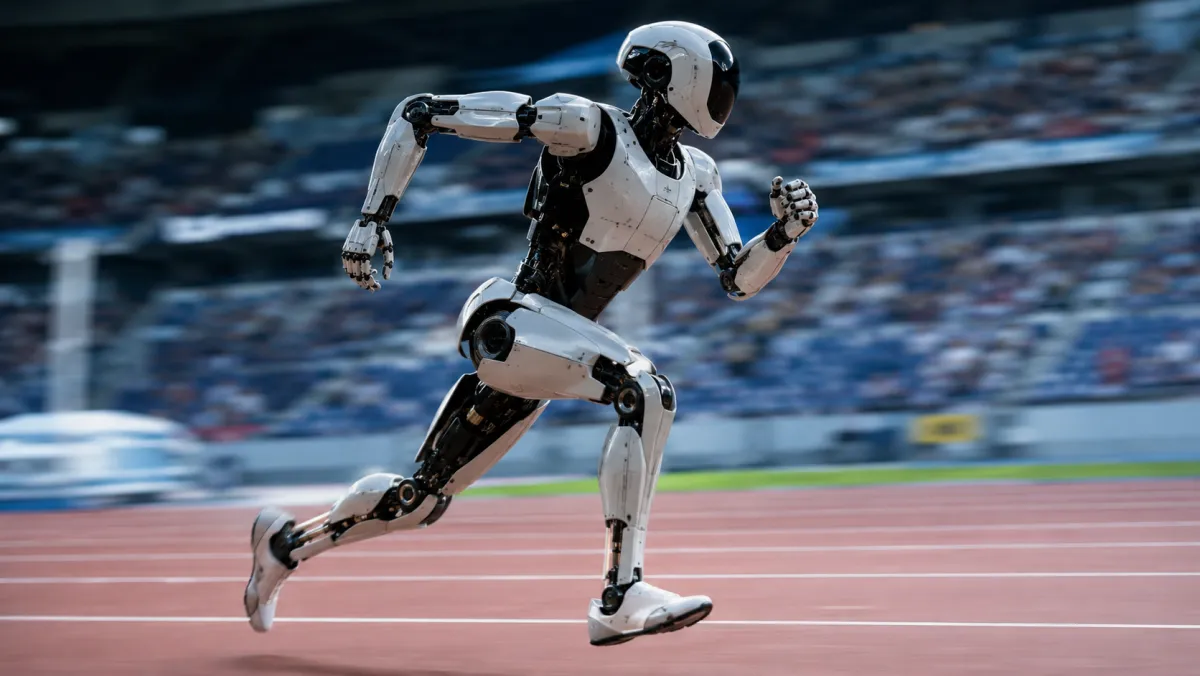
On August 22-23, at the second World Humanoid Robot Games in Beijing's National Speed Skating Oval, robots competed in track and field events alongside humans. The results were stunning. Tiangong Ultra ran the 100m in 9.39 seconds—0.19 seconds faster than Usain Bolt's world record. It jumped 2.8843 meters—0.43 meters higher than the human record. In the 400m final, Tiangong Ultra finished in 38.15 seconds, shattering the human record of 43.03 seconds set by Wayde van Niekerk in 2016. Second and third place went to Glory "Lightning" robots with times of 39.45 and 39.66 seconds.
The event was fully autonomous. No remote control. The robots navigated the track using onboard AI perception and decision-making. This is the difference between a remote-controlled machine and an autonomous agent.
Two Narratives, One Weekend
The Games had two parallel storylines. At the opening ceremony on August 22, Galaxea Robotics demonstrated a tennis exhibition match alongside former Grand Slam champion Zheng Jie—forehands, backhands, serves, returns, volleys, all executed through autonomous perception and real-time decision-making. The match was broadcast live globally by China Central Television.
Some observers called it "the AstraTennis moment for embodied intelligence." In 2016, AlphaGo beat Lee Sedol on a 19x19 board. In 2026, robots competed in real-time physical interaction on a tennis court. The difference between those two events defines the shift in AI: from symbolic reasoning in a closed environment to continuous perception and decision-making in an open physical world.
The Physics of Speed
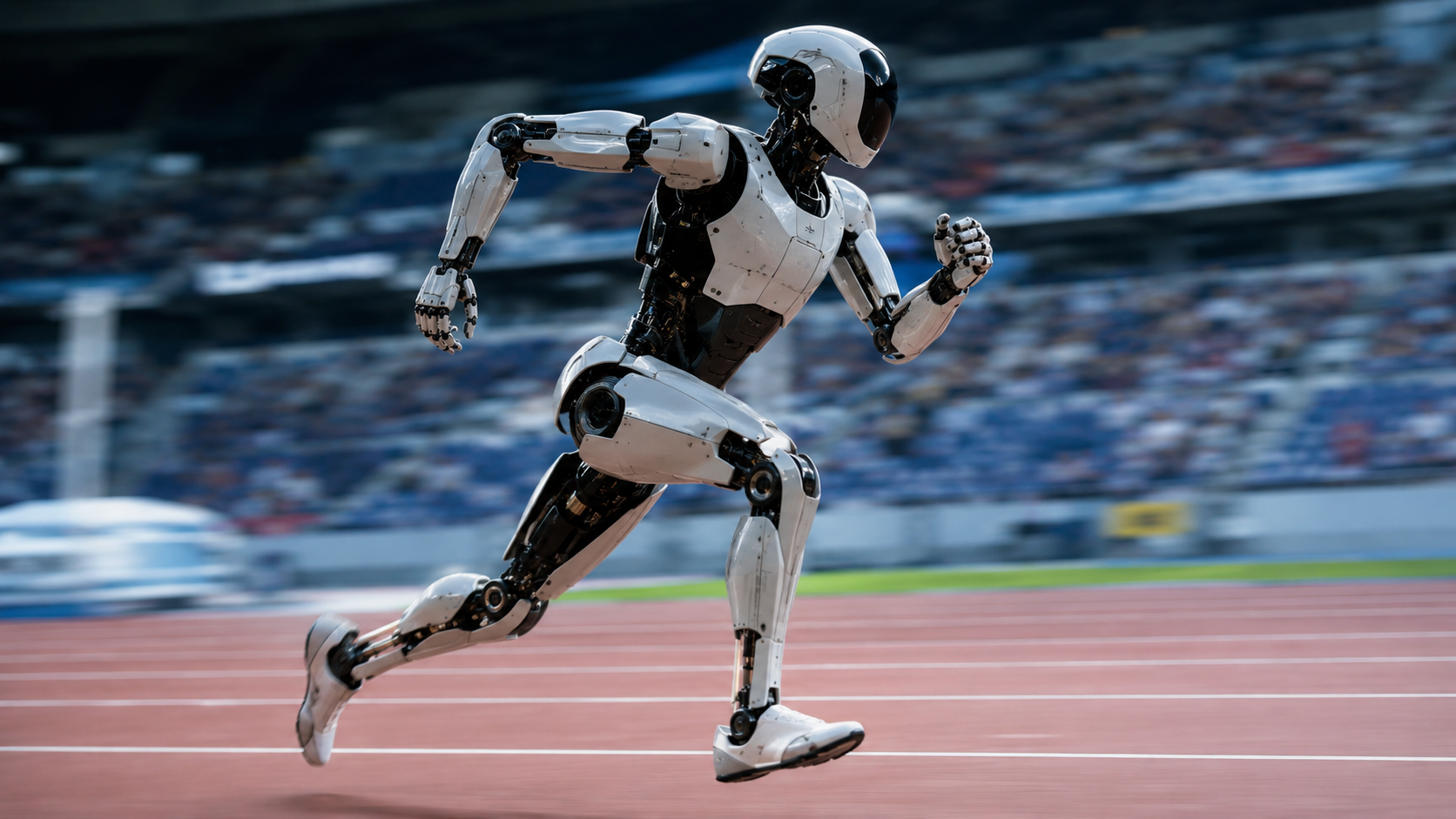
The gap between the 100m and 400m results tells its own story. The 100m record was beaten by just 0.19 seconds—human sprinters still have an edge in explosive power. But the 400m was crushed by 4.88 seconds. That's not a close contest. That's a new category.
The difference reflects the physics of the machines. Tiangong Ultra stands 180cm tall and weighs 52kg, with a top speed of 12km/h and an average of 10km/h. In short bursts, human biomechanics still compete. Over sustained distance, electric motors and algorithmic gait control have no equivalent biological limitation.
Last year's 400m champion finished in 88.03 seconds. This year's winner ran 38.15. A 50-second improvement in one year. That's not iteration—that's a phase transition.
The Engineering Behind the Records
Tiangong's technical lead acknowledged the real challenge: turning peak performance into sustained reliability. High-speed running exposes structural fatigue, joint cooling, and transmission durability. The records are not the end of the road—they are stress tests for the engineering that will eventually need to run factory shifts, not just 400-meter sprints.
China has now built over 70 embodied intelligence training grounds across the country, with 46 more under construction or planned. These are not just testing sites. They are the infrastructure for scaling embodied AI from demonstration to deployment.
What the Numbers Mean
The robots' victories at the World Humanoid Robot Games validate three things: autonomous decision-making systems can operate in real time at high speed; joint, thermal, and structural engineering is solving physical constraints at scale; and China has built the testing infrastructure to support that scaling.
As one commentator put it: last year's Games were about "proving robots could run." This year's Games are about "proving they can win." The next station is the factory floor, the warehouse, and the home. Not the track.
P.S. The quiet signal from the 400m result: one year ago, the winning time was 88 seconds. This year, it was 38 seconds. A 50-second improvement in one year means the learning curve for embodied intelligence has entered its steep phase—and the next question isn't whether robots can outrun humans, but whether they can outlast them in an eight-hour factory shift.
Frequently Asked Questions
Q: What records did humanoid robots break at the Games?
A: Humanoid robots broke three human world records: 100m in 9.39 seconds (Bolt's record is 9.58s), 400m in 38.15 seconds (van Niekerk's record is 43.03s), and high jump at 2.8843 meters (the human record is 2.45m). All events were fully autonomous with no remote control.
Q: Which robots competed?
A: Tiangong Ultra (developed by China's National and Local Co-built Humanoid Robotics Innovation Center) won all three track events. Tiangong Ultra is 180cm tall, weighs 52kg, and has a top speed of 12km/h. Glory "Lightning" robots took second and third in the 400m. Galaxea Robotics also demonstrated a tennis exhibition match with a human player.
Q: How much did the 400m time improve from last year?
A: Last year's 400m champion finished in 88.03 seconds. This year's winner ran 38.15 seconds—a 50-second improvement in one year. That's not iteration; it's a phase transition.
Q: Were the robots remote-controlled?
A: No. The events were fully autonomous—robots used onboard AI for perception, decision-making, and control. No remote control or teleoperation was allowed.
Q: What was the tennis demonstration?
A: At the opening ceremony on August 22, Galaxea Robotics demonstrated a tennis exhibition match alongside former Grand Slam champion Zheng Jie. The robot performed forehands, backhands, serves, returns, and volleys—all through autonomous perception and real-time decision-making.
Q: What is the "AstraTennis moment"?
A: It's a reference to AlphaGo's victory over Lee Sedol in 2016. AlphaGo beat a human in a closed board game. The tennis demonstration represents the next step: a robot competing in real-time physical interaction in an open environment.
Q: What is the significance of the 100m vs 400m results?
A: The 100m record was beaten by just 0.19 seconds—humans still have an edge in explosive power. The 400m was crushed by 4.88 seconds, suggesting that robots have a greater advantage in sustained speed and endurance.
Q: What are embodied intelligence training grounds?
A: China has built over 70 embodied intelligence training grounds across the country, with 46 more under construction or planned. These are facilities where robots learn and test real-world skills—manufacturing, warehouse operations, home tasks—at scale, beyond the lab.
Q: What happens next for humanoid robots?
A: The next step is not the track—it's the factory floor, warehouse, and home. As one commentator put it, last year's Games were about "proving robots could run." This year's Games are about "proving they can win." The next challenge is eight-hour factory shifts.
Q: What is the quiet signal from this year's results?
A: The 400m improvement from 88 seconds to 38 seconds in one year suggests the learning curve for embodied intelligence has entered a steep phase. The question is no longer whether robots can outrun humans, but whether they can outlast them in real-world work environments.