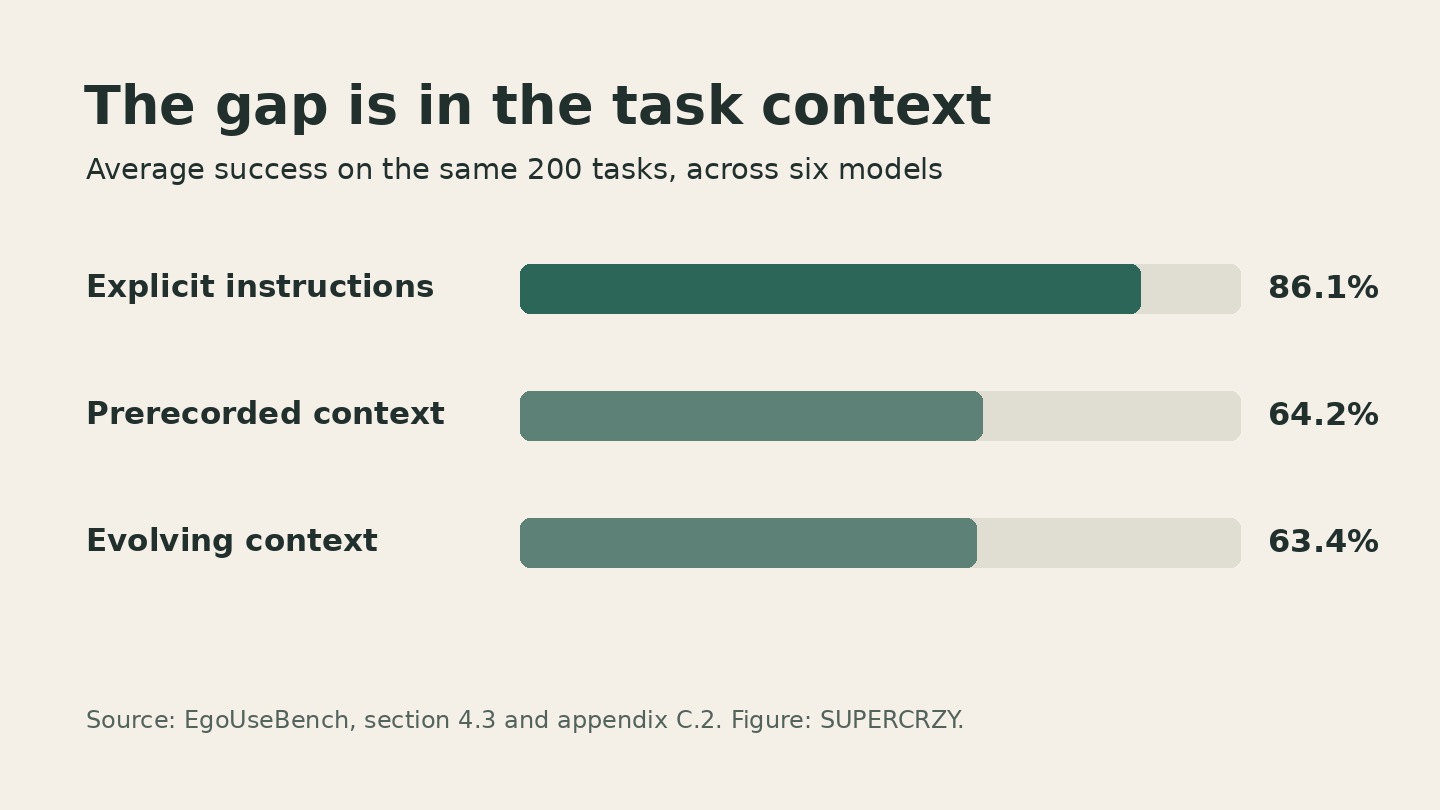
On November 25, 2026, a Zhejiang University team submitted EgoUseBench, a benchmark for agents that act on a computer using clues from first-person video. On the same 200 tasks, six tested models averaged 86.1% success with explicit written instructions and 63.4% with evolving first-person input. With prerecorded first-person context before the task, they averaged 64.2%. The large gap was between explicit and first-person settings, not between prerecorded and streaming video.
The hard part isn’t always seeing the new thing
An agent that already picked one item may need to remove it after a user changes their mind. Sometimes the user says so outright. In other cases, a new clip is the clue that the relevant object has changed. The researchers distinguish new observations from the state of the website and the user’s instructions.
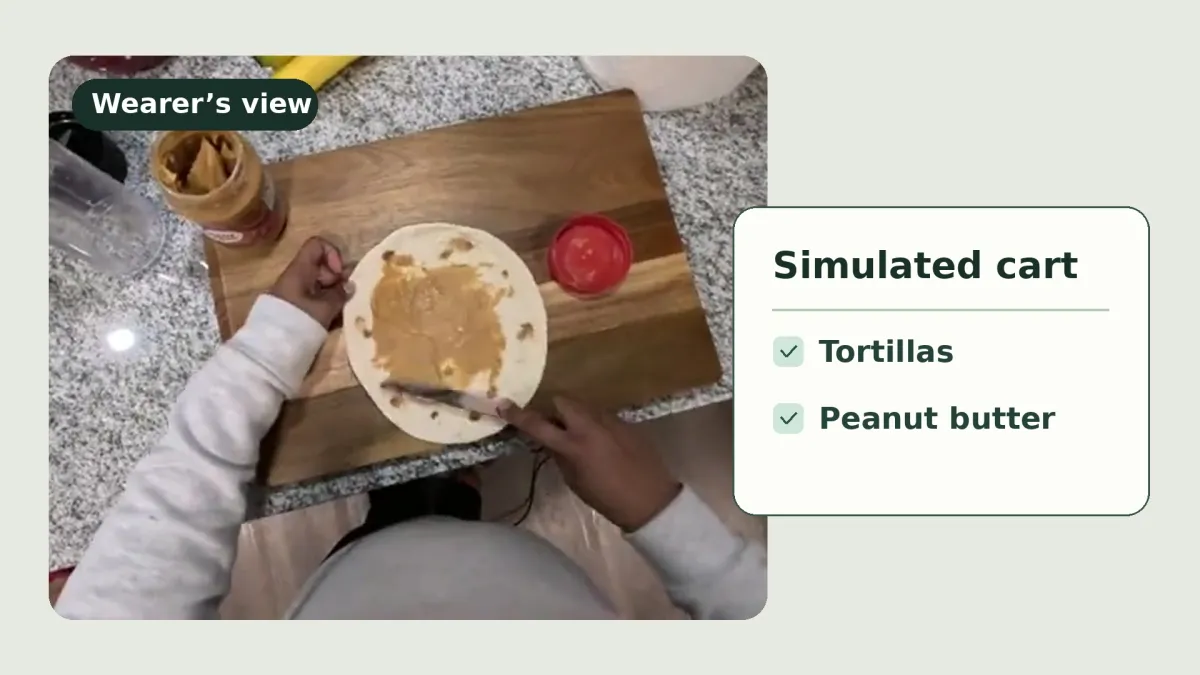
The project’s interactive replay makes the problem concrete. In one scenario, a wearer wants the tortillas they used and later adds a request for a spread. The agent must finish with the right simulated cart, not just describe what it sees. Other scenarios require replacing or removing an earlier choice. The cover combines a still from the project’s credited CaptainCook4D recording (Apache 2.0) with SUPERCRZY’s reconstruction of the simulated cart.
Not every model fell by the same amount
GPT-6.1 Terra scored 94% with explicit instructions and 87% with evolving first-person input on the common subset. Kimi K2.6 fell from 77.5% to 39%. The 63.4% online figure is the average across the six models, not the best score.
The broader benchmark has 693 tasks built from more than 74 hours of real first-person recordings. The actions ran on simulated websites. No purchase went through on a retail site, and the study did not test any particular pair of retail glasses.
A better question for a wearable agent
An impressive demo can stop when the agent finds an item. A useful wearable assistant has to know whether the thing it did a moment ago is still what the wearer wants. One way to test that is to revise the request after the agent has acted, then score the final state rather than taking “done” at face value.
P.S. For a cart or booking, showing the final selection before confirmation is more useful than making the assistant sound certain.
Frequently Asked Questions (FAQ)
Q: What is EgoUseBench?
A: A research benchmark for computer-use agents that act with changing first-person context.
Q: How big was the benchmark?
A: It contains 693 tasks; the headline comparison uses the same 200 tasks in each setting.
Q: Was 63.4% the best score?
A: No. It was the six-model average in the online setting. GPT-6.1 Terra reached 87%.
Q: Were real websites or payments involved?
A: No. The researchers used simulated websites and real recorded video, not live transactions.
Q: Does this mean AI glasses cannot work?
A: No. It measures how the tested computer-use agents handled these benchmark tasks, not how a retail device performs.