
On September 9, 2026, DeepSeek team member Tianyi Cui posted a two-sentence notice on X. The message: internal and external testing showed V4.1 Flash outperformed V4 Pro on performance, cost, speed, and total time. Selling a slower, weaker model at a higher price no longer made sense. Once V4.1 Flash shipped, V4 Pro requests would route to Flash at Flash pricing — “until V4.1 Pro is released.”
That was the first and only company-level confirmation that V4.1 Pro exists.
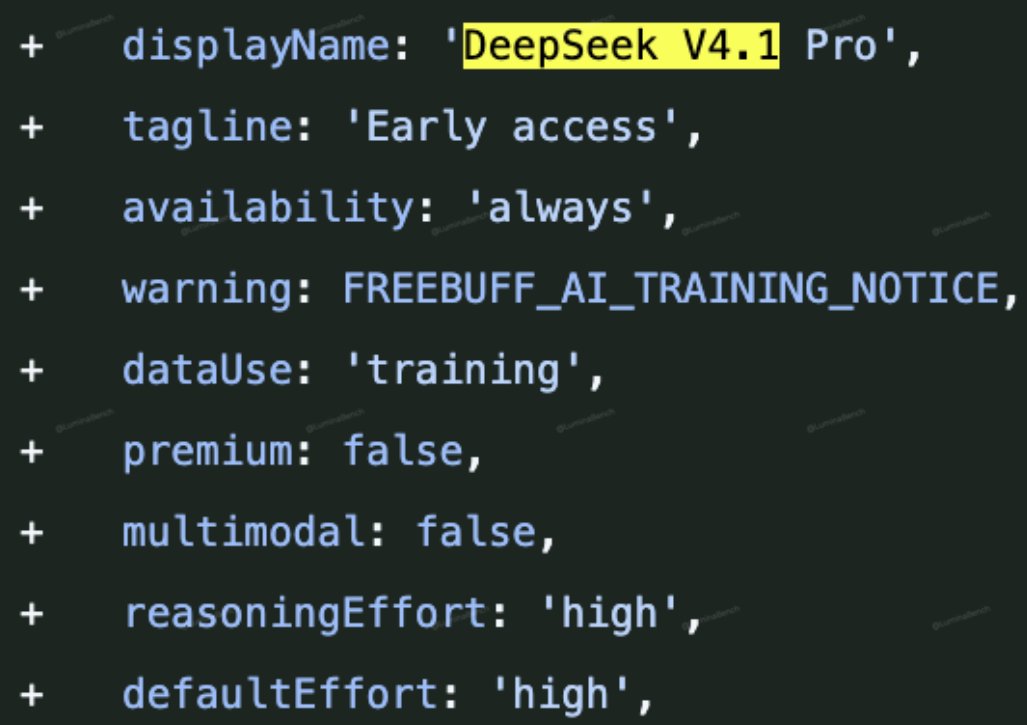
The first half of the notice held. On September 10, DeepSeek released V4.1 Flash: a 552-billion-parameter MoE model on a new Causal-Encoder-Decoder architecture, 1M-token context, native multimodal, MIT-licensed open weights. It scored 74.2 on DeepSWE v1.1, above Claude Opus 5's 74.0 — on DeepSeek's own evaluation harness.
The second half did not. After developers objected to having a production model swapped underneath them with four days' notice, DeepSeek reversed the V4 Pro retirement. V4 Pro stays online at unchanged pricing.
What survived that week was the clause almost nobody noticed: DeepSeek V4.1 Pro exists.
It Does Not Exist in the Documentation
As of today, the DeepSeek API exposes two model names: deepseek-flash and deepseek-v4-pro. V4.1 Pro has no endpoint, no rate limit, no price sheet, no model card, no weights, and no benchmarks.
The most recent repository on DeepSeek's Hugging Face organization is DeepSeek-V4.1-Flash, created September 10. Nothing newer has appeared.
DeepSeek's own documentation contains a sentence more concrete than any rumor: V4 Pro service continues after September 14, 2026, “with no change in billing,” and users will be notified of any changes.
A Third-Party Inference, Not a Release Report
Tracking account @teortaxesTex proposed on September 25 that DeepSeek's recent papers had exhausted the news cycle, China's National Day holiday begins October 1, and the company might move on “Monday” (September 28).
That inference does not match DeepSeek's own release history. The changelog shows: September 10 (Thursday), August 21 (Friday), August 13 (Thursday), July 31 (Friday), April 24 (Friday). The last Monday release in the entire log is V3.2 on December 1, 2025. A September 28 Monday release would be the first in roughly ten months.
OrcaRouter classified the claim as “an inference about a schedule, not a report about a model.”
The Only Lead on Specifications
Liang Wenfeng reportedly told a private investor meeting that DeepSeek is training a 2-trillion-parameter model, up from V4's 1.6 trillion, with plans to scale to 8 trillion. Chinese media connected the 2T figure to V4.1 Pro and reported a possible mid-to-late October release. The claim comes from a single secondhand source and has not been confirmed by DeepSeek.
V4's own technical report acknowledged several limitations: a “relatively complex” architecture, two training-stabilization mechanisms whose principles are “not well understood,” long-context retrieval degrading past 128K tokens (8-needle score around 0.59 at 1M), and vision capabilities bolted on rather than natively integrated. V4.1 Flash's release notes explicitly use the language of a “new model structure” and native multimodality. A larger version built on the same resolved baseline is the natural next step — but that is inference, not fact.
What You Can Actually Verify
Two model names. One new architecture. One retracted retirement plan. One sentence in a blog post that says a third model exists.
If you run V4 Pro in production, the only action available this week has nothing to do with V4.1 Pro: check which model ID your config actually sends, replace any legacy Flash alias with an explicit deepseek-flash or deepseek-v4-pro, and save the documentation sentence somewhere you can find it.
P.S. DeepSeek engineer Liu Shengyu, who worked on the V4.1 models, wrote on September 15 that the most advanced intelligence should be provided “openly and cheaply” to everyone. He said he does not trust Anthropic or OpenAI to do that. His post appeared six days after the V4.1 Pro name first surfaced.
Frequently Asked Questions
Q: Has DeepSeek V4.1 Pro been released?
A: No. It has no endpoint, model card, weights, price sheet, or benchmarks. The DeepSeek API exposes only deepseek-flash and deepseek-v4-pro.
Q: Where did the name come from?
A: A September 9 routing notice from DeepSeek team member Tianyi Cui said V4 Pro requests would route to Flash “until V4.1 Pro is released.” The notice was retracted the same day after developer backlash.
Q: Is there a release date?
A: No official date. A third-party tracker speculated about September 28, but DeepSeek's changelog shows no Monday release since December 2025.
Q: What do we know about its specifications?
A: Only that Liang Wenfeng reportedly mentioned a 2-trillion-parameter model in a private meeting. DeepSeek has not confirmed any connection to V4.1 Pro.
Q: What should V4 Pro users do now?
A: Check which model ID your configuration sends, replace legacy Flash aliases with explicit deepseek-flash or deepseek-v4-pro, and save the documentation confirming V4 Pro's continued service.