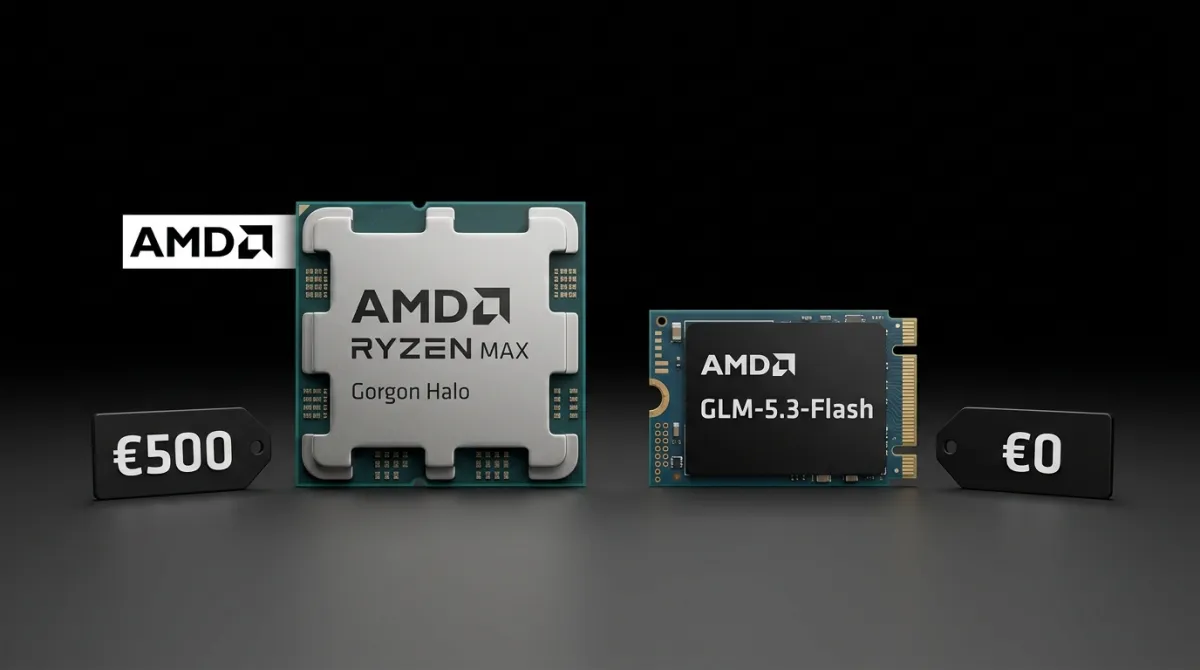
At IFA 2026, AMD demonstrated something that shifts the AI industry's pricing logic. The company showed the 320-billion-parameter GLM-5.3-Flash running entirely on a Gorgon Halo system with 192GB of unified memory. On the same benchmark, the local model outperformed Anthropic's Claude Fable 5 running in the cloud.
The cost comparison makes the point: running Fable 5 for 10 million output tokens costs approximately €500 at its $50-per-million-token price. Running GLM-5.3-Flash on local hardware has no per-token cost. You pay for the hardware once, then run as many tokens as you want.
The Hardware That Made It Possible
AMD's Gorgon Halo (Ryzen AI Max 400 series) pushes unified memory from 128GB to 192GB, enough to fit models up to 300 billion parameters. GLM-5.3-Flash is a Mixture of Experts model with 320 billion total parameters and 18 billion active per token, making it a practical fit for unified memory architectures.
The chip is part of AMD's "Personal AI" strategy—moving intelligence from cloud data centers to local devices. AMD's Jack Huynh described it as a shift from "smart computing" to "cheaper computing." For a PC user processing 1.7 million trillion tokens per month, cloud costs would be prohibitive. Local inference flattens the curve.
What GLM-5.3-Flash Actually Does
The model, previously released anonymously as Ox Alpha, scored approximately 80% on 10 coding tasks against Fable 5's 65%. Developer tests found it "competitive with Fable 5" on 3D rendering and website recreation tasks.
Independent analysis shows GLM-5.3-Flash scores 57 on the Artificial Analysis Intelligence Index at approximately $0.045 per task, compared to much higher costs for comparable closed models. On benchmark comparisons, it remains slightly behind Opus 4.8 in some tests but the gap is narrow—roughly 29.0 vs. 29.5 on Z.ai Code Bench.
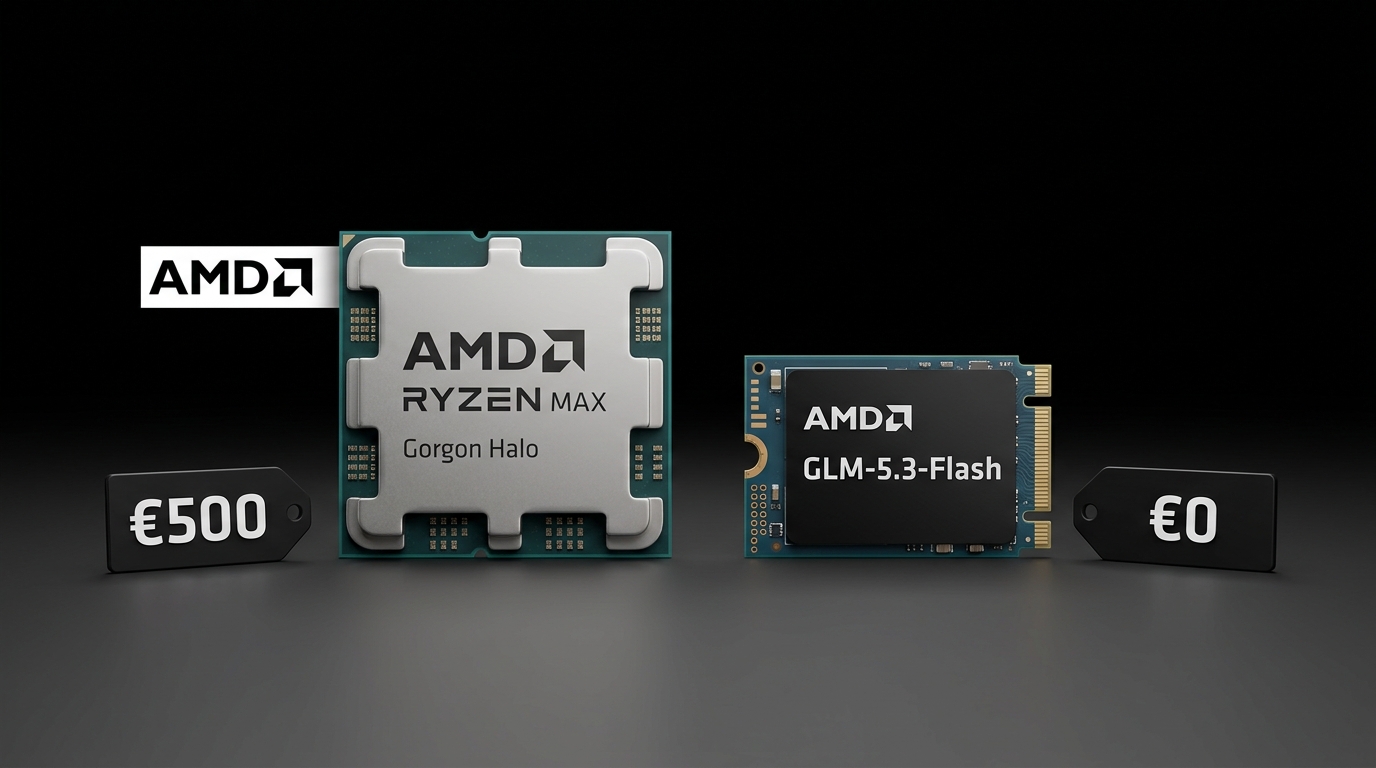
The AMD demo shows that the frontier of AI is no longer exclusively in the cloud. A 320-billion-parameter open model running locally on PC hardware can match or exceed top-tier cloud models on certain benchmarks. The cloud still offers scale, but the gap is narrowing.
The economics are now the sharper differentiator. Cloud models charge per token. Local hardware charges per purchase. For developers running millions of tokens per month, the math tilts toward ownership.
P.S. The quietest signal in AMD's demo is the "personal AI" framing. The company is betting that users will want their AI to know their personal context—files, calendar, habits—without sending that data to the cloud. Local inference isn't just cheaper. It's also more private. And in enterprise AI, that matters as much as the benchmark score.
Frequently Asked Questions
Q: What did AMD demonstrate at IFA 2026?
A: AMD showed GLM-5.3-Flash, a 320-billion-parameter open model, running locally on a Gorgon Halo system with 192GB of unified memory. The local model outperformed cloud-based Claude Fable 5 on the same benchmark.
Q: How much does running Fable 5 cost?
A: Fable 5 costs $50 per million output tokens. Running 10 million tokens costs approximately €500.
Q: How much does running GLM-5.3-Flash locally cost?
A: After purchasing the hardware, local inference has no per-token cost. You pay for the hardware once and run as many tokens as you want.
Q: What is Gorgon Halo?
A: AMD's Gorgon Halo (Ryzen AI Max 400 series) is a PC platform with up to 192GB of unified memory—enough to fit models up to 300 billion parameters.
Q: What is GLM-5.3-Flash?
A: GLM-5.3-Flash is a Mixture of Experts model with 320 billion total parameters and 18 billion active per token. It was previously released anonymously as Ox Alpha before Zhipu confirmed its identity.
Q: How does GLM-5.3-Flash compare to Fable 5 on benchmarks?
A: Independent analysis shows GLM-5.3-Flash scores 57 on the Artificial Analysis Intelligence Index at approximately $0.045 per task. On some benchmarks, it slightly trails Opus 4.8 but the gap is narrow.
Q: What is the significance of this demo?
A: It shows that a 320-billion-parameter open model running locally on PC hardware can match or exceed top-tier cloud models on certain benchmarks. The economics of AI—$500 per 10M tokens vs. $0 after hardware—is now the sharper differentiator.
Q: What is AMD's "Personal AI" strategy?
A: AMD is moving intelligence from cloud data centers to local devices. The company is betting that users will want their AI to know personal context—files, calendar, habits—without sending that data to the cloud.
Q: What does "local inference" mean?
A: Local inference means running AI models on your own hardware instead of sending requests to cloud APIs. It eliminates per-token costs and keeps data private.
Q: Is this the end of cloud AI?
A: No. The cloud still offers scale and access to models that may not fit on local hardware. But the gap is narrowing, and for many workloads, the economics of local inference are becoming increasingly attractive.