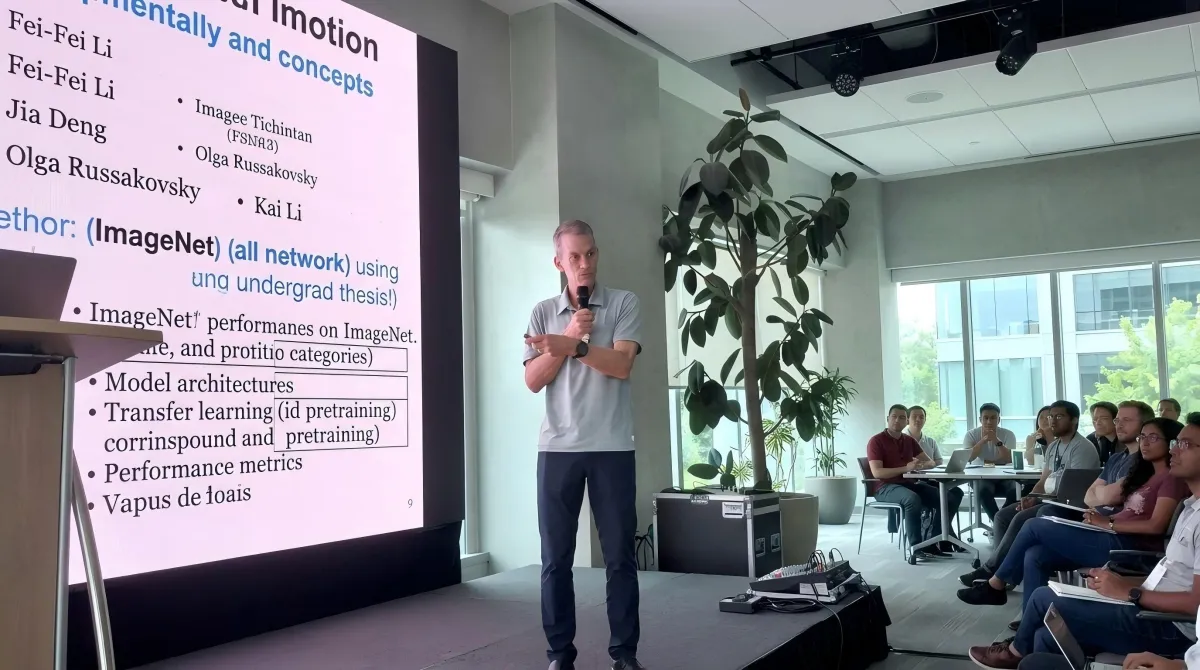
Jeff Dean gave his first public lecture since leaving Google on August 13, speaking at Seoul AI Hub in South Korea. His message was simple: human-AI collaboration works better than either alone. But the subtext was about something bigger. This wasn't just a lecture—it was the first public pitch for Discovery Loop, his new startup that aims to automate the scientific method itself.
Dean, who spent 27 years at Google and co-founded Google Brain, left the company on August 5. He left with three colleagues: Sanjay Ghemawat, Oriol Vinyals, and Quoc Le. Within 12 hours, he was on stage at Stanford. Within a week, he was in Seoul.
The KAIST lecture, co-hosted with Korea's National AI Research Hub, was his first full-length presentation outside Google. About 150 people attended in person, with another 220 online.
"When Humans and AI Work Together, They Do Better"
Dean's lecture was titled "Major Trends in Machine Learning." He traced AI's evolution over 15 years, arguing that the consistent driver of progress has been the same triad: more compute, more data, bigger models.
He recalled his undergraduate years in the 1990s, trying to train neural networks across multiple computers—and failing because compute was insufficient. "Ideas that couldn't be implemented back then became reality only after enough computing resources became available some 20 years later," he said.
He also emphasized the role of dedicated hardware. When Google's speech recognition usage grew, projections showed they would need to double data centers—which led to the development of TPUs.
But the most quoted line from the lecture was his answer to a question about AI taking jobs: "When humans and AI work together, they can reach better outcomes than when either works alone."
The lecture was delivered during his visit to South Korea for KDD 2026, where he delivered a keynote on data mining and machine learning.
Discovery Loop's Goal: Automate the Scientific Method
Dean's startup, Discovery Loop, is not building a chatbot. It is not building another model. It is building the infrastructure to automate the entire scientific method.
According to Dean, the research process follows a consistent pattern: break a big problem into subproblems, propose solutions, run experiments, evaluate results, iterate. The goal is to automate that loop—turning a slow human-driven cycle into an AI-accelerated, massively parallel one.
The company's first target is AI itself: using automated experimentation to improve machine learning algorithms. Long term, it plans to expand into chip design, biology, drug discovery, and materials science.
One key principle: Discovery Loop is structured as a Public Benefit Corporation, meaning public scientific progress is part of its formal mission, not just a byproduct.
Small Team + Big Compute Is Discovery Loop's Edge
When Dean was asked what a startup can do that Google cannot, his answer was simple: focus.
A small team with one goal, he argued, avoids the coordination overhead of a large organization. "If the entire team wakes up every day thinking about the same problem, all resources are focused on one thing," he said.
The other factor is the cloud. When Dean started at Google, only tech giants could access the compute needed for large-scale ML research. Now, a well-funded small team can rent it. "Small team + big compute" is the core of Discovery Loop's strategy.
He also acknowledged that leaving Google was "a little bit nerve-wracking"—but worth it for the chance to start something new.
Gemini's Three Leads All Left Google
The Gemini era at Google was led by three people: Dean, Oriol Vinyals, and Noam Shazeer. All three have left. Shazeer joined OpenAI in June. Vinyals left with Dean. The team that built Google's flagship AI is no longer at Google.
Dean's lecture in Seoul was not a farewell tour—it was a strategy session, staged in the open. The message to the research community was not "here's what I used to do." It was "here's what I'm building next."
And the next thing, if Dean is right, is not a better model. It is a faster scientific method.
P.S. The name "Discovery Loop" is literal. The loop is: hypothesize → experiment → evaluate → iterate. Dean's bet is that when AI runs that loop at scale, across disciplines, the speed of science changes fundamentally. The lecture in Seoul was the first public step in that loop.
Frequently Asked Questions
Q: When did Jeff Dean leave Google?
A: Jeff Dean left Google on August 5, 2026, along with three colleagues: Sanjay Ghemawat, Oriol Vinyals, and Quoc Le. He had spent 27 years at the company and co-founded Google Brain.
Q: What was Jeff Dean's first public lecture after leaving Google?
A: Dean gave his first public lecture on August 13 at Seoul AI Hub in South Korea, co-hosted with KAIST and Korea's National AI Research Hub. He spoke on "Major Trends in Machine Learning" and his new venture, Discovery Loop.
Q: What is Discovery Loop?
A: Discovery Loop is Dean's new startup, structured as a Public Benefit Corporation. It aims to automate the scientific method—using AI to propose hypotheses, run experiments, evaluate results, and iterate at scale. The goal is to accelerate research across AI, chip design, biology, drug discovery, and materials science.
Q: What was Dean's response to AI taking jobs?
A: Dean said: "When humans and AI work together, they can reach better outcomes than when either works alone." He emphasized that AI will change how work is done and the skills required, but human-AI collaboration remains essential.
Q: Why did Dean leave Google?
A: Dean said leaving was "a little bit nerve-wracking" but worth it for the chance to start something new. He argued that a small team with one goal avoids the coordination overhead of a large organization, and that "small team + big compute" is now possible in the cloud.
Q: What is the significance of Dean's talk in Seoul?
A: Dean was in Seoul for KDD 2026, where he delivered a keynote on data mining and machine learning. The lecture was his first full-length presentation outside Google and served as the public launch of Discovery Loop's mission.
Q: Who else left Google with Dean?
A: Sanjay Ghemawat, Oriol Vinyals, and Quoc Le left with Dean. Gemini's three co-leads—Dean, Vinyals, and Noam Shazeer—have all now left Google. Shazeer joined OpenAI in June 2026.
Q: What is Discovery Loop's first target?
A: Discovery Loop's first target is improving machine learning itself through automated experimentation. Longer term, it plans to expand into chip design, biology, drug discovery, and materials science.
Q: How does Discovery Loop differ from Google?
A: Dean emphasized focus and compute access. A small team with a single goal avoids coordination overhead. When Dean started at Google, only tech giants could access large-scale compute—now, a well-funded small team can rent it in the cloud.
Q: What does "Discovery Loop" mean?
A: The name is literal: hypothesize → experiment → evaluate → iterate. Dean's bet is that when AI runs that loop at scale, across disciplines, the speed of science changes fundamentally.