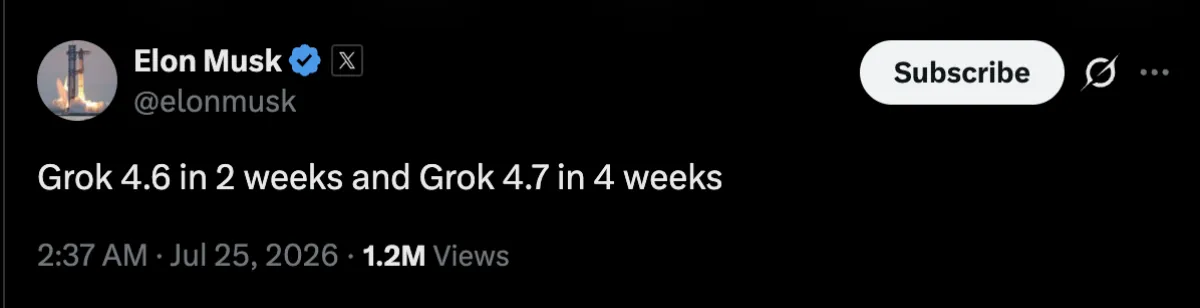
On July 24, Elon Musk posted three sentences on X. "Grok 4.6 in 2 weeks and Grok 4.7 in 4 weeks."
No benchmarks. No feature lists. Just a calendar.
If he delivers, SpaceXAI will have released three models in six weeks — Grok 4.5 on July 9, Grok 4.6 around August 7, and Grok 4.7 around August 21. That is one of the fastest release cycles in the AI industry.
This is not an accident. Musk promised in June that xAI would release "new AI models trained from scratch every month for the rest of the year." He is now delivering on that promise.
Grok 4.6 is the 2-trillion-parameter model Musk has been teasing. It will be "better than our 1.5T in every way," with speed and token efficiency close to Grok 4.5. The company is also adding SpaceX's engineering data to its supplemental training run — excluding ITAR-restricted material — to boost reasoning and real-world engineering performance. Grok 4.7 is rumored to be 4 to 6 trillion parameters, though details remain scarce.
The target is clear. On July 17, Musk said Grok 4.6 "might be able to exceed Kimi." Kimi K3, the 2.8-trillion-parameter open-weight model from Moonshot AI, had just topped Arena's front-end coding leaderboard, beating Claude Fable 5 and GPT-5.6 Sol. Musk didn't say "exceed." He said "might."
Kimi's team noticed. Moonshot's enterprise lead responded: "We hope they come out and compete with us." Kimi K3's open weights are due on July 27 — just days before Grok 4.6's expected release.
The monthly release cadence is a strategy, not a stunt. It is a bet on speed over perfection. Musk is treating AI development like software development — ship a version, get feedback, ship the next one. The industrial logic is clear: every month a model is in the market, it collects real-world feedback that no internal benchmark can replicate. Grok 4.5 was already tested internally at SpaceX and Tesla before release, allowing engineers to evaluate it under real-world conditions. Monthly releases mean that feedback loop gets faster.
But the cost is staggering. xAI's operating loss for Q1 2026 reached $2.47 billion, with capital expenditures at $7.7 billion. Training a new foundation model from scratch every month only increases that burn rate. The company raised $20 billion in early 2026. The clock is ticking.
The release schedule is also a direct challenge to competitors. OpenAI and Anthropic take months to release new flagships. Google has been delaying Gemini 3.5 Pro for weeks. Musk is saying: "Move faster, or get left behind."
Two things make this possible. First, the 20,000+ Nvidia GB300 GPUs running the training cluster. Second, the Cursor data pipeline — Grok 4.5 was the first model trained with Cursor's real developer interaction data. Grok 4.6 and 4.7 will extend that advantage. Musk calls it "speed" as the competitive advantage. But speed without data is just noise.
The industry is watching. If Grok 4.6 actually beats Kimi K3, xAI's strategy will be validated. If it falls short, Musk will have proven that even fast iteration can't close the gap. Either way, he just put AI on a monthly release clock.
P.S. If you are an OpenAI or Anthropic product planner, can you match this cadence — not once, but every month? The answer is probably no, and that is exactly what Musk wants you to admit.
Frequently Asked Questions
Q: When will Grok 4.6 be available?
A: Musk said "in two weeks" on July 24, putting the release around August 7, 2026. Grok 4.7 follows two weeks after that, around August 21. If he delivers, xAI will have released three models in six weeks — Grok 4.5 on July 9, Grok 4.6 in early August, and Grok 4.7 in late August.
Q: How does Grok 4.6 compare to Kimi K3?
A: Grok 4.6 has 2 trillion parameters to Kimi K3's 2.8 trillion. Musk said it "might be able to exceed Kimi" but used the word "might" — not a guarantee. Kimi K3 currently tops Arena's front-end coding leaderboard ahead of Claude Fable 5 and GPT-5.6 Sol. Real comparison will require independent benchmarks once Grok 4.6 ships.
Q: Is Grok 4.6 open source?
A: No. Prior Grok versions have been closed-weight commercial releases with API access via xAI. Kimi K3, by contrast, will release full open weights on July 27, allowing anyone to download and run the model. This is a fundamental strategic difference between the two approaches.
Q: How much does Grok cost?
A: xAI has not announced pricing for Grok 4.6. Grok 4.5 is reportedly priced around two dollars per million input tokens and six dollars per million output. Grok models are primarily embedded in X Premium subscriptions and tested internally at SpaceX and Tesla before wider release.
Q: Can xAI afford to release models every month?
A: The numbers are staggering. xAI posted a 2.47 billion dollar operating loss in Q1 2026 with 7.7 billion in capital expenditure. The company raised 20 billion dollars in early 2026, but training full foundation models from scratch every month burns cash at an unprecedented rate. Whether this pace is sustainable depends on whether Grok 4.6 delivers competitive performance.
Q: How did Kimi K3's team respond to Musk?
A: Moonshot's enterprise lead said "We hope they come out and compete with us." Previously, when Musk praised Kimi's research, Moonshot responded with "Your rockets are pretty good too." The tone is competitive but respectful — both sides recognize each other's technical capability.
Q: What makes monthly releases possible for xAI?
A: Two things. First, a 20,000-plus Nvidia GB300 GPU training cluster. Second, the Cursor data pipeline — Grok 4.5 was the first model trained with real developer interaction data from Cursor, and Grok 4.6 and 4.7 extend that. SpaceX engineering data is also being added to the training run for Grok 4.6, excluding ITAR-restricted material.