On November 25, 2026, Artificial Analysis released a research preview of AA-Robotics-Sim. Nine frontier language models controlled a simulated Unitree G1 across ten tasks, from crossing a warehouse to loading a dishwasher. GPT-6.2 Astra led with 71.0 points. That was a score, not a 71 percent success rate: Astra completed 61 of its 100 scored attempts.
The robot can walk. Grasping is harder.
All nine models completed every warehouse navigation run without moving a package. Across the same field, only five of 90 standard dishwasher attempts ended with a dish in the rack. Not one laundry run ended with even one piece of clothing in the drum.
The lab used NVIDIA Isaac Sim and a simulated G1 with three-fingered hands. Each model got five practice scenes per task and ten new scenes for scoring, with its practice notes and code preserved. Every model used the same controller and tools. The result isolates a particular question: what can today’s language models get done when an existing control stack already handles the robot’s balance? It is not a physical G1 test.
The clock exposes what the leaderboard hides
The robot moved for 35 seconds in Astra’s average scored run. The full run took 24.6 minutes. GPT-6.2 Sol averaged 17.3 minutes even though its robot spent longer actually moving, 42 seconds. Waiting between movements was the larger part of the job.
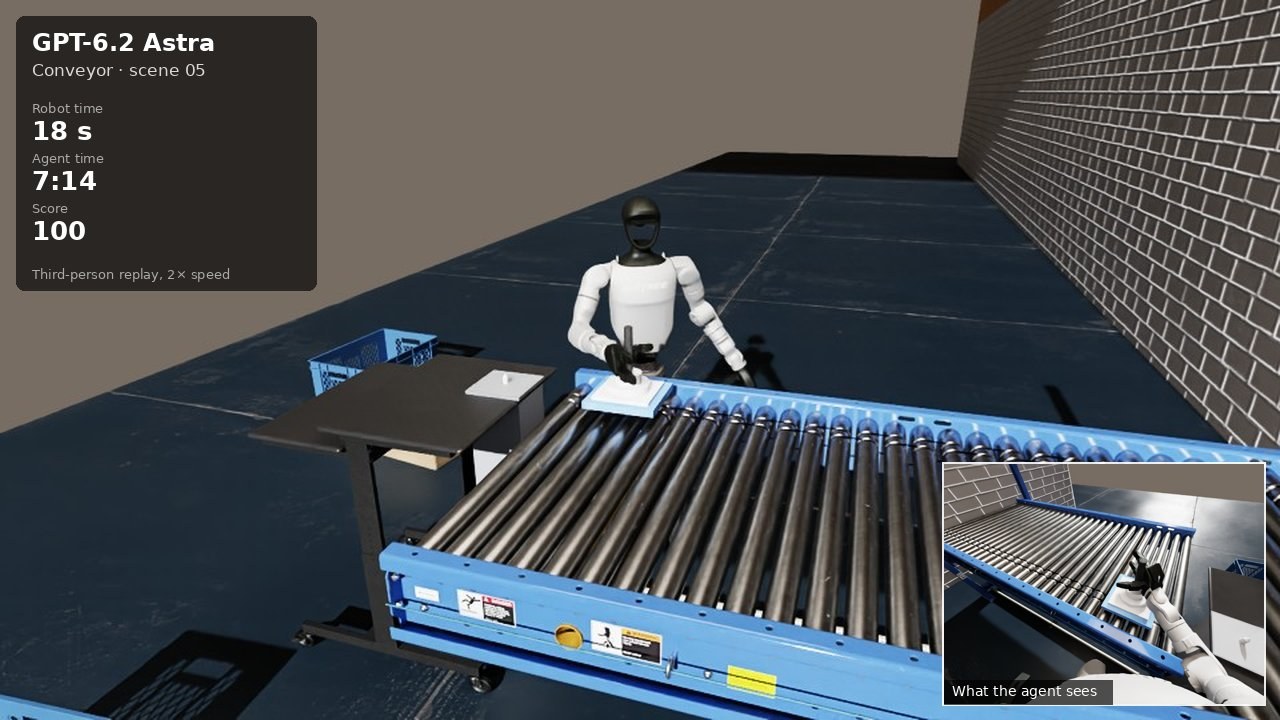
The test does not show that those times are unavoidable in a commercial robot. It does show why elapsed time belongs next to the score. A system that works in short bursts separated by minutes of interpreting camera frames or rewriting code serves a different purpose from one that can act continuously on a line.
The fragile dish is a different test
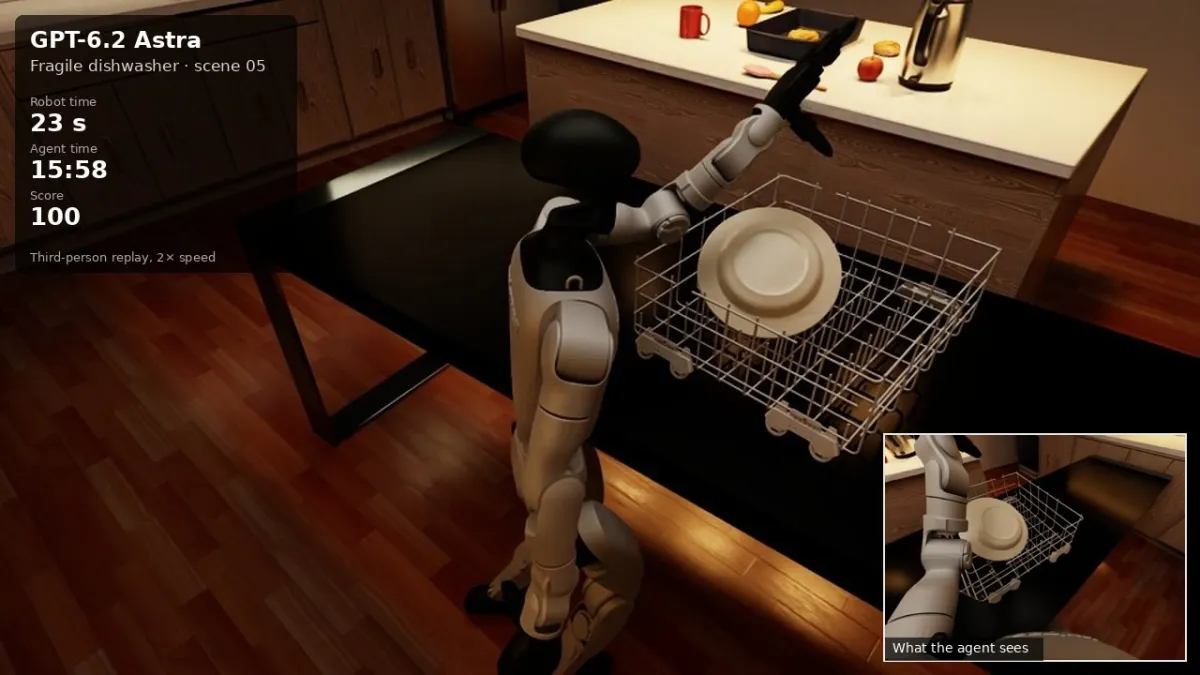
The lab also ran a separate test that penalized breaking a fragile dish. Seven models broke at least one. Astra was the only model that successfully loaded a dish twice, but it also broke the most, three times. Those trials are not part of the 71.0 score. The cover shows one successful replay, not the typical outcome.
A buyer evaluating a robot for repetitive handling would want successful placements, damage and elapsed time together. That would tell them more than an average that also rewards jobs such as playing a toy piano or operating an abacus. Real hardware testing is still needed to learn how these approaches respond to slips, sensor errors and wear.
P.S. The next result to watch is not a higher overall score. It’s how often the same system can place a fragile object without damage, within a fixed time limit.
Frequently Asked Questions
Q: What is AA-Robotics-Sim?
A: It is an Artificial Analysis research benchmark where language models control a simulated Unitree G1 through ten household and light industrial tasks.
Q: Did GPT-6.2 Astra pass 71 percent of trials?
A: No. It averaged 71.0 points including partial credit and fully completed 61 of 100 scored trials.
Q: Did the robot spend 24 minutes moving?
A: No. In Astra’s average evaluation episode, the agent took 24.6 minutes, while the simulated robot moved for 35 seconds.
Q: Are the fragile dishwasher results part of the main score?
A: No. Artificial Analysis reports them separately. The five successful placements in 90 attempts refer to the regular dishwasher task.
Q: Does this show how a real Unitree G1 would perform?
A: No. This was a simulation with a particular controller, camera setup and agent harness. It doesn’t establish physical reliability or throughput.