On September 15, Google released Gemini 3.8 Live and Gemini 3.8 Live Extended Thinking, two real-time voice models that represent the company's most advanced audio-to-audio systems to date. The announcement presents them as a pair. The leaderboard tells a different story.
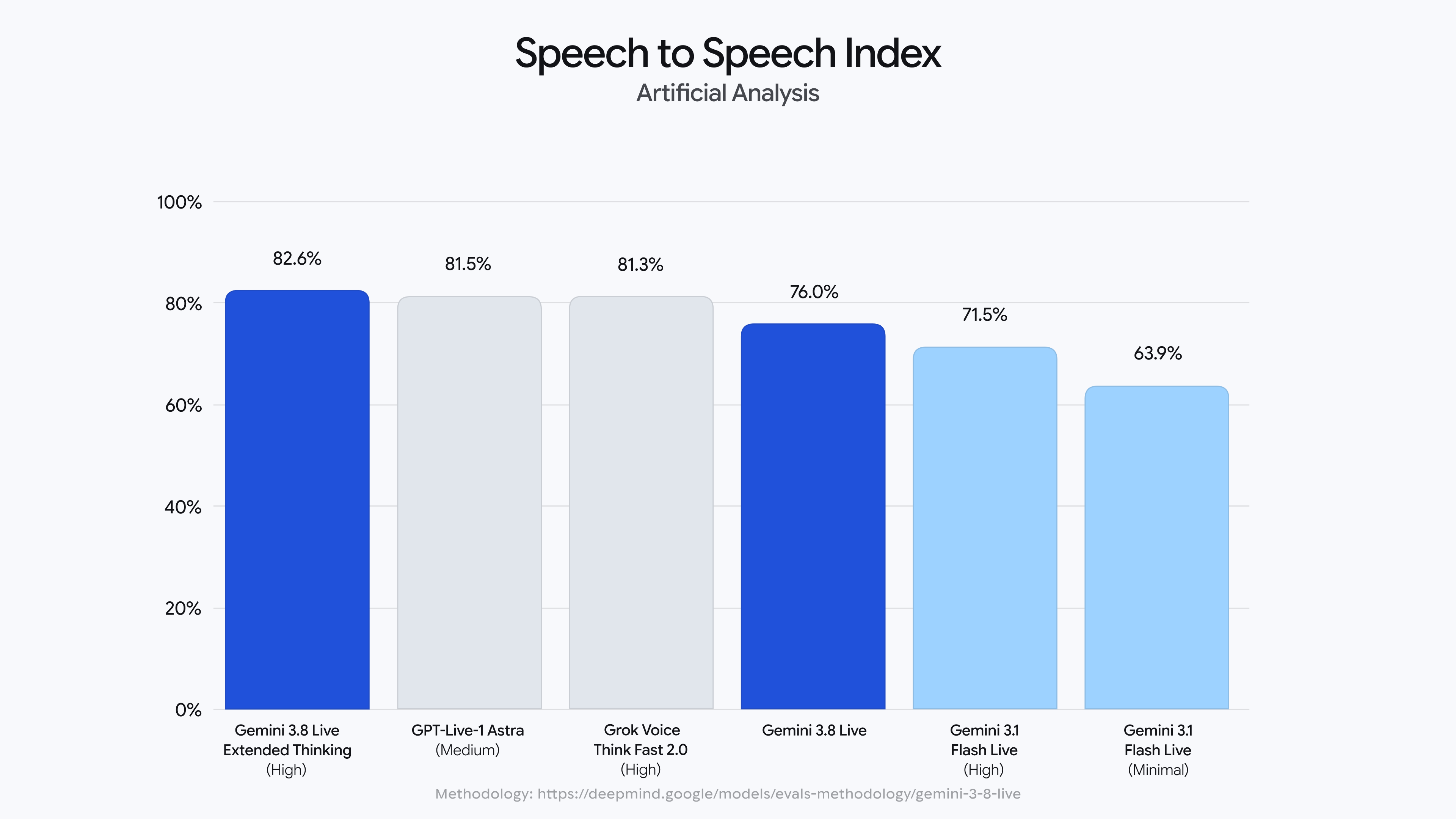
Artificial Analysis's Speech to Speech Index, captured September 16, shows the structure the launch narrative obscured:
Rank | Model | Score |
|---|---|---|
1 | Gemini 3.8 Live Extended Thinking | 82.6 |
2 | GPT-Live-1 (Astra backend, medium effort) | 81.5 |
3 | Grok Voice Think Fast 2.0 High | 81.3 |
4 | GPT-Live-1 (Sol backend, low effort) | 80.1 |
5 | Gemini 3.8 Live | 76.0 |
6 | GPT-Realtime-2.1 High | 73.9 |
7 | Gemini 3.1 Flash Live High | 71.5 |
Source: Artificial Analysis, September 16, 2026.
Three facts follow from this ordering. First, Google holds the top slot, but with the expensive variant — Extended Thinking, built for “high-complexity tasks,” not the model most developers will deploy. Second, GPT-Live-1 appears twice because the index scores the entire system, not just the voice front-end. Third, the model in this matchup's title — Gemini 3.8 Live — ranks fifth, below both GPT-Live-1 configurations.
Standard-tier against standard-tier, GPT-Live-1 wins the composite index, and it is not close.
One Talks While Listening. The Other Talks While Working.
The gap is architectural.
GPT-Live-1 is true full-duplex. It processes input and output audio continuously and synchronously inside a single model, not chaining speech-to-text into a language model into text-to-speech. The behavior users notice: you can interrupt mid-answer and it adapts; it does not mistake a pause for the end of your turn; it stays quiet until called on.
Gemini 3.8 Live is turn-based. Google did not achieve full-duplex, and did not claim to. Instead, it shipped two things that compensate for the absence.
The standard version leans on workflow capabilities: near real-time visual input processing, automatic switching between 97 languages mid-conversation, and background tool and API calls that acknowledge a request and keep talking while the work completes.
The Extended Thinking version adds “Think as it speaks” — reasoning and speaking simultaneously, using early verbal cues like “Let me check that…” to acknowledge prompts, with live progress narration during multi-step background tasks.
Both models refuse to hang up while they think. GPT-Live-1 does it by never stopping the audio stream. Google does it by talking over the work.
That is a compensation mechanism, not an architectural advantage. It makes a turn-based model feel natural in work scenarios. It does not change the turn-based nature.
68.6% on τ-Voice. 76.0 on the Index. Neither Is the Cheap Model's Number.
Google's own benchmarks show Extended Thinking at 68.6% on τ-Voice and 35.1% on Sierra's τ-Voice-banking benchmark, with 97.7% on Big Bench Audio. Those figures are vendor-reported and have not been independently reproduced.
More telling is what Google has not published. GPT-Live-1 scores 67.9% on τ-Voice. Google has published no comparable τ-Voice figure for the standard Gemini 3.8 Live — only for the Extended Thinking variant. On conversational dynamics, Google has published no Full Duplex Bench figure at all, while Grok Voice Think Fast 2.0 reports 95.1%.
The standard model's published strengths are elsewhere: second place in Speech Agent Arena, which measures a different capability set.
$1.38 an Hour vs $4.47 an Hour
If the standard version loses on the composite index, why ship it? Price.
Gemini 3.8 Live bills at $0.005 per minute of audio input and $0.018 per minute of audio output — about $1.38 per hour of two-way conversation. GPT-Live-1's all-in measured cost runs $4.47 to $8.83 per hour.
That is a three-to-six-fold difference. For enterprises deploying voice agents at scale, the price gap may be decisive even when the standard model trails GPT-Live-1 on the composite index.
Google's own framing acknowledges the tradeoff. It describes the standard model as “built for scale and cost efficiency” and the Extended Thinking version as “built for high-complexity tasks”. The Extended Thinking variant, at roughly $3.50 per hour, still undercuts GPT-Live-1 while claiming the 6.6-point quality advantage.
Two Bets, One Missing Capability
Google has split its voice product line into two bets on what a voice agent is for.
One bet — Extended Thinking — is that the voice agent is a reasoning system that happens to speak. It claims the top score and prices below the frontier competition.
The other bet — standard Gemini 3.8 Live — is that the voice agent is a cheap conversational interface with visual and multilingual grounding. It loses to GPT-Live-1 on the composite index and wins on price.
Neither bet is full-duplex. Google did not close that architectural gap. It shipped the thing full-duplex was supposed to compensate for: a voice model that can keep a conversation alive while multi-step work runs in the background.
The architecture difference is real. It is just no longer the axis that decides the purchase.
P.S. Google's launch materials emphasize that all generated audio carries SynthID watermarks, and that developer platforms including LiveKit, Pipecat, and Vercel are integrated with the Live API. Those are distribution advantages. They do not change the leaderboard structure: the standard model sits fifth, and the model that beats it is already shipping.
Frequently Asked Questions
Q: What did Google release on September 15?
A: Google released Gemini 3.8 Live and Gemini 3.8 Live Extended Thinking, two real-time voice models. The standard version is built for scale and cost efficiency; the Extended Thinking version is built for high-complexity tasks.
Q: What is the difference in their leaderboard scores?
A: On the Artificial Analysis Speech to Speech Index, Gemini 3.8 Live Extended Thinking scores 82.6 (first place). Standard Gemini 3.8 Live scores 76.0 (fifth place).
Q: How does GPT-Live-1 compare?
A: GPT-Live-1 scores 81.5 and 80.1 in its two configurations, both above standard Gemini 3.8 Live. GPT-Live-1 appears twice because the index scores the entire system, not just the voice front-end.
Q: What is full-duplex, and does Google support it?
A: Full-duplex means processing input and output audio simultaneously inside one model, so you can interrupt mid-answer and the system adapts. GPT-Live-1 is full-duplex. Gemini 3.8 Live is turn-based. Google did not claim otherwise.
Q: How does Google compensate for the turn-based architecture?
A: Two ways. The standard version uses background tool calls that keep talking while work completes, plus visual input and 97-language switching. The Extended Thinking version adds “Think as it speaks” — reasoning while speaking, using cues like “Let me check that…” to fill silence.
Q: What benchmarks has Google published?
A: Extended Thinking scores 68.6% on τ-Voice, 35.1% on τ-Voice-banking, and 97.7% on Big Bench Audio. These are vendor-reported. Google has not published comparable τ-Voice figures for the standard model, nor any Full Duplex Bench figure.
Q: How much does each model cost?
A: Gemini 3.8 Live bills at $0.005 per minute input and $0.018 per minute output — about $1.38 per hour of two-way conversation. GPT-Live-1's all-in measured cost runs $4.47 to $8.83 per hour. Extended Thinking is roughly $3.50 per hour.
Q: Why ship the standard model if it loses on the index?
A: Price. The three-to-six-fold cost difference may be decisive for enterprises deploying voice agents at scale. Google describes it as “built for scale and cost efficiency”.
Q: What is the core tension in this launch?
A: Google split its voice line into two bets on what a voice agent is for: a reasoning system that speaks, or a cheap conversational interface. Neither bet is full-duplex. Google shipped workarounds for the architecture gap rather than closing it.
Q: What distribution advantages did Google announce?
A: All generated audio carries SynthID watermarks. Developer platforms including LiveKit, Pipecat, and Vercel are integrated with the Live API. These are distribution advantages that don't change the leaderboard structure.