Meta released Muse Code in beta on August 5, entering the AI coding agent race dominated by Anthropic's Claude Code and OpenAI's Codex. The terminal-based tool runs on Muse Spark 1.2 and handles complex software engineering tasks across large repositories, planning changes, writing code, and validating results.
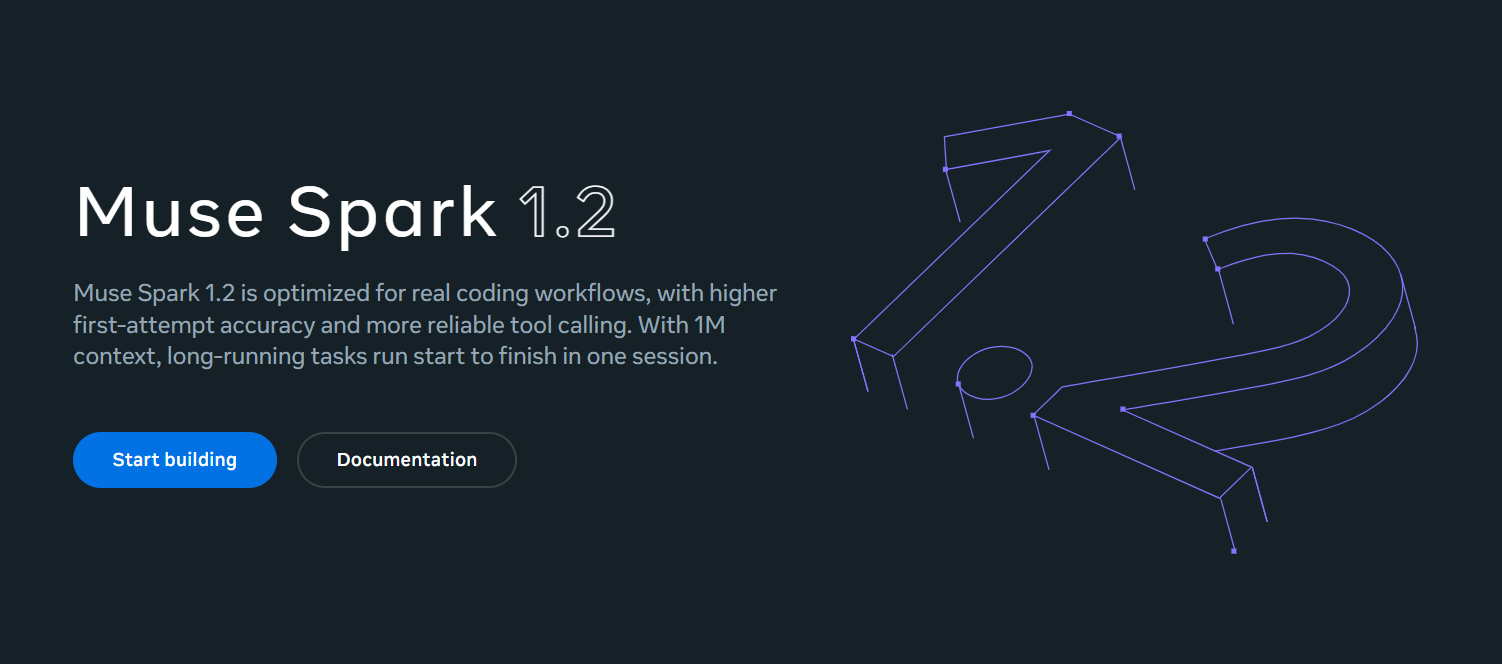
The pricing is the most aggressive move in the launch. Muse Code runs $1.25 per million input tokens and $4.25 per million output tokens. The contributor tier drops that to $0.10 input and $0.20 output — 12.5x cheaper on input and 21x cheaper on output. The catch: developers on contributor tier grant Meta permission to train future models on their prompts and code.
But Meta is not claiming superiority on capability. Its own published charts place Claude Opus 5 first on all three coding benchmarks it released. Muse Spark 1.2 scored 70.6% where Claude scored 79.4%. Meta is competing on price and architecture while openly acknowledging the capability gap.
The architecture introduces features absent from competitors: a local append-only event log, crash recovery, and persistent background agents that build context over time rather than starting fresh with every session. For developers, that means if Muse Code crashes 20 hours into a long-running task, it resumes exactly where it stopped.
Google's approach is different. The company is in talks for a $1.5B+ deal with Mechanize, an AI coding startup that builds training environments and evaluation frameworks for AI agents — not a consumer coding assistant. Mechanize created GBA Eval, a test requiring AI agents to write a Game Boy Advance emulator from scratch within 24 hours, and launched in May 2026.
The deal structure reflects Google's pattern: non-exclusive technology licensing plus hiring key personnel for model evaluation and development. Mechanize CEO Tamay Besiroglu previously co-founded Epoch AI. Backers include former GitHub CEO Nat Friedman, Stripe CEO Patrick Collison, and Quora CEO Adam D'Angelo. Google previously used the same playbook with Windsurf and Character AI. The Mechanize deal aims to close a capability gap that has seen Anthropic's Claude Code capture 24.9% of Vercel token usage and 71.8% of spending.
AWS is pursuing a different bet. Kiro Crew is an open source workspace that lets developers assign asynchronous coding tasks to autonomous AI agents while they are offline. The orchestrator coordinates multiple agents and sub-agents, preserving context across sessions, and delays human intervention until review is needed. The system provides an operating system-level sandbox with denied-by-default commands, suspicious-pattern blocking, credential redaction, and signed audit logs of every action.
The broader context makes the timing significant. Anthropic's Claude Code and OpenAI's Codex have established dominance, with Anthropic's token consumption in coding tools estimated at $470 billion annualized as of May. Meanwhile, Chinese competitors are moving fast: ByteDance is training an AI model with up to 10 trillion parameters, potentially close to Anthropic's Mythos system in scale. Alibaba opened Qwen3.8-Max via API with pricing below Moonshot's Kimi K3.
Each company has a distinct bet. Meta is betting on volume — the cheapest entry point wins the mass market. Google is betting on talent and infrastructure — better evaluation means better models. AWS is betting on autonomy — AI that never stops is more valuable than AI that needs babysitting.
All three are likely right. The AI coding market is becoming one of the first large-scale AI application categories with proven willingness to pay. And the competition is just getting started.
P.S. One stat worth sitting with: Anthropic's coding token consumption hit $470 billion annualized in May, and Cursor passed $40 billion. That's not "experiment" territory. That's infrastructure.
Frequently Asked Questions
Q: How much does Meta's Muse Code cost compared to Claude Code and OpenAI Codex?
A: Muse Code runs $1.25 per million input tokens and $4.25 per million output tokens. The contributor tier drops to $0.10 input and $0.20 output — that's 12.5x cheaper on input and 21x cheaper on output than standard pricing, and roughly comparable to or cheaper than Anthropic's Claude Code and OpenAI Codex. The catch: developers on contributor tier grant Meta permission to train on their prompts and code.
Q: Why does Meta say it isn't the best at coding yet?
A: Meta's own benchmarks show Claude Opus 5 first on all three coding benchmarks released with Muse Code. Muse Spark 1.2 scored 70.6% where Claude scored 79.4%. Meta is competing on price and architecture, not claiming capability superiority — but the gap is closing.
Q: What's different about Meta's architecture?
A: Muse Code introduces three features absent from competitors: a local append-only event log (tracking every action), crash recovery (resuming exactly where it stopped after a crash), and persistent background agents (building context over time rather than starting fresh every session). The terminal tool is designed for running tasks across large codebases.
Q: What does Google's Mechanize acquisition actually buy?
A: Not a consumer coding assistant. Mechanize builds training environments and evaluation frameworks for AI agents — they created GBA Eval, a test requiring AI agents to write a Game Boy Advance emulator from scratch within 24 hours. The deal is structured as non-exclusive technology licensing plus hiring key personnel for model evaluation. Google previously used the same playbook with Windsurf and Character AI.
Q: Why is Google spending $1.5B+ on Mechanize?
A: The short answer is evaluation infrastructure. Better evaluation leads to better training leads to better models. Google faces real competitive pressure: Anthropic's Claude Code captured 24.9% of Vercel token usage and 71.8% of spending. Building better tests is Google's strategy to close that gap.
Q: What is AWS Kiro Crew?
A: An open source workspace that lets developers assign asynchronous coding tasks to autonomous AI agents that continue working while the developer is offline. The orchestrator coordinates multiple agents and sub-agents, preserving context across sessions. It delays human intervention until review is needed, with denied-by-default commands, suspicious-pattern blocking, credential redaction, and signed audit logs.
Q: Is open source a competitive advantage for AWS Kiro Crew?
A: AWS is betting that it is. Kiro Crew is open source, with source code available on GitHub. The company said the workspace is "free to use and modify, and we expect the community to improve the workspace." For enterprise customers, AWS aims to monetize through integration with its broader cloud services.
Q: How big is the AI coding market right now?
A: Anthropic's coding token consumption hit $470 billion annualized in May, and Cursor passed $40 billion. That's not experiment territory — that's infrastructure spending. The market is large enough for multiple strategies to coexist, which is exactly what Meta (volume), Google (infrastructure), and AWS (autonomy) are betting on.
Q: What are Chinese competitors doing in this space?
A: ByteDance is training an AI model with up to 10 trillion parameters, potentially close to Anthropic's Mythos system in scale. Alibaba opened Qwen3.8-Max via API with pricing below Moonshot's Kimi K3. The global coding AI market is increasingly multipolar.
Q: Will these tools replace software engineers?
A: The tools are designed to augment, not replace. Meta describes Muse Code as handling "time-consuming and repetitive" tasks. AWS Kiro Crew delegates work to autonomous agents but still requires human review. The goal is productivity, not replacement — but the productivity gains are the source of their value.