
On September 10, DeepSeek officially released V4.1 Flash, a 552-billion-parameter Mixture of Experts model built on a new Causal Encoder-Decoder architecture. The company confirmed that V4 Pro will be retired on September 14, with all requests automatically routed to V4.1 Flash and billed at the lower Flash rate.
The model is not a small update. It uses an asymmetric architecture—8B active parameters for input, 16B for output—and it retired the previous generation's Flash models on the same day. V4-Flash and V4-Flash-Vision-Exp are retired. For compatibility, their API endpoints temporarily route to V4.1 Flash.
8B In, 16B Out—Understanding Is Cheaper Than Generating
The core innovation is the asymmetric Causal Encoder-Decoder structure. The model activates just 8 billion parameters when processing input, and 16 billion when generating output. The logic is straightforward: understanding a problem should be cheaper than producing an answer.
For agent workflows—where the model reads large contexts repeatedly and generates short, precise outputs—this asymmetry directly reduces the dominant cost. The model spends less compute on reading and more on writing. DeepSeek's own description: "More intelligence, less cost."
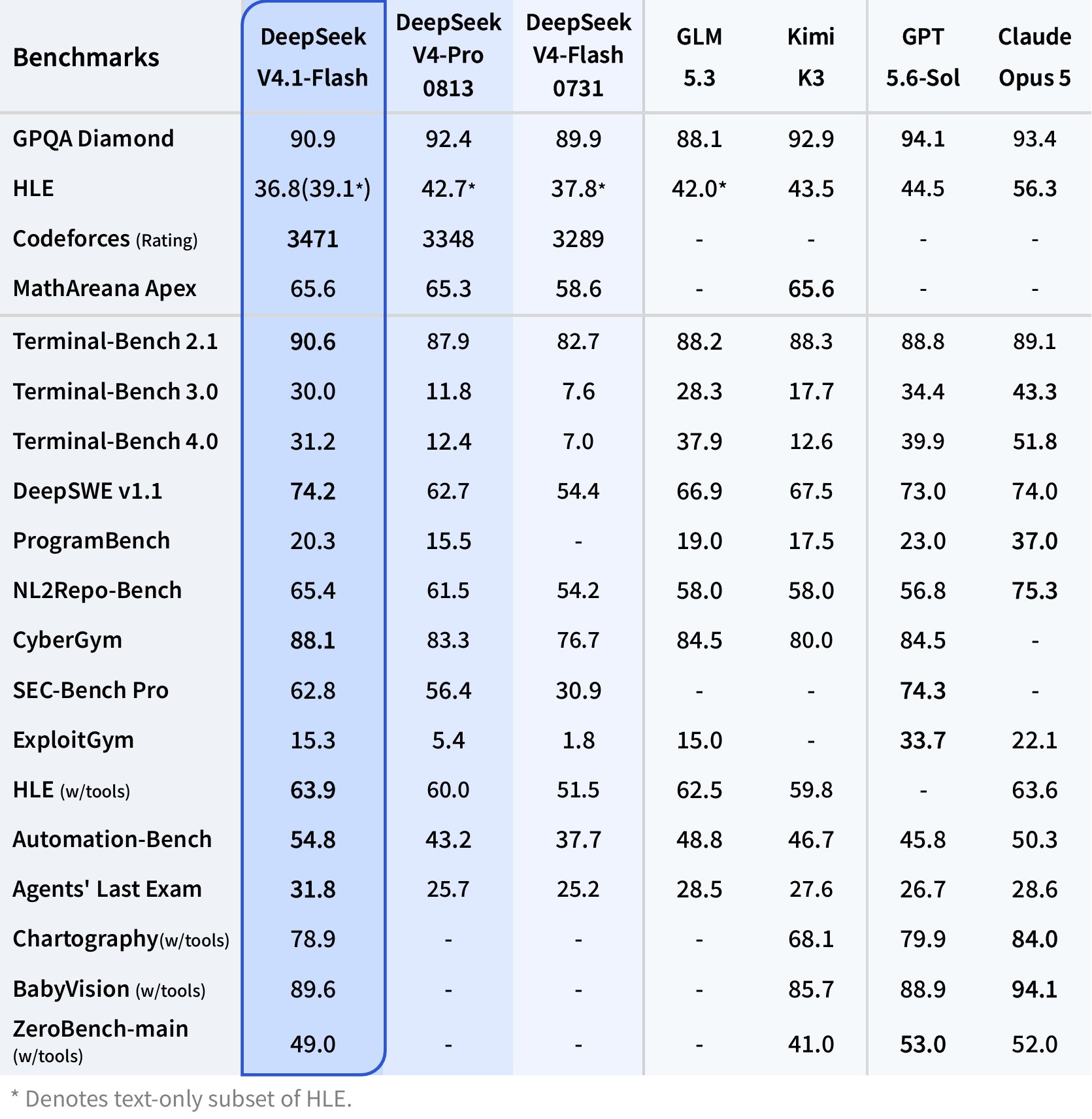
The architecture is not a post-training optimization. It is a new model structure. DeepSeek says the pre-training methods and larger-scale RL post-training were also updated. The result is benchmark results ahead of V4 Pro across the board.
KV Cache Cut 437x—Agent Bills Just Dropped
The KV cache improvement may matter more than the architecture. Compared to the previous generation, V4.1 Flash's KV cache needs just 1/4 the HBM and 1/8 the SSD storage. Relative to the original V4 architecture, DeepSeek says the cache has shrunk by a factor of 437.
For agent workflows, cache hits are the dominant cost. An agent re-reading a repository, re-processing a document, or re-querying context pays for cache-hit tokens repeatedly. A smaller cache means lower HBM requirements, less SSD storage, and cheaper cache-hit pricing.
Under the new pricing, cache-hit input tokens cost 0.02 yuan per million tokens during idle hours—down from 0.05 yuan, a 60% cut. The cache compression and the price cut reinforce each other.
DeepSeek Just Killed the Pro Tier
V4 Pro launched on August 13. It will be retired on September 14—roughly one month. During the transition, deepseek-v4-pro requests will be automatically routed to V4.1 Flash and billed at V4.1 Flash pricing.
The "Pro" tier no longer means "more capable." It means "more expensive for the same capability." DeepSeek removed the premium without removing the model.
The company's own survey question—"Do you think this model can fully replace the live DeepSeek V4 Pro?"—was answered by the pricing page before users could respond. V4 Pro requests will be auto-routed to V4.1 Flash, billed at Flash rates, with no Pro premium.
DeepSeek just demonstrated that its product tiers are not fixed. The Pro model lasted 40 days. The Flash model replaced it at a lower price. The KV cache shrank 437x. The architecture changed from symmetric to asymmetric. This is not a product roadmap. It's a product rethink—executed in six weeks.
The question isn't whether V4.1 Flash can replace V4 Pro. It already has. The question is whether V4.1 Pro will replace V4.1 Flash before the year ends.
P.S. V4 Pro requests will be auto-routed to V4.1 Flash on September 14. If you had a V4 Pro integration, it will keep working—at the Flash price. DeepSeek didn't announce a deprecation; it just changed the price and let the model disappear. That's a quieter way to retire a flagship than most companies would choose.
Frequently Asked Questions
Q: What is DeepSeek V4.1 Flash?
A: DeepSeek V4.1 Flash is a 552-billion-parameter Mixture of Experts model released on September 10, 2026. It uses a new asymmetric Causal Encoder-Decoder architecture with native multimodal support.
Q: What is the asymmetric architecture?
A: The model activates just 8 billion parameters for input processing and 16 billion for output generation. Understanding a problem is cheaper than producing an answer—which reduces costs for agent workflows that read large contexts and generate short outputs.
Q: How much did the KV cache shrink?
A: Compared to the previous generation, V4.1 Flash's KV cache needs just 1/4 the HBM and 1/8 the SSD storage. Relative to the original V4 architecture, the cache has shrunk by a factor of 437.
Q: Why does KV cache compression matter?
A: For agent workflows, cache hits are the dominant cost. An agent re-reading a repository or re-processing a document pays for cache-hit tokens repeatedly. A smaller cache means lower HBM requirements, less SSD storage, and cheaper cache-hit pricing.
Q: What happened to V4 Pro?
A: V4 Pro launched on August 13, 2026. It will be retired on September 14, 2026—roughly one month. All V4 Pro requests will be automatically routed to V4.1 Flash and billed at Flash prices.
Q: What happened to the previous Flash models?
A: V4-Flash and V4-Flash-Vision-Exp are retired. For compatibility, their API endpoints temporarily route to V4.1 Flash.
Q: What are the new prices?
A: Cache-hit input: 0.02 yuan per million tokens (idle) and 0.04 yuan (peak). Cache-miss input: 1 yuan (idle) and 2 yuan (peak). Output: 4 yuan (idle) and 8 yuan (peak).
Q: Is V4.1 Flash faster than V4 Flash?
A: Yes. Developer benchmarks show generation speeds of 280-507 tokens per second, compared to roughly 120-140 for V4 Flash. In long-context retrieval and code-generation tasks, end-to-end speed improved 5-6x.
Q: What does the "Pro" tier mean now?
A: The "Pro" tier no longer means "more capable." It means "more expensive for the same capability." DeepSeek removed the premium without removing the model.
Q: Will existing V4 Pro integrations break?
A: No. V4 Pro requests will be auto-routed to V4.1 Flash on September 14. Existing integrations will keep working—at the Flash price.