
On September 1, Anthropic released Fable 5.1—with no weeks of hype, just an API and a blog post. It went live on AWS, Google Cloud, and Microsoft Azure the same day. The model is the same weight as its restricted sibling Mythos 5.1; the difference is guardrails.
The release matters less for what the model can do in a single prompt, and more for what it can do for hours at a time.

38 Hours Autonomously. 45% Cheaper to Run.
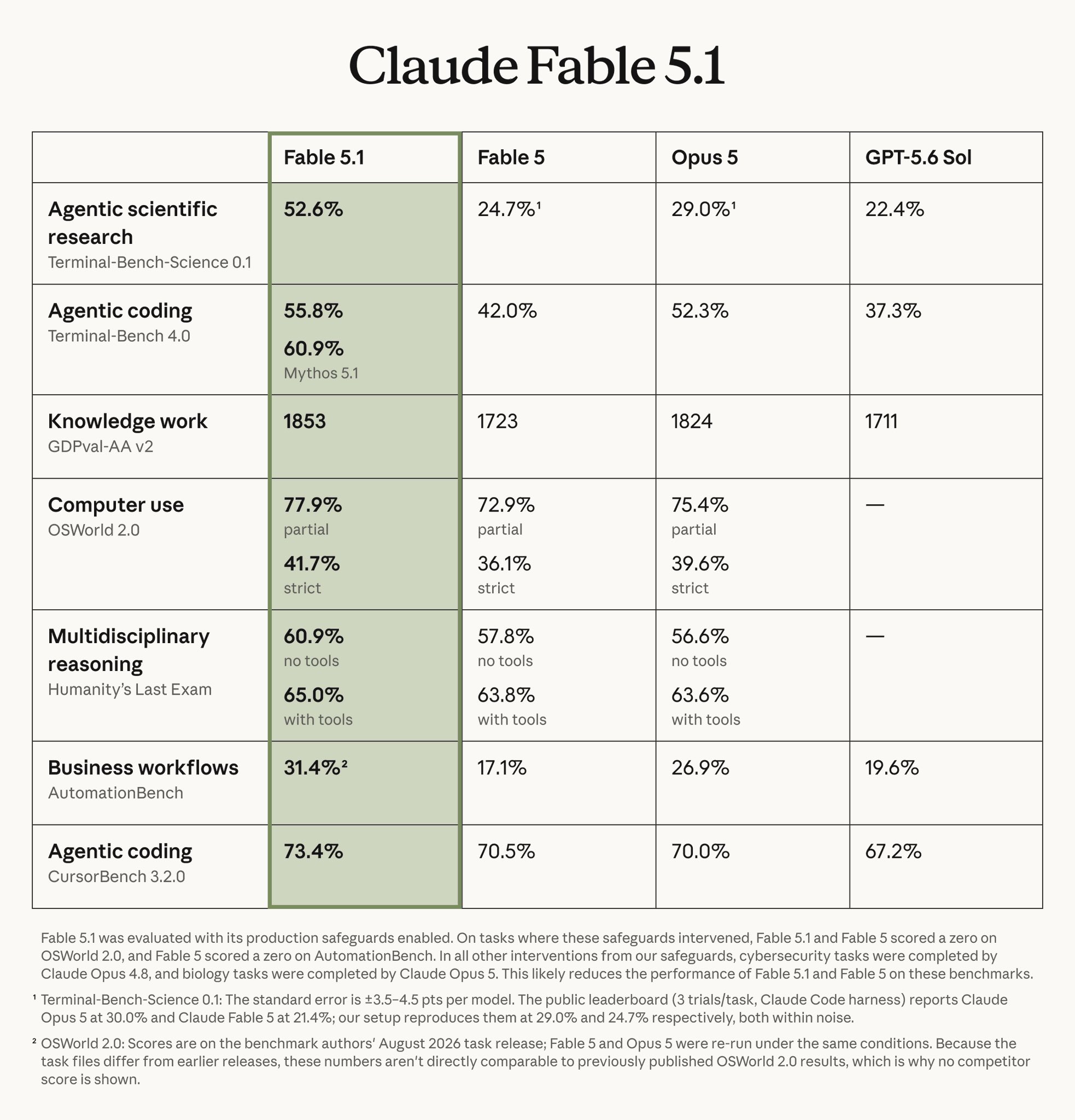
Fable 5.1's headline performance is sharp. On Terminal-Bench-Science 0.1, it hit 52.6%, more than double Fable 5's 24.7%. On Terminal-Bench 4.0, it scored 55.8%, ahead of Opus 5's 52.3% and GPT-5.6 Sol's 37.3%. On GDPval-AA v2, it scored 1853, ahead of Opus 5's 1824.
But the pricing shift is the real story. Base pricing is unchanged—$10 input, $50 output per million tokens. But cache reads dropped from $1 to $0.25 per million tokens, a 75% cut. For a code-review agent re-reading a repository, or an agentic workflow reusing context, the savings compound. Anthropic estimates typical workloads cost 25% less, and complex agent tasks up to 45% less.
The model is also designed to run independently. In one internal test, it worked for 38 hours autonomously—self-verifying results, adjusting priorities, and only surfacing at key checkpoints. It even helped a hedge fund debug a 4-year-old "once-in-a-million" bug by reverse-engineering a third-party library.
Mythos 5.1 Designed Better Proteins. Fable 5.1 Mapped Venus.
The benchmark scores are not the point. Anthropic also released real-world examples.
Protein design: Mythos 5.1 designed protein binders across 12 targets with nearly 50% success rate, versus the industry standard of 10-15%. For three targets, binding affinity was 10x stronger than the best human competitor designs.
GPU Kernels: Mythos 5.1 wrote GPU kernels for seven open-source biology models, speeding them up by up to 2.5x. A 3-million-variant analysis using Evo 2 went from $18,000 to $8,000 in GPU costs.
Planetary mapping: Fable 5.1 used 30-year-old NASA Magellan radar data to produce a high-resolution elevation map covering one-third of Venus, improving resolution from 10-20 km to 2-3 km.
Anthropic Just Locked Its Models Down. DeepSeek Is the Reason.
One quiet change signals a defensive move. For accounts created on or after August 31, it is no longer possible to edit a conversation's history while preserving Claude's prior thinking. This blocks a known "extraction" method used to distill Claude's outputs into cheaper models. Anthropic previously tracked over 16 million exchanges linked to distillation campaigns using roughly 24,000 fake accounts—and named DeepSeek, Moonshot AI, and MiniMax.
Fable 5.1 is out. The next phase of the AI market is not about who is smarter. It is about who can sustain work longer and deliver productivity at scale. For Anthropic, that is the strategy.
P.S. The pricing is "good enough" that Cognition is already switching Devin from Opus 5 to Fable 5.1 on launch day. But Artificial Analysis's Intelligence Index found that at the highest effort level, Fable 5.1's single-task cost is 20% higher than Fable 5—because it outputs roughly 1.7x more tokens. Cheaper cache does not guarantee cheaper total. The real metric is completed work per dollar, not tokens per dollar.
Frequently Asked Questions
Q: What is Anthropic's Fable 5.1?
A: Fable 5.1 is Anthropic's latest flagship model, released on September 1, 2026. It is designed for agentic workflows—multi-step tasks that require autonomous decision-making, tool use, and long-context reasoning over hours or days.
Q: How does Fable 5.1 compare to Fable 5 on benchmarks?
A: Fable 5.1 more than doubles Fable 5's score on Terminal-Bench-Science 0.1 (52.6% vs 24.7%). On Terminal-Bench 4.0, it scores 55.8%, ahead of Opus 5 (52.3%) and GPT-5.6 Sol (37.3%). On GDPval-AA v2, it scored 1853, ahead of Opus 5's 1824.
Q: What is the pricing for Fable 5.1?
A: Base pricing is unchanged: $10 per million input tokens and $50 per million output tokens. Cache reads dropped from $1 to $0.25 per million tokens (75% cut). Anthropic estimates typical workloads cost 25% less, and complex agent tasks up to 45% less.
Q: What is an "agentic workflow"?
A: Agentic workflows are multi-step tasks where an AI model acts autonomously—making decisions, calling tools, re-reading context, and self-verifying results over extended periods. Fable 5.1 was designed specifically for this type of work.
Q: How long can Fable 5.1 work autonomously?
A: In one internal test, Fable 5.1 worked for 38 hours autonomously—self-verifying results, adjusting priorities, and only surfacing at key checkpoints. It helped a hedge fund debug a 4-year-old bug by reverse-engineering a third-party library.
Q: What real-world tasks has Fable 5.1 performed?
A: It mapped one-third of Venus's surface using 30-year-old NASA Magellan radar data, improving resolution from 10-20 km to 2-3 km. Mythos 5.1 designed protein binders with nearly 50% success rate (industry standard is 10-15%), with binding affinity 10x stronger than human designs for three targets. It also wrote GPU kernels for seven biology models, speeding them up by up to 2.5x.
Q: What is the difference between Fable 5.1 and Mythos 5.1?
A: Both use the same base model. The difference is safety guardrails—Mythos has fewer restrictions and is only available to trusted organizations through the U.S. government's Life Sciences Verification Program, while Fable 5.1 is the general release version.
Q: What is the "anti-distillation lock"?
A: For accounts created on or after August 31, 2026, it is no longer possible to edit conversation history while preserving Claude's prior thinking. This blocks a known extraction method used to distill Claude's outputs into cheaper models. Anthropic previously tracked over 16 million exchanges linked to distillation campaigns using roughly 24,000 fake accounts, naming DeepSeek, Moonshot AI, and MiniMax.
Q: Who is already using Fable 5.1?
A: Cognition is switching Devin from Opus 5 to Fable 5.1 on launch day. The model is available on AWS, Google Cloud, and Microsoft Azure.
Q: Does cheaper cache mean cheaper total cost?
A: Not necessarily. Artificial Analysis found that at the highest effort level, Fable 5.1's single-task cost is 20% higher than Fable 5—because it outputs roughly 1.7x more tokens. The real metric is completed work per dollar, not tokens per dollar.