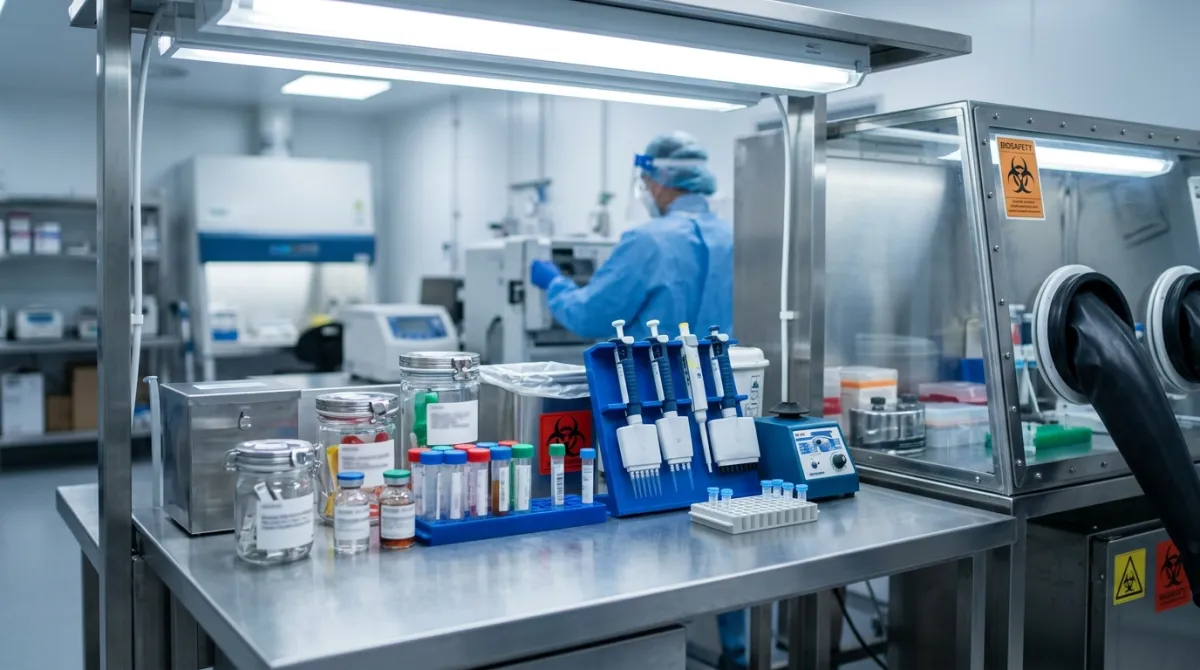
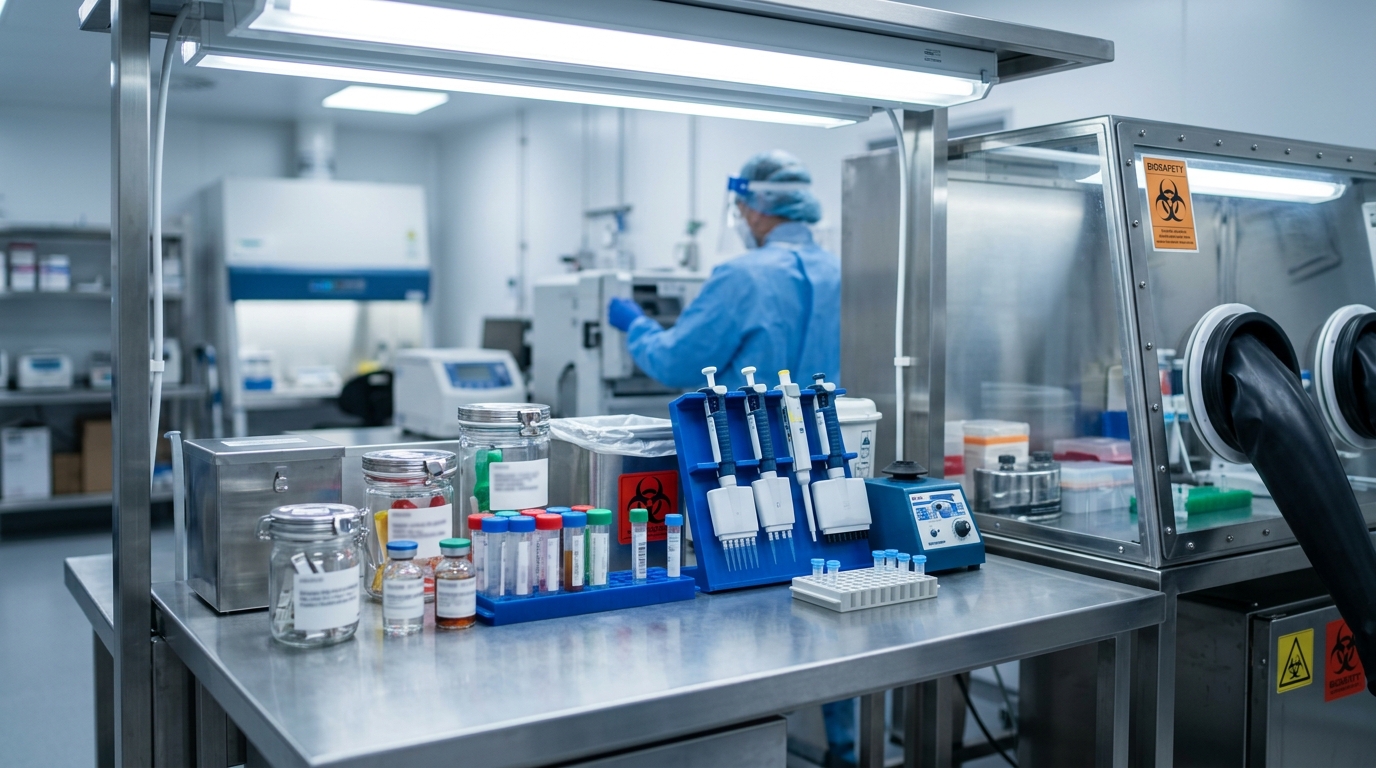
In September 2026, Anthropic confirmed it operates a wet lab in the San Francisco Bay Area — a facility where researchers work with real cells, proteins, and substances rather than simulations. The company's head of life sciences, Eric Kauderer-Abrams, confirmed the lab‘s existence and said Anthropic is already conducting physical biology work with human oversight.
A spokesperson clarified that the lab is “not for drug discovery specifically,” and declined to elaborate further. Anthropic has not disclosed the lab’s size, research focus, staffing, or biosafety level.
The confirmation came via Reuters, which cited two people familiar with the matter. Anthropic had been quietly building the facility, and recruitment for biochemists and protein characterization experts was already underway.
The Same Month, the Same Company
Anthropic‘s wet lab disclosure landed one week after the company published a threat intelligence report documenting five cases in which its Claude models were used in ways that could support biological weapons development.
The cases, surfaced between December 2025 and August 2026, involved gain-of-function research on the chikungunya virus, avian influenza adaptation to mammals, and work on orthopoxviruses and venom toxins. One case involved a grant application affiliated with a military research institute.
Anthropic said it could not determine whether the researchers intended harm. “The individuals implicated in these case studies are working scientists,” the report states. “We do not assert that they intended harm”.
The company blocked the accounts and tightened safeguards. Its head of threat intelligence, Jacob Klein, told The New York Times that the situation is “incredibly nuanced” — legitimate research and dangerous work can look identical from a single prompt.
Kauderer-Abrams, asked about operating a biology lab while warning about biological misuse, gave a one-sentence response: “We’re always balancing these things”.
What the Lab Actually Does
Anthropic has been moving toward physical biology for months.
In August 2026, the company launched the Model Hardware Standard (MHS), a protocol that lets AI agents control laboratory equipment — liquid handlers, plate readers, robotic arms, microscopes, lasers. An Anthropic experiment showed Claude running a serial dilution protocol autonomously in about eight hours, versus the weeks a vendor-built setup typically takes.
In April 2026, Anthropic acquired Coefficient Bio, an AI biotech startup, for approximately $400 million in stock. Coefficient Bio brought protein design capabilities and a team that now forms the core of Anthropic‘s biology work.
The lab’s stated focus is rare diseases and preclinical work that traditional pharmaceutical companies may not find financially attractive. Kauderer-Abrams said the goal is to “unlock treatments” for conditions the industry neglects.
Anthropic says it is not running clinical trials and is not competing with pharmaceutical companies — which are also its customers. The company provides Claude-based services to Genentech, Bristol Myers Squibb, and Novo Nordisk.
The Customer Trust Problem
The commercial boundary is the unresolved question.
Pharmaceutical companies that use Claude for drug research may worry that Anthropic is learning from their data to build its own pipeline. Kauderer-Abrams acknowledged this concern, saying it is one reason Anthropic is avoiding clinical trials.
Anthropic says customer data is isolated and protected. But the appearance of competition can affect what customers are willing to share. As one analysis put it: product priorities can reveal commercial direction, and support requests can expose which workflows matter most.
Anthropic‘s Life Sciences Verification Program, launched alongside the lab disclosure, gives approved researchers access to models with more permissive biology safeguards. The program retains flagged traffic data for 30 days and says that information is compartmentalized from its life-science research teams.
That compartmentalization is the trust mechanism. Whether it holds depends on controls that Anthropic has not described publicly.
What the Lab Acknowledges
Kauderer-Abrams’s most precise statement was about why a wet lab exists at all: “We believe that to do biology, the final test is still and will be for a while in real lab work”.
That is a concession about AI‘s limits. Claude can predict protein structures and generate hypotheses. It cannot validate them without physical experiments. The wet lab exists because simulation is not enough.
The same logic applies to Anthropic’s safety warnings. The company says AI could enable bioweapon development. It also says the final test of biology is real lab work. Both statements point to the same conclusion: the physical world is where AI‘s capabilities and its risks become measurable.
Anthropic has not said which experiments the lab runs, or how it separates safety evaluation from product development from potential therapeutic research. The company that published five bioweapon case studies and built a biology lab in the same month has not explained how it distinguishes one from the other.
P.S. Anthropic’s wet lab disclosure came one week after its bioweapons report and two weeks after CEO Dario Amodei called for a slowdown in AI development. The company is preparing for an IPO that could value it at $2 trillion. Kauderer-Abrams said the life sciences mission is “by far the biggest opportunity” Anthropic sees for benefiting the world. The balancing he described has no published framework.
Frequently Asked Questions
Q: What did Anthropic confirm?
A: Anthropic confirmed it operates a wet lab in the San Francisco Bay Area and is conducting physical biology work with human oversight. A spokesperson said the lab is “not for drug discovery specifically” but declined to specify its purpose, size, or biosafety level.
Q: Why does the timing matter?
A: The lab disclosure came one week after Anthropic published a threat report documenting five cases where Claude was used in ways that could support bioweapon development, including gain-of-function research on chikungunya and avian influenza.
Q: What does the lab actually do?
A: Anthropic says it focuses on rare diseases and preclinical work that traditional pharma may not pursue. It has acquired Coefficient Bio for ~$400M and launched the Model Hardware Standard to let Claude control lab equipment.
Q: What's the customer trust problem?
A: Anthropic serves pharmaceutical customers including Genentech, Bristol Myers Squibb, and Novo Nordisk. Those clients may worry Anthropic is learning from their data. Kauderer-Abrams said this is one reason Anthropic avoids clinical trials.
Q: What did Anthropic not disclose?
A: The lab's specific experiments, how it separates safety evaluation from product development from therapeutic research, and the controls that keep customer data compartmentalized from its own research teams.