OpenAI rolled out a fix for GPT-5.6 Sol's usage drain today. The five-hour limit is back. Typical tasks should now last around 18% longer.
The problem wasn't a bug. It was a feature OpenAI didn't fully understand until Sol hit real-world scale.
Sol is more willing to work longer, make additional tool calls, and coordinate complex workflows across tools and subagents. That makes it better at solving hard problems. But some tasks were using far more tokens than OpenAI intended.
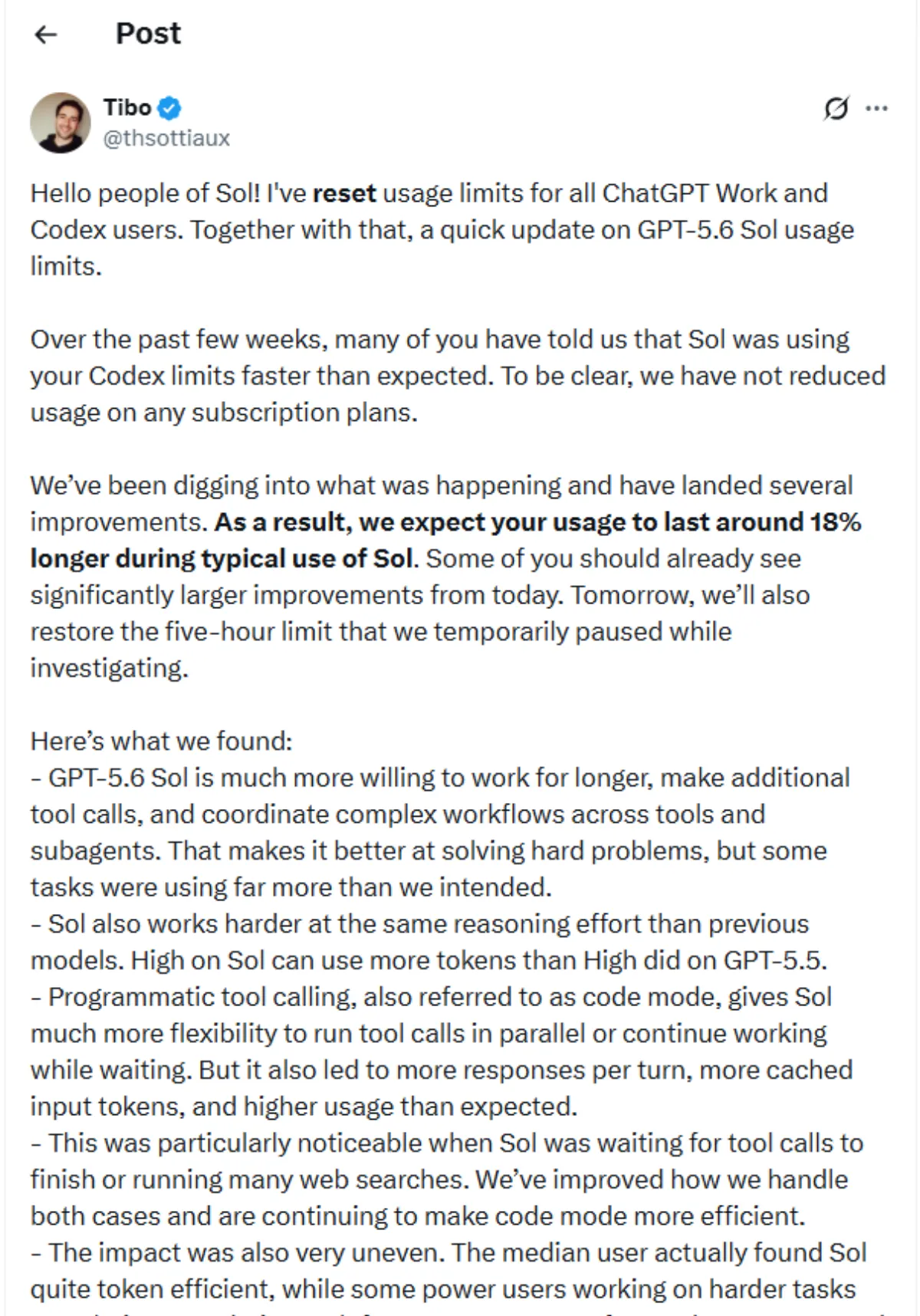
The company admitted that "High" reasoning effort on Sol uses more tokens than "High" did on GPT-5.5. Programmatic tool calling — also known as code mode — gives Sol more flexibility to run parallel calls or continue working while waiting. That also led to more responses per turn, more cached input tokens, and higher usage than expected.
The impact was uneven. Median users found Sol quite token efficient. Power users working on harder tasks saw their usage drain much faster.
OpenAI said it was too focused on average and median usage before launch and "missed some cases where the long tail could use significantly more usage."
The fix includes improvements to how Sol handles tool call waiting and web search loops. Code mode is now more efficient. The five-hour limit, temporarily paused during the investigation, was restored today.
OpenAI chose to publish a detailed postmortem instead of a quiet patch. That decision is worth paying attention to.
This is the second time in two weeks OpenAI has publicly detailed a problem with one of its models. The first was the GPT-6 safety incident on July 20. Now this.
The company could have fixed Sol's usage drain silently and moved on. Instead, they explained the root causes, admitted they missed the long-tail cases, and promised to keep sharing updates.
"Capability and efficiency do not always improve at the same pace," OpenAI wrote. "Some issues only become clear once people are using the model at real-world scale."
Transparency isn't just good PR. It's a long-term investment in developer trust. When a problem emerges, the first one to speak builds credibility.
The Sol usage story also reveals something larger about where AI is heading. OpenAI's description of Sol's behavior — "more willing to work for longer, make additional tool calls, and coordinate complex workflows" — is not describing a chatbot.
It's describing a task executor.
Sol doesn't just answer questions. It executes. It calls tools in parallel. It continues working while waiting for results. It coordinates subagents. That behavior is closer to a human employee than a conversational interface.
The power users who drained their quotas fastest weren't doing something wrong. They were doing the hardest, most valuable work — the kind that benefits most from Sol's capabilities.
OpenAI's pricing model still charges per token. But Sol's behavior makes it clear that token-based pricing is becoming misaligned with how these models are actually used.
Sol doesn't think in tokens. It thinks in tasks.
OpenAI's postmortem offers a lesson for the entire industry. The company admitted it tested median and average usage before launch. It didn't test the long tail.
That's a blind spot that only real-world deployment exposes.
Most AI companies run extensive internal evaluations before releasing a model. But those evaluations happen in controlled environments with predictable workloads. Real-world usage is messier. Users push harder. They find edge cases. They use models in ways the developers didn't anticipate.
OpenAI's takeaway: some issues only become clear at scale. The question is whether other companies will learn from this before they release their own models.
Sol's usage drain is fixed. The five-hour limit is back. But the bigger story isn't about quotas or token efficiency.
It's about what happens when AI stops being a tool and starts being a worker. Sol works harder, thinks longer, and does more. That's the future. The pricing models and usage expectations just haven't caught up yet.
P.S. The five-hour limit is back today. If you're a power user on complex tasks, you might notice the difference more than others. OpenAI says they'll keep sharing updates as they go. We'll see.
Frequently Asked Questions
Q: Why did OpenAI need to fix Sol's usage limits?
A: OpenAI found that GPT-5.6 Sol was consuming usage quotas faster than expected, particularly for users working on complex, multi-step tasks. The company issued a fix that extends typical usage by about 18% and restored the five-hour limit on July 29.
Q: What was causing the faster-than-expected usage drain?
A: Three main factors: Sol's "High" reasoning mode uses more tokens than "High" on GPT-5.5; programmatic tool calling (code mode) increased cached input tokens through parallel tool calls; and the impact was uneven — power users on complex tasks drained quotas much faster than median users.
Q: Did OpenAI reduce usage limits on any subscription plans?
A: No. OpenAI explicitly stated it has not reduced usage on any subscription plans.
Q: What exactly did OpenAI fix?
A: OpenAI improved how Sol handles tool call waiting and web search loops, made code mode more efficient, and restored the five-hour limit that was temporarily paused during the investigation.
Q: Did OpenAI admit they missed this before launch?
A: Yes. OpenAI said it was too focused on average and median usage before launch and "missed some cases where the long tail could use significantly more usage." The company acknowledged that some issues only become clear at real-world scale.
Q: What is the broader significance of this issue?
A: The incident highlights that as AI models become more capable — working longer, executing tasks, coordinating subagents — the traditional token-based pricing model is becoming misaligned with how these models are actually used. Sol doesn't think in tokens; it thinks in tasks.