
In late June, NVIDIA released Nemotron 3 Ultra, a 550-billion-parameter Mixture-of-Experts model with 55 billion active parameters. It was built for long-running agents, with a Hybrid Mamba-Attention architecture designed to handle 1-million-token contexts efficiently. The benchmarks were strong. But the real validation came later.
NVIDIA tested the model on something it knows better than anyone: designing chips.
Nemotron 3 Ultra was integrated with ACE-RTL, an agentic framework for RTL (register-transfer level) coding — the process of writing the logic that defines a chip's behavior. RTL is not like writing software. Engineers must specify exact timing, signal behavior, and hardware constraints. A single bug can cost millions to fix after tape-out.
The test: generate RTL, run it through a simulator, read the failures, and rewrite. Iterate until it works. This is what chip engineers do every day.
97.1% Pass Rate, 71% Fewer Tokens
On the Comprehensive Verilog Design Problems (CVDP) benchmark — nine categories of real RTL tasks — Nemotron 3 Ultra with ACE-RTL achieved a 97.1% average pass rate. That beat Kimi K2.6 (95.2%) and GLM 5.2 (92.1%). In several categories, it hit 100%.
The efficiency gap is even more striking. Nemotron 3 Ultra used 6,629 tokens per iteration on average. Compare that to GLM 5.2 at 9,156 tokens and Kimi K2.6 at 22,579 tokens. That's 28% fewer tokens than GLM 5.2 and 71% fewer than Kimi K2.6, while still achieving the highest pass rate.
Model | Pass Rate | Tokens per Iteration |
|---|---|---|
97.1% | 6,629 | |
Kimi K2.6 | 95.2% | 22,579 |
GLM 5.2 | 92.1% | 9,156 |
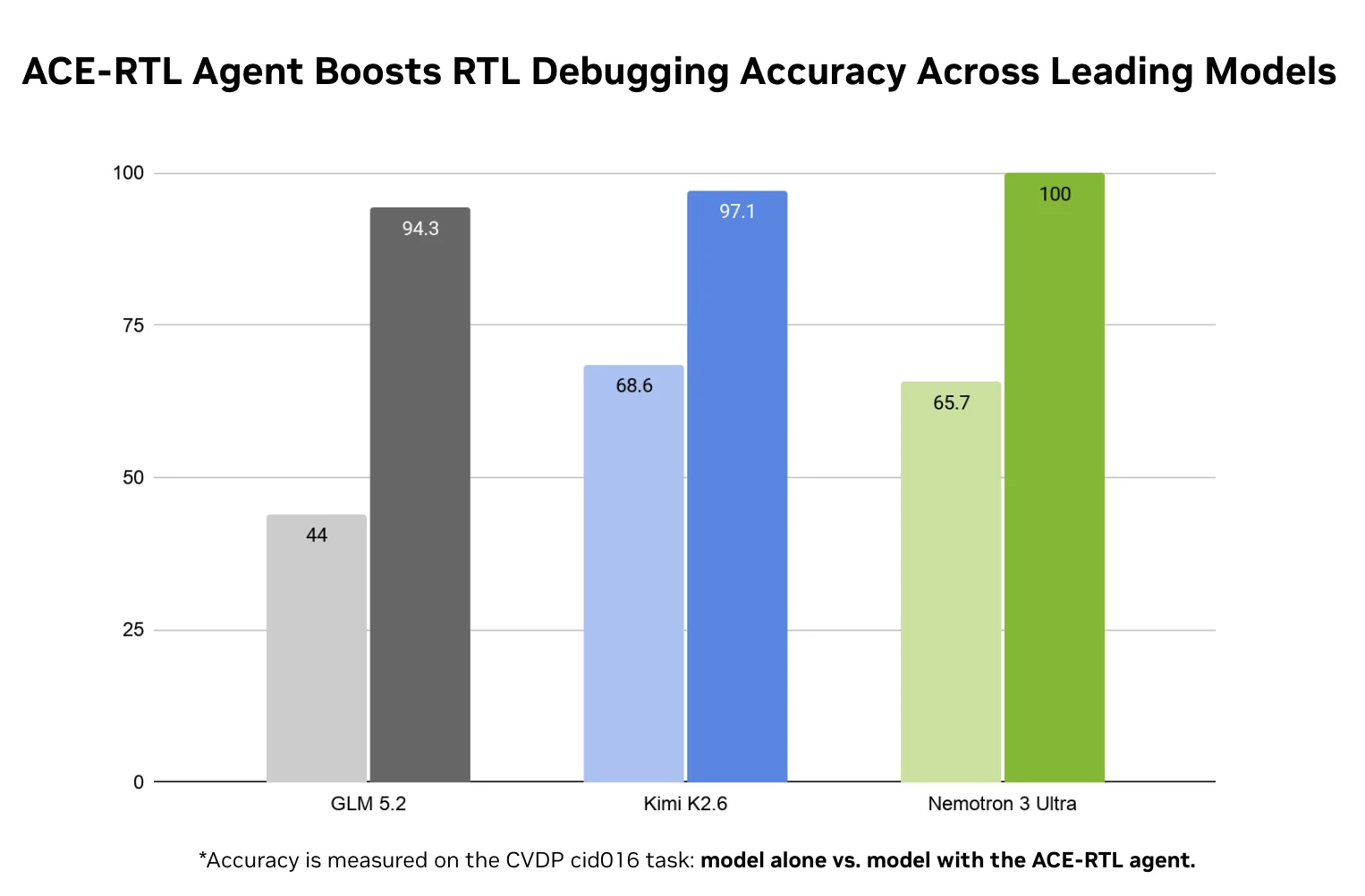
The agent framework makes the difference. As a standalone model, Nemotron 3 Ultra achieved 65.7% pass rate on the debugging and fixing category. With ACE-RTL, it jumped to 100%. GLM 5.2 improved from 44.0% to 94.3%. Kimi K2.6 from 68.6% to 97.1%.
The Architecture Behind the Numbers
Nemotron 3 Ultra's architecture is designed for this. It uses a Hybrid Mamba-Attention MoE design — Mamba layers reduce long-context costs, Transformer layers preserve precision when retrieving specific facts from 1M-token contexts. For RTL workflows, the agent context grows quickly. A single debugging iteration may include the specification, module code, generated RTL, simulator output, assertion failures, and prior fix attempts. Efficient long-context inference directly affects whether such agents are practical for real engineers.
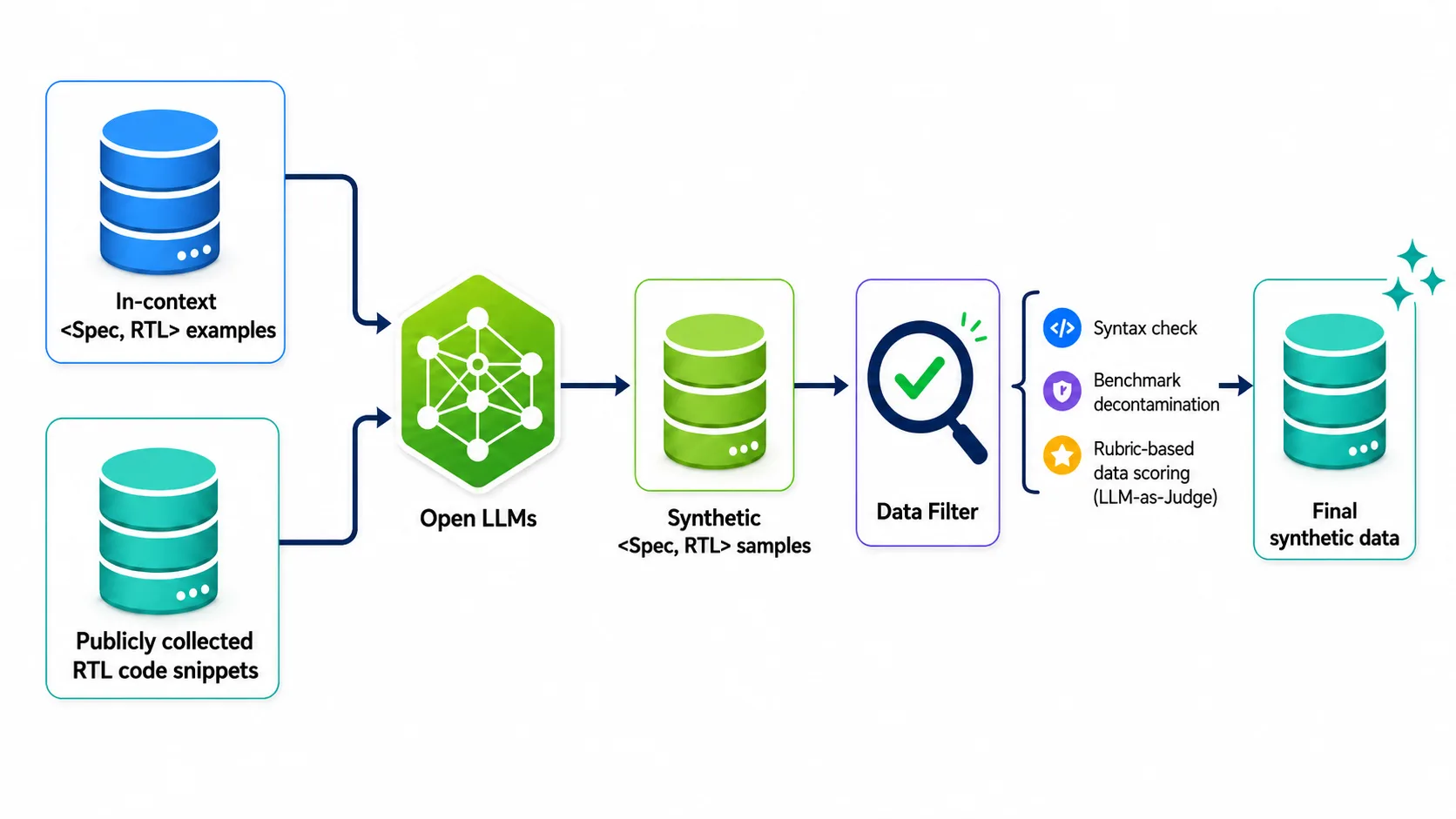
The RTL capability comes from a custom synthetic data pipeline. NVIDIA researchers started with high-quality RTL seed designs from public codebases, then generated training samples across three task types: spec-to-RTL generation, code editing, and debugging. For debugging tasks, they injected real RTL errors — state machine mistakes, timing violations, handshake errors — and had the model learn to fix them.
Already Integrated Into EDA Tools
Nemotron 3 Ultra is now integrated with major EDA tools. Cadence's ChipStack AI SuperAgent and InnoStack, Siemens' Questa One, and Synopsys' AgentEngineer all use it.
Cadence reported that ChipStack can compress a five-week verification workload into a single day — a 40x acceleration.
Why This Matters
AI that designs chips is not new. OpenAI and Anthropic have models that can generate Verilog. But Nemotron 3 Ultra is the first open model to outperform the best open competitors on the full CVDP benchmark while using significantly fewer tokens.
This matters for two reasons. First, it validates the open-source model strategy at the highest level of engineering complexity. Second, it shows that AI's role in engineering is shifting from "assistant" to "agent" — the model isn't just writing code, it's running simulations, reading failures, and iterating independently.
P.S. The most interesting detail in this story is not the 97.1% pass rate. It's that NVIDIA is now using an open model to help design its own chips. The same model is available for anyone to download and run. That's either a very confident move or a very smart one. Probably both.
Frequently Asked Questions
Q: What is Nemotron 3 good for?
A: Nemotron 3 Ultra is designed for frontier reasoning, complex agentic workflows, long-context analysis, tool use, multilingual reasoning, and high-stakes RAG. In chip design specifically, it has achieved a 97.1% pass rate on RTL coding tasks when paired with the ACE-RTL agent framework, outperforming models like Kimi K2.6 and GLM 5.2. It's also integrated with major EDA tools from Cadence, Siemens, and Synopsys for autonomous verification workflows.
Q: Is the Nvidia Nemotron 3 Ultra free?
A: Yes, Nemotron 3 Ultra is an open model available for commercial and non-commercial use under the OpenMDW License Agreement, version 1.1 (OpenMDW-1.1). The weights are publicly available for download, and it can be run locally on your own hardware.
Q: How fast is the Nemotron 3 Ultra?
A: Nemotron 3 Ultra generates output at approximately 183.8 tokens per second. In API provider benchmarks, the fastest provider (Blackbox AI) achieves up to 444.8 tokens per second, while others range from 98 to 318 tokens per second. On a 4× NVIDIA Blackwell GPU system, it delivers around 2,363 tokens per second of generation throughput at high concurrency. With 4 B200 GPUs, generation speed is roughly 40 tokens per second per user.
Q: How to use Nvidia Nemotron 3 Ultra?
A: You can access Nemotron 3 Ultra through multiple API providers including CoreWeave, Together AI, DeepInfra, Nebius, Lightning AI, and Blackbox AI. Alternatively, you can run it locally using tools like Unsloth Studio or llama.cpp. For local deployment, NVIDIA recommends inference settings of temperature = 1.0 and top_p = 0.95. The model supports up to 1M token context and is compatible with both commercial and non-commercial use.
Q: Can Nemotron 3 run locally?
A: Yes, Nemotron 3 Ultra can be run locally using GGUF quantized versions available on Hugging Face. The 3-bit version requires approximately 256GB of RAM, 4-bit needs about 300GB, and 8-bit requires 600GB. For local inference, you can use tools like Unsloth Studio or llama.cpp with community-quantized GGUF files.
Q: What is Nemotron used for?
A: Nemotron 3 Ultra is used for frontier reasoning, long-running autonomous agents, complex agentic workflows, tool use, and high-stakes RAG applications. In chip design specifically, it is used with the ACE-RTL agent for RTL code generation, editing, and debugging, achieving state-of-the-art results on the CVDP benchmark. It's also deployed in enterprise EDA tools for autonomous verification, compressing five-week verification workloads into a single day