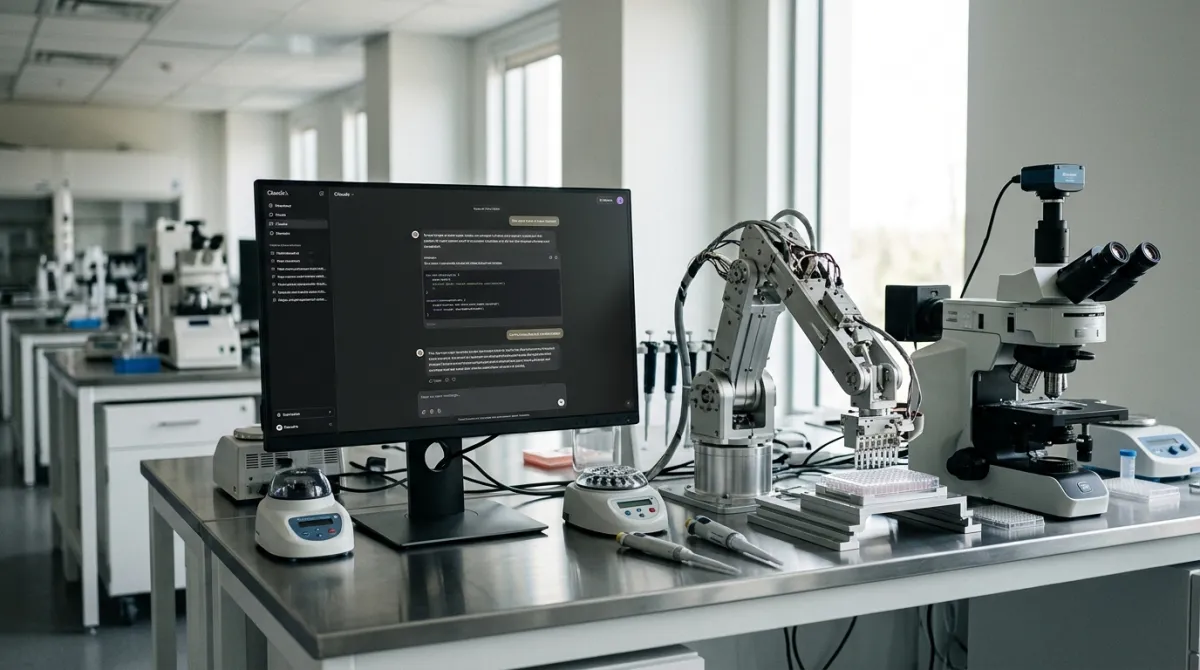
On August 27, Anthropic launched Model Hardware Standard (MHS)—a standard that lets Claude and other AI agents directly control microscopes, robotic arms, liquid handlers, and quantum computing lasers in the physical world. Integration time drops from weeks to hours. Experiments can run 24/7 without human intervention. And Anthropic just opened a door to a trillion-dollar market—right before its IPO.
This is not a robot. This is not a new model. This is the bridge between the two—a standard that turns physical devices into plug-and-play tools for AI agents.
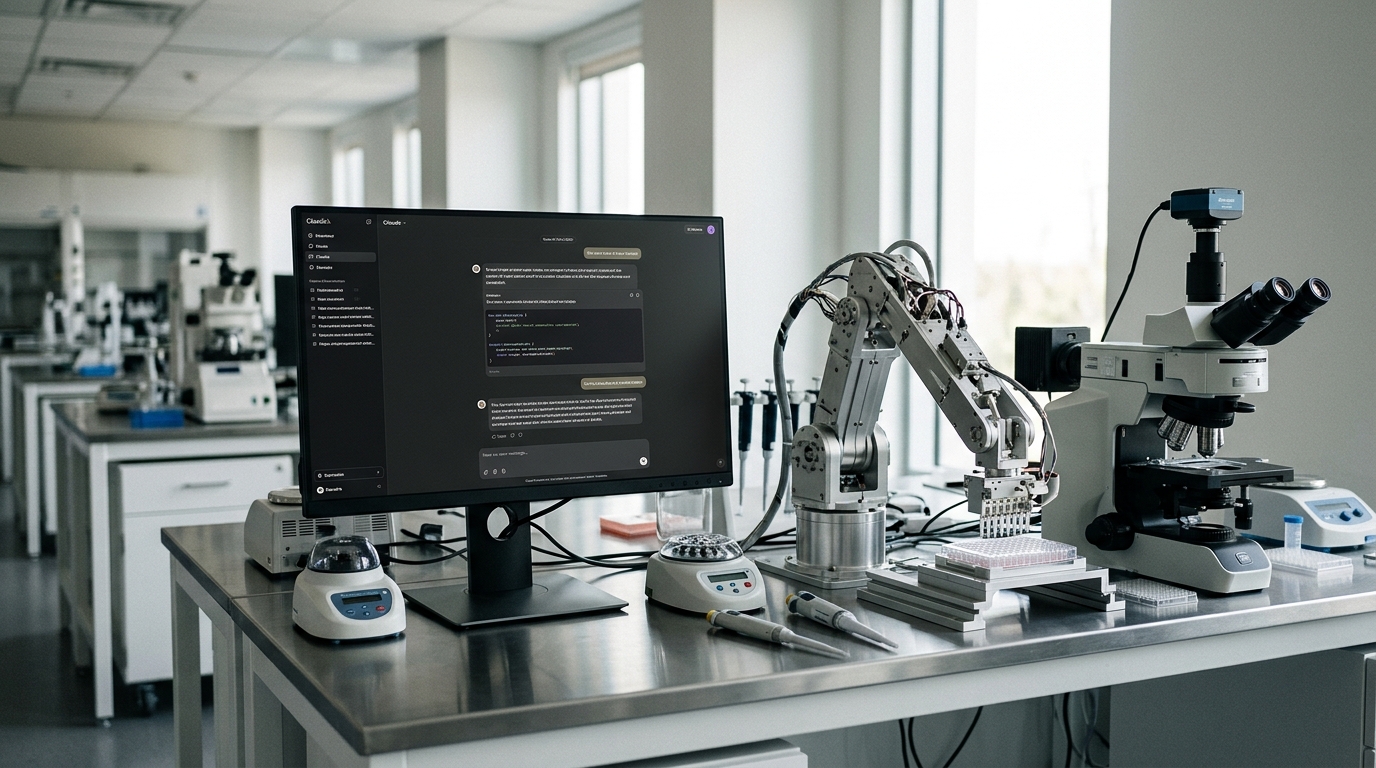
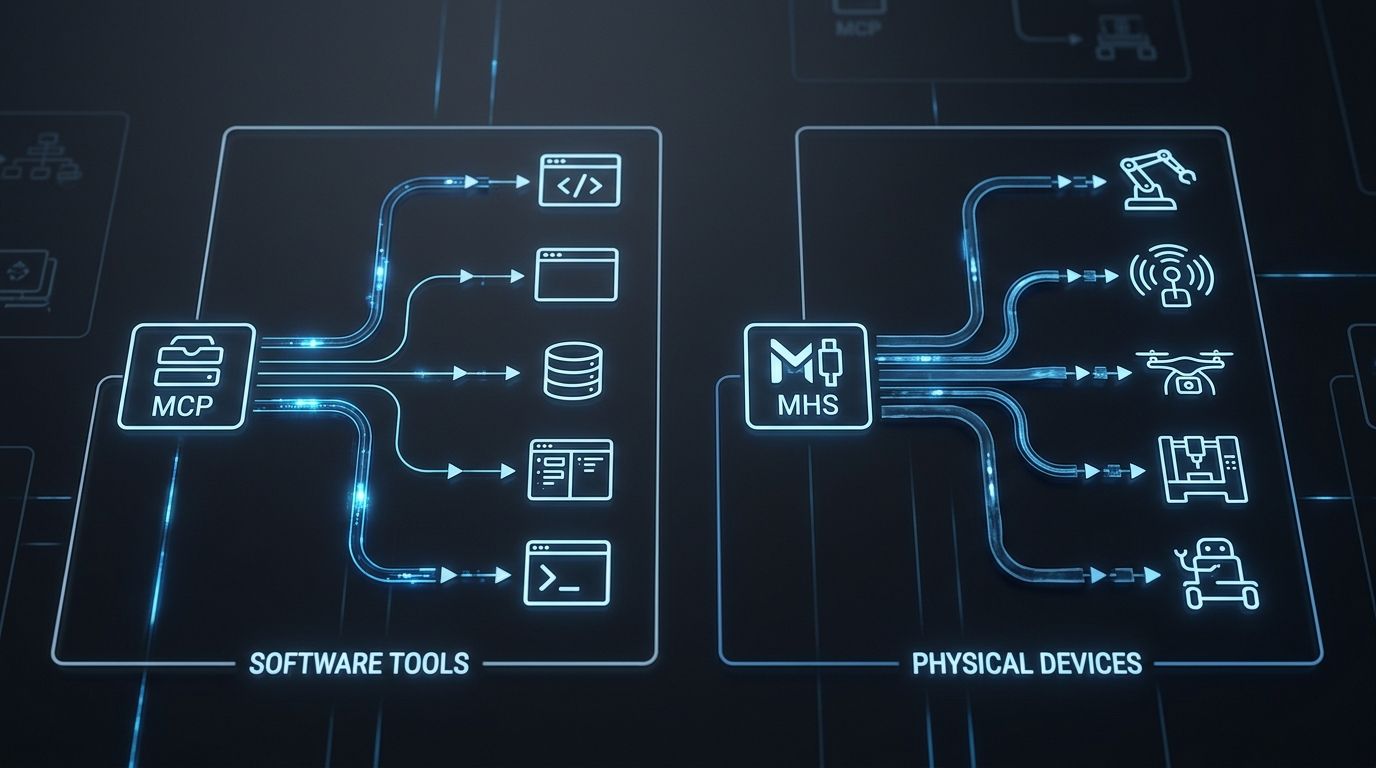
MHS Is MCP for the Physical World
MHS is the physical-world counterpart to Anthropic's Model Context Protocol (MCP), the industry-standard "USB-C for AI" that connects models to software tools. MCP has become the de facto standard for AI-agent integration with external data sources, files, and applications. MHS does for hardware what MCP did for software.
The problem MHS solves is simple but expensive: laboratories and factories have hundreds of devices—microscopes, liquid handlers, laser systems—each with its own software and interface. Integrating them takes weeks or months of custom engineering. MHS provides a standardized driver system that lets any AI agent discover, read, and control any programmable device through a common set of commands.
Claude can now measure a robotic arm's workspace, calibrate it, and execute precise movements without any pre-training or human demonstration. It can track a moving cell under a microscope and adjust the focus in real time. In one test, it controlled lasers to focus on a specific brain region—a task the supervising scientist had never seen before.
Why This Matters for Anthropic's $2T IPO
MHS is not a solo project. Anthropic developed it with the Howard Hughes Medical Institute's Janelia Research Campus and has been testing it with biotech, robotics, and quantum computing labs.
Partners include AWS, Danaher, Doosan Robotics, Hugging Face, Raspberry Pi, Genentech, Carnegie Mellon, and QuEra. In one early test, Genentech used MHS to cut the development and execution time of a fully automated dose-response curve experiment to one-third of its original duration.
The timing matters. Anthropic is preparing for what could be the largest IPO in history, with a potential $2 trillion valuation. MHS provides a narrative that goes beyond "another capable model"—it positions Anthropic as the company that bridges AI and the physical world. That story has a larger addressable market than any model provider alone.
The Same Bridge That Heals Can Also Harm
Anthropic is proceeding cautiously. The company is releasing MHS as a research preview, not a public launch, and plans to open-source it only after building adequate safety safeguards.
The risks are different from digital tool use. A software tool can cause data loss or security breaches; a physical tool can cause physical harm. Anthropic has built safety features into the standard: devices can define their own safety boundaries (like a robotic arm's speed or angle limits), and users can inject additional constraints through natural-language "tags" that describe device behavior.
Anthropic CEO Dario Amodei warned that society remains "dangerously unprepared" for AI's biological risks—the same capability that accelerates drug discovery can be misused for bioweapon design. MHS cuts both ways: the bridge that speeds up life-saving research is the same bridge that could be used for harm.
MHS Makes Anthropic a Physical-World Standard—Not Just a Model Provider
MHS is Anthropic's most important non-model product announcement. It takes MCP's ecosystem logic—a standard that benefits all players—and extends it from digital tools to physical infrastructure.
The commercial opportunity is clear: the autonomous robotics market is projected to reach a trillion dollars by 2035. Anthropic is positioning itself not just as a model provider but as the standard that connects AI to physical systems across industries.
The question is not whether MHS works—the demos already show it does. The question is whether Anthropic can keep it safe enough to open, open enough to become a standard, and standard enough to become the bridge that defines how AI enters the physical world.
P.S. Anthropic's IPO is expected in the coming months. MHS adds a new dimension to the valuation story: software MCP already made Claude a tool for digital work. Hardware MHS makes it a tool for physical work. The addressable market just got a lot bigger—and so did the risks. Investors will need to decide which side of that equation they're betting on.
Frequently Asked Questions
Q: What is Anthropic's Model Hardware Standard (MHS)?
A: MHS is a new standard that lets AI agents like Claude directly control physical laboratory and manufacturing equipment—including microscopes, robotic arms, liquid handlers, and quantum computing lasers. It functions as the hardware equivalent of Anthropic's Model Context Protocol (MCP), which connects AI to software tools.
Q: How does MHS work?
A: MHS provides a standardized driver system that lets any AI agent discover, read, and control any programmable device through a common set of commands. Instead of requiring custom integration for each device, MHS acts as a universal bridge between AI models and hardware.
Q: When was MHS announced?
A: Anthropic launched MHS on August 27, 2026, during the lead-up to its planned IPO. The company is releasing it as a research preview, not a public launch.
Q: What can Claude actually do with MHS?
A: Claude can measure a robotic arm's workspace, calibrate it, execute precise movements, track moving cells under a microscope, adjust focus in real time, and control lasers to focus on specific targets—all without pre-training or human demonstration.
Q: What is the difference between MHS and MCP?
A: MCP (Model Context Protocol) connects AI agents to software tools and data sources. MHS does the same for physical devices. Together, they form a complete bridge between AI and both digital and physical infrastructure.
Q: Who are Anthropic's partners for MHS?
A: Partners include AWS, Danaher, Doosan Robotics, Hugging Face, Raspberry Pi, Genentech, Carnegie Mellon, and QuEra. The standard was developed with the Howard Hughes Medical Institute's Janelia Research Campus.
Q: What is the commercial significance of MHS?
A: MHS positions Anthropic as a standard for physical-world AI integration, opening up the trillion-dollar autonomous robotics and lab automation markets. It adds a new dimension to Anthropic's IPO narrative beyond model capabilities.
Q: What are the safety concerns with MHS?
A: The risks are physical rather than digital. A software tool can cause data loss; a physical tool can cause physical harm. Anthropic has built safety features into the standard—devices can set their own boundaries, and users can inject constraints through natural-language "tags."
Q: Is MHS open-source?
A: Anthropic plans to open-source MHS, but only after building adequate safety safeguards. The company is currently releasing it as a research preview.
Q: How does MHS fit into Anthropic's IPO story?
A: Anthropic is preparing for what could be the largest IPO in history, with a potential $2 trillion valuation. MHS expands the company's addressable market from digital AI tools to physical-world automation, strengthening the narrative that Anthropic is building infrastructure, not just models.