
"Paris" Could Be a City, a Person, or a Top-Secret Project. NER-D Knows Which.
Traditional security tools are dumb. They match patterns. See a credit card number? Alert. See a Social Security number? Alert. See something that looks like a date? Alert. They don't ask what the context is. They just scream. In the AI era, that approach is dead.
WitnessAI launched NER-D yesterday. A new detection model built specifically for AI conversations. NER-D stands for Named Entity Recognition - Double Pass. It reads the entire sentence at once, not word by word.
Here's why that matters. Imagine an employee pastes a chat into an AI assistant: "Our Paris team closed the deal. The contract ID is PAR-2026-0042. Sarah, can you review by Friday?" The word "Paris" appears. Is it a city? A person's name? Or a classified project codename?
A legacy tool doesn't know. It sees a string of letters and alerts. NER-D reads the context. It understands that this is a legitimate business conversation, not a data breach. That's semantic understanding. And it's the difference between a security system that helps and one that wastes everyone's time.
20x Faster and 7.9 Points More Accurate — Without the Hallucinations
The AI security world has been stuck. You either use fast-but-dumb pattern matching or smart-but-slow generative models. NER-D broke that tradeoff. The company released a technical paper with the numbers. Speed: 20x faster than generative methods. Accuracy: 7.9 points higher than industry best. That's not incremental. That's a leap.
How? Instead of generating answers token by token, NER-D processes the entire input in a single parallel pass. No autoregressive decoding. No hallucinations. No parsing errors. Just classification at high speed using LLM world knowledge. The paper puts it bluntly: "Legacy tools match patterns, but NER-D understands meaning."
One CEO put it even more directly: "Paris could be the city, the person, or the project codename, and our model instantly figures it out." That's the killer feature. AI security isn't about listing bad words. It's about reading the room. And NER-D just learned how to do that faster than anyone else.
Enterprises Are Terrified. WitnessAI's 500% Growth Proves It.
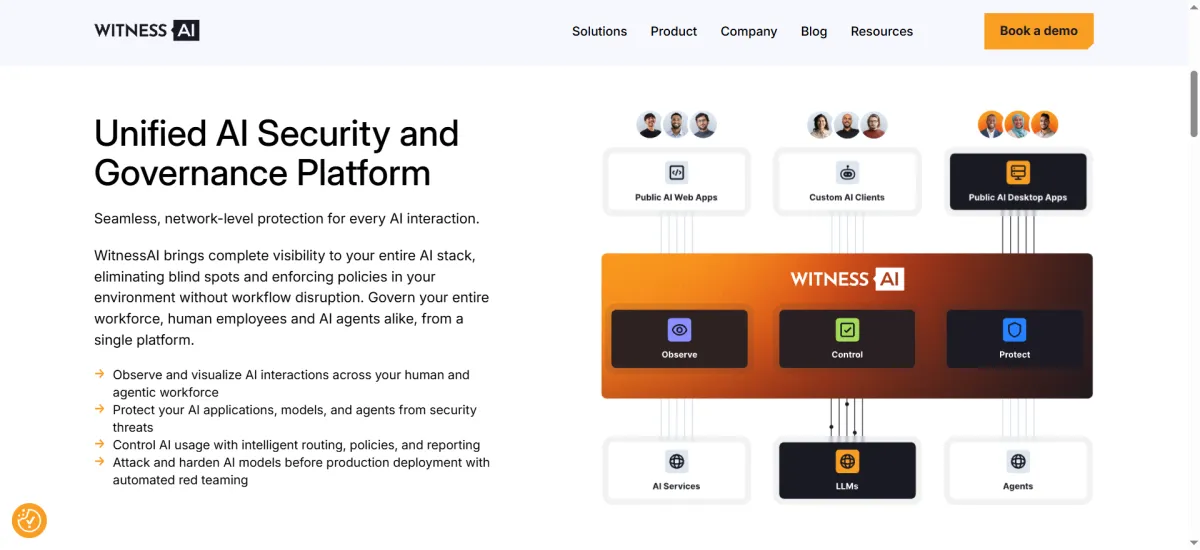
WitnessAI didn't invent this in a lab. They built it because the market is screaming for it. The company's annual recurring revenue grew over 500% in the past year. Headcount grew 5x. Customers include top global financial institutions, airlines, and utilities. Enterprises are terrified.
Here's why. Every employee is pasting sales contracts into ChatGPT. Every developer is feeding proprietary code to Claude. Every customer support agent is copying customer data into AI assistants. Traditional data loss prevention tools can't see any of this — because AI apps are native applications, not web pages sitting behind a proxy.
SaaS security tools can't read what's inside a ChatGPT conversation. They can't block a user from pasting a confidential document into a public AI model. NER-D solves that. It sits in the conversation, reads the context, and decides in real-time whether this is a business use case or a data leak. WitnessAI also launched Agentic Control — bringing MCP servers and tool calls into the security perimeter. If an AI Agent tries to access an unauthorized server, it gets blocked. The era of AI doing whatever it wants inside enterprise systems is over. Security finally caught up.

False Alarms Are the Real Enemy. NER-D Just Killed Most of Them.
Security teams don't just worry about attacks. They worry about noise. Every false alarm takes time to investigate. Every alert that turns out to be nothing erodes trust in the security system. When everything is an emergency, nothing is an emergency.
NER-D reduces false alarms by understanding intent. A social security number in a payroll document is normal. A social security number in an email to a competitor is a breach. Traditional tools can't tell the difference. NER-D can.
It's not just about blocking data leaks. It's about letting security teams focus on actual threats instead of drowning in false positives. The paper published alongside NER-D shows it breaks the limitations of causal attention — allowing each token to see the full context of the sentence. That's the architectural shift that makes all of this possible. Legacy DLP tools are still playing 2015's game. The game has changed. And NER-D just built a better way to play it.
This Changes the AI Security Game
WitnessAI's NER-D solves a problem most people didn't know they had. But anyone deploying AI in a regulated industry knows exactly how painful this is. The old way was keyword lists, regular expressions, and endless false alarms. The new way is semantic understanding at 20x the speed.
This isn't just a product update. It's a signal that AI security is growing up. The first generation was about policy and rules. The next generation is about understanding. WitnessAI grew 5x in a year. NER-D is why. Because enterprises don't just want to use AI. They want to use it without losing their data. And that requires security that's as smart as the AI it's protecting.
P.S. If you're an enterprise security leader, the question isn't "do I need this?" It's "how many data leaks have already happened that my legacy tools didn't catch?" The answer is probably more than you think. NER-D won't fix the past. But it will make the future a lot less leaky.