
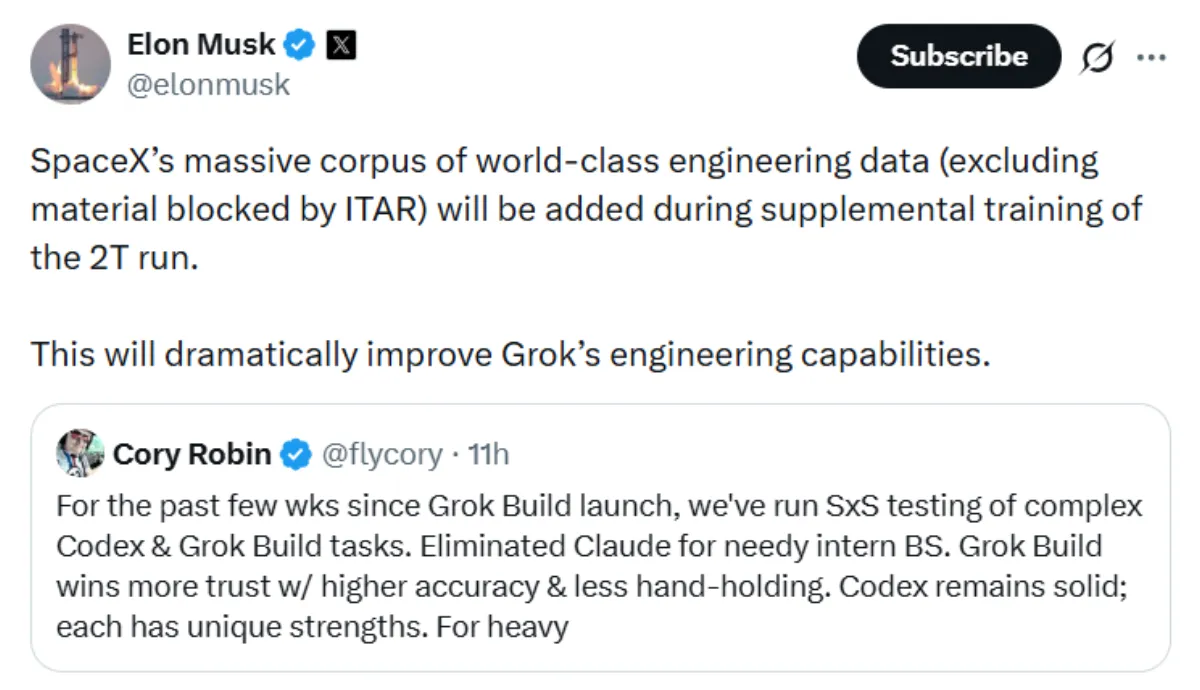
Elon Musk posted an update on X today. It didn't get as much attention as the Kimi K3 release or the Gemini delay. But it might matter more.
"SpaceX's massive corpus of world-class engineering data will be added during supplemental training of the 2T run. This will dramatically improve Grok's engineering capabilities."
That's a quiet announcement with loud implications.
Most AI models are trained on public data. Web pages. GitHub repositories. Academic papers. Forums. They know what the internet knows about engineering, which is a lot — but it's shallow. They can recite textbook definitions. They cannot tell you what happens when a component fails in a vacuum chamber.
SpaceX has that data. Real engineering documentation. Test results. Failure modes. Systems integration notes. Manufacturing tolerances. The things that actually make rockets fly.
Not all of it can be used. Musk specifically excluded material blocked by ITAR — International Traffic in Arms Regulations, the US rules that control defense-related technical data. The aerospace industry is full of export-controlled information that cannot legally be used to train a public-facing AI model.

But what remains is still a massive corpus of world-class engineering data that no web crawl can replicate.
The contrast with other AI labs is stark. OpenAI and Anthropic train on what they can scrape. Google has search data. Meta has social data. xAI has rocket data.
SpaceX is not just a customer for xAI's models. It's a data supplier.
This is not the first time Musk has used his companies to feed Grok. The model was trained on Cursor's data, which captures real developer interactions with codebases — not just code, but the process of writing, debugging, and fixing it. That's what gave Grok 4.5 its unusual token efficiency: learning from the actual workflow of developers, not just the final output.
Now SpaceX is doing the same thing for engineering. The model isn't just learning what rockets look like. It's learning how rockets are built.
The 2T model Musk references is the next Grok release, expected in August. This will be the first model trained from scratch with SpaceX data integrated from the start — not added later as a supplement. Early feedback from SpaceX and Tesla engineers reportedly found Grok 4.5 useful in real engineering contexts. Musk framed it as the real measure: "real-world usefulness, not benchmarks."
P.S. If you're an Anthropic or OpenAI product planner, here's the problem: you can't replicate this. You can't buy SpaceX engineering data. You can't build a rocket company to generate it. And every time Musk's companies build something new, they add more data to the pipeline. The gap is not just about compute. It's about what the compute is trained on.