

On July 24, Jensen Huang did something he had never done before. He posted on X .
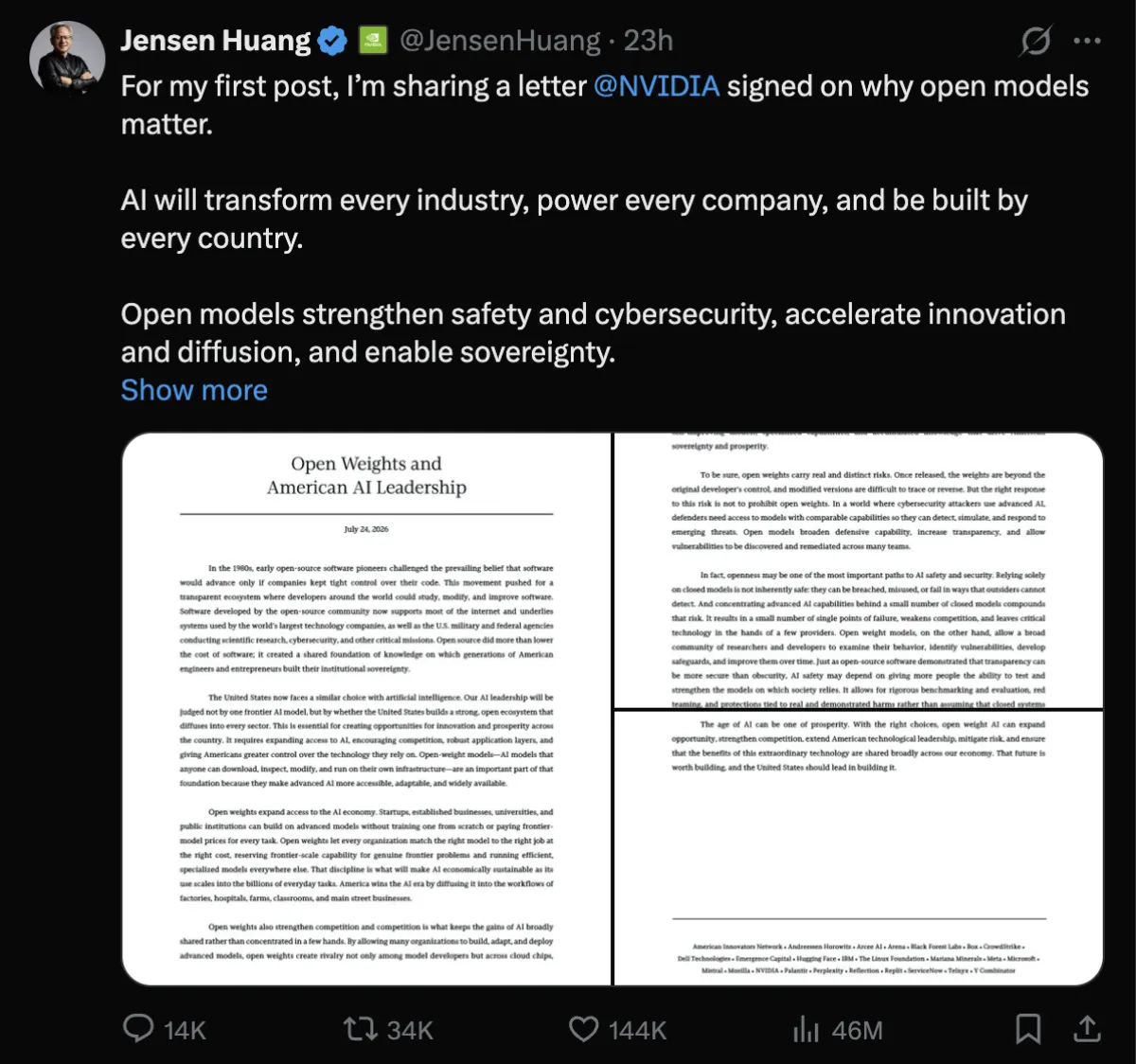
Not a leather jacket photo. Not a new GPU announcement. He shared an open letter titled "Open Weights and American AI Leadership." His caption: "AI will transform every industry, empower every company, and be built by every nation. The world needs both frontier closed-source models and frontier open-source models" .
The letter was signed by 25 companies and institutions: NVIDIA, Microsoft, Meta, IBM, Dell, Palantir, Hugging Face, Mistral AI, a16z, Y Combinator, and Perplexity .
The absence list is equally telling. OpenAI, Anthropic, and Google did not sign .
Three days earlier, OpenAI's strategy chief Dean Ball had posted his own thread — warning of "AI communism" and proposing the US government "create regulatory risk" around Chinese open-weight models . Now Huang had assembled the largest coalition in Silicon Valley to push back.
The letter directly addresses the "distillation" argument. It describes distillation as a "natural phenomenon" in AI development, not infringement, and argues that "legitimate intellectual property concerns should be addressed through targeted legal frameworks, not blanket restrictions on the technology itself" .
The fracture in the industry maps onto a simple economic split . The "diffusion" camp — NVIDIA, Microsoft, Meta, and the venture world — makes money when AI is cheap and widely used. The "scarcity" camp — OpenAI, Anthropic, Google — makes money when frontier models are locked up and scarce .

Huang's first-ever X post signals which side he is on. And he is not alone. Microsoft CEO Satya Nadella also signed the letter. Elon Musk reposted: "Old Huang is right. I fully support" .
Kimi K3 sits at the center of this fracture. The 2.8-trillion-parameter model launched on July 17 — the largest open-weight model ever — has become the catalyst for a policy debate . Its open weights arrive on July 27.
The letter's framing is striking for its ambition: "US AI leadership will not be measured by a single frontier model — it will be measured by whether the US builds a robust, open ecosystem that penetrates every industry" .
The question is no longer whether open-source AI can compete. It is whether the companies that make money off closed models will be able to stop it.
P.S. If you are an enterprise AI buyer, the calculus just got simpler. The hardware layer, the cloud layer, and the venture capital layer are all backing open-source. The only holdouts are the model labs themselves. That is not a balanced debate. That is an industry choosing sides — and the side with the most money just picked one.
Frequently Asked Questions
Q: What are open weight AI models?
A: AI models whose trained parameters (weights) are publicly downloadable. Anyone can inspect, modify, fine-tune, and run them on their own hardware. Unlike closed models like GPT-5 or Claude, which are only accessible through paid APIs, open weight models give users full control over deployment without ongoing per-token costs.
Q: Why did Jensen Huang post on X for the first time?
A: To rally support for open weight AI models against potential U.S. government restrictions. His debut post on July 24, 2026 shared a joint letter signed by 25 companies, drawing a parallel to the 1980s open source software movement and arguing that open models are essential for American AI leadership.
Q: What did the open weights letter actually argue?
A: Five points: open models lower costs for startups and universities, create competition across the AI stack, give customers control over their data, improve security by enabling broad community auditing, and enhance safety through transparent red-teaming. It also defended distillation as a legitimate research technique.
Q: Who signed the letter and who did not?
A: Signers included NVIDIA, Microsoft, Meta, IBM, Dell, Palantir, Hugging Face, Mistral, a16z, Y Combinator, Perplexity, and Mozilla — 25 organizations total. OpenAI, Anthropic, and Google did not sign. Their absence reflects the economic split between companies that profit from open diffusion of AI versus those that profit from keeping frontier models closed.
Q: What is AI distillation and why is it controversial?
A: Distillation trains one model using another model's outputs. The letter calls it a legitimate, widely used technique rooted in open source tradition. OpenAI and Anthropic argue it can cross into intellectual property theft. The debate centers on Kimi K3 — U.S. officials accuse Moonshot of distilling Anthropic's models, while independent researchers say the timeline makes full distillation implausible.
Q: Does open weight AI improve security?
A: Supporters argue yes — more researchers can audit code, find vulnerabilities, and build safeguards. Closed-only systems create concentrated single points of failure. Critics counter that open models can be stripped of safety filters and deployed maliciously with no oversight, since the developer cannot revoke access once weights are public.
Q: Why does NVIDIA support open weight AI?
A: It is a business strategy. Open models increase demand for GPUs — every company running AI on its own hardware needs NVIDIA chips. Huang has previously said one in every four AI tokens is generated from an open model. More open models mean more compute sold, directly benefiting NVIDIA's bottom line regardless of who builds the model.
Q: Why do Chinese AI labs release open weight models?
A: Because open weights bypass distribution barriers. A Chinese model like Kimi K3 does not need users to download a new app or build overseas sales channels — developers worldwide can download and run it directly. It is a strategy to gain global influence without competing on consumer-facing products, where U.S. companies dominate with ChatGPT and Claude.