
The model first appeared on August 20 under the codename Ox Alpha. No name. No provider. No press release. Just a free API on OpenRouter and OpenCode. Within hours, it hit the top of the charts, setting a new single-day record on OpenRouter and ending DeepSeek's 56-day streak at the top of OpenCode. OpenCode provided 100 trillion tokens of daily capacity to meet the surge.
The community was left guessing. Tokenizer fingerprints pointed to Zhipu's GLM-5 family. Video encoding matched GLM-5V-Turbo. Error codes matched Zhipu's API. But the company stayed silent—until August 26.
The "Blind Test" Playbook, Perfected
This is not Zhipu's first anonymous launch. In February, the company released "Pony Alpha" on OpenRouter, later confirmed as GLM-5. In its technical report, Zhipu called this a "blind test"—a deliberate attempt to let the model be judged on capability alone, without brand bias.
The Ox Alpha run follows the same pattern—but at scale. In five days, the model processed over 50 trillion tokens, with more than 10 million users trying it across both platforms. Usage peaked at over twice DeepSeek's volume.
The strategy works because it's not a press release. It's an invitation. Developers test the model because it's there, not because a PR team told them to. The model's performance—not its brand—determines whether they keep using it.
The Numbers That Matter: 57, $0.50, 1/40
GLM-5.3-Flash is a 320B-parameter model with 18B active parameters, making it the lightest flagship in the GLM-5 series. Its Artificial Analysis Intelligence score of 57 matches Claude Opus 4.8 and surpasses GLM-5.2. In Zhipu's internal coding benchmarks, its performance is comparable to Opus 4.8.
The pricing is where the math gets aggressive. Input is 0.8 yuan ($0.11) per million tokens; output is 2.8 yuan ($0.39) per million. For comparison, Claude Opus 4.8 charges $25 per million output tokens—roughly 40 times more. Even compared to DeepSeek V4 Flash after its August price hike, GLM-5.3-Flash comes out cheaper in most scenarios.
The architecture makes the price possible. GLM-5.3-Flash is the first open frontier model to use a hybrid sparse-linear attention architecture. Linear attention handles local patterns; sparse attention fetches relevant global context without processing every token. An IndexPool compresses four cache vectors into one. Compared to GLM-5.3, attention compute drops 3x and KV cache drops 4.4x.
The Real Signal: 100,000 Chinese Chips in Production
The most significant detail in the release is not the model's performance or its price. It's where it ran.
Zhipu confirmed that all Ox Alpha traffic—more than 50 trillion tokens, processed by millions of users—was powered entirely by Chinese chips. The company deployed over 100,000 domestic AI accelerators to handle the load. According to LatePost, the suppliers are likely Huawei, Moore Threads, and Hygon.
Zhipu rebuilt its inference stack to make this work. Single Chinese chips face memory and bandwidth constraints, particularly with a 1-million-token context window. The team built a custom inference engine on SGLang, adding node-level tensor parallelism, W8A8 quantization, INT8/FP8/BF16 hybrid cache quantization, and an Encode-Prefill-Decode (EPD) disaggregated architecture that splits encoding, prefill, and decoding into independently scalable pools.
The result: end-to-end service performance improved 3x compared to the initial baseline, and token costs reached parity with Nvidia GPUs. SemiAnalysis called it a sign that "CUDA's moat is being tested again".
This is not a lab test. This is global production traffic, with real users making real decisions based on speed and reliability, not brand loyalty. The model's name—Ox Alpha—came from a Chinese meme film, but its technical claim is straightforward: the hardware worked.
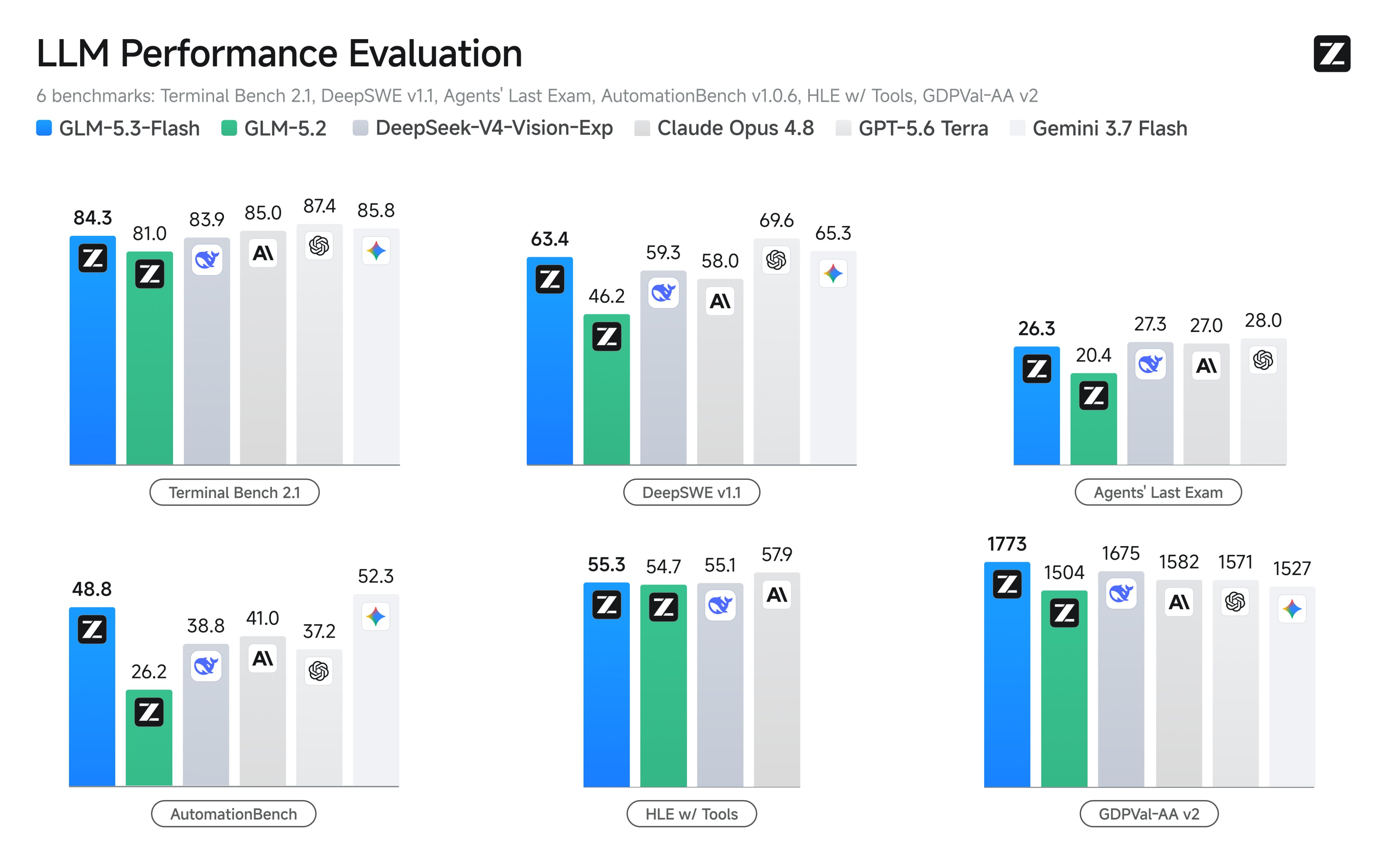
GLM-5.3-Flash is the first model to prove three things at once: it can match the intelligence of a $25-per-million-token flagship, sell at 1/40 of the price, and run entirely on domestic chips at scale. The "stealth launch" tactic turned anonymous testing into free marketing. The open-source release turns free marketing into permanent ecosystem leverage.
The question is no longer whether Chinese chips can support frontier inference. It's what happens when every category has a GLM-5.3-Flash equivalent—and when the hardware that powers it no longer comes from Silicon Valley.
P.S. The model's free preview ended on August 26, coinciding with its open-source release. The weights are now available on Hugging Face under an MIT license, and the API price has officially taken effect. The developers who burned through trillions of tokens for free this week now face a choice: pay for Zhipu's service, or run the open model themselves on whatever chips they can find. That choice is exactly the point.
Frequently Asked Questions
Q: What is GLM-5.3-Flash?
A: GLM-5.3-Flash is Zhipu's latest open-weight model, released on August 26, 2026. It is the first native multimodal model in the GLM-5 series, with 320B total parameters and 18B active parameters. It scored 57 on the Artificial Analysis Intelligence Index, tied with Claude Opus 4.8.
Q: What was Ox Alpha?
A: Ox Alpha was the anonymous name under which GLM-5.3-Flash was tested on OpenRouter and OpenCode for five days before its official release. It quickly became the most popular model on both platforms.
Q: How much does GLM-5.3-Flash cost?
A: The API price is 0.8 yuan ($0.11) per million input tokens and 2.8 yuan ($0.39) per million output tokens. This is about 1/10 of GLM-5.3's price and 1/40 of Claude Opus 4.8's price.
Q: What hardware powers GLM-5.3-Flash?
A: All inference traffic for GLM-5.3-Flash runs on Chinese chips. Zhipu deployed over 100,000 domestic AI accelerators, likely from Huawei, Moore Threads, and Hyogon.
Q: How does GLM-5.3-Flash compare to Claude Opus 4.8?
A: It matches Opus 4.8's 57-point Artificial Analysis score and comparable coding performance, but costs roughly 1/40 as much. There may still be differences in long-context stability and real-world agent tasks.
Q: Is GLM-5.3-Flash open-source?
A: Yes. The model weights are available on Hugging Face under an MIT license.
Q: How many developers tested Ox Alpha?
A: Over 10 million users tried Ox Alpha across OpenRouter and OpenCode during its five-day anonymous test period.
Q: How did Zhipu optimize the model for Chinese chips?
A: Zhipu built a custom inference engine on SGLang with W8A8 quantization, INT8/FP8/BF16 hybrid cache, and an Encode-Prefill-Decode disaggregated architecture. Compared to the baseline, end-to-end performance improved 3x.