
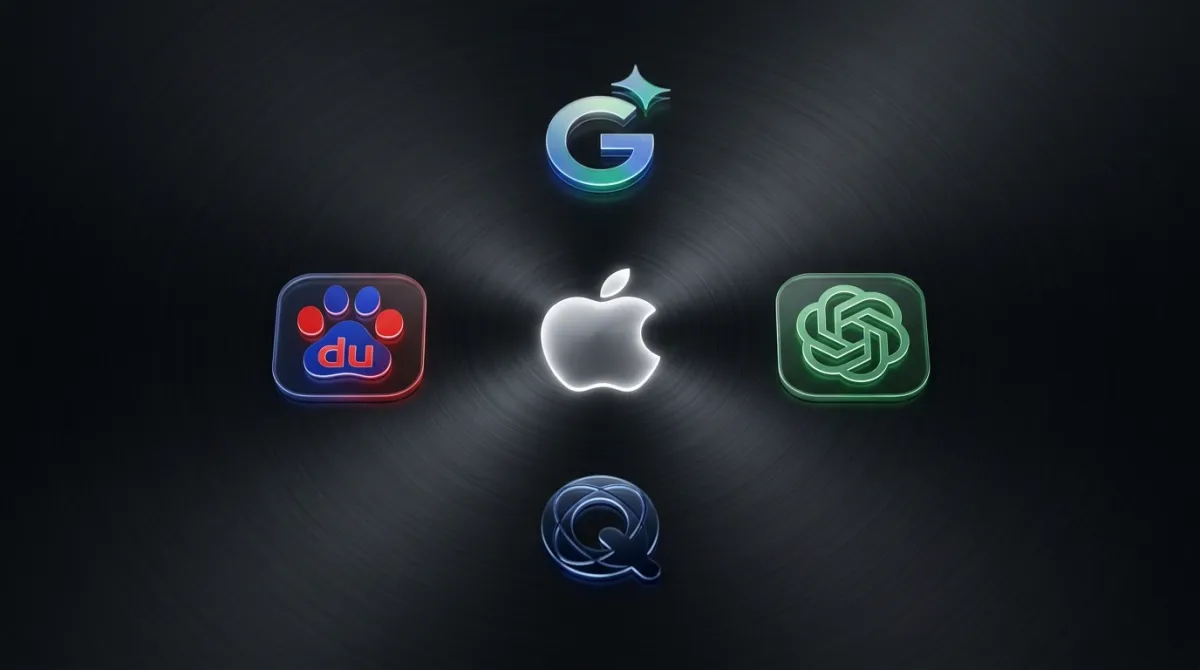
On September 9, Apple held its fall event in Cupertino and introduced the iPhone Duo, Siri AI, and a new AI strategy. The company doesn't make frontier models. It makes the layer that decides which model runs where. The Apple Foundation Models are a hybrid: on-device self-developed, cloud-based Gemini-customized, ChatGPT as an extension, and in China, Alibaba's Qwen and Baidu. Apple's job is not to build the best model. It's to decide which model reaches which user—under which privacy rules and which regulatory regime.
Apple is not trying to win the model race. It is trying to win the distribution race.
Four Models, One Experience—Apple's Hybrid Stack
Apple's Foundation Models are a four-layer hybrid. On-device, the AFM Core handles basic AI tasks and the AFM Core Advanced handles native multimodal and complex local workloads. In the cloud, the AFM Cloud series—custom-built with Google's Gemini technology—handles high-load requests, image generation, and agentic tools. For external capabilities, ChatGPT is an optional extension for Siri, writing tools, and visual intelligence. In China, Alibaba's Qwen and Baidu provide localized support.
Apple is careful about how it describes this. The company says the Foundation Models are "custom-built in partnership with Google and its Gemini models," but it emphasizes that the final product is "Apple code, Apple data systems." Users don't directly interact with Google code or Gemini agents.
The privacy architecture is the differentiator. On-device processing keeps personal data local. Private Cloud Compute handles the rest, with Apple promising that personal data is "not stored and not accessible to Apple or anyone else." The model layer is heterogeneous. The privacy layer is Apple's own.
Siri Became an Agent—System-Level, Not App-Level
Siri AI's core upgrade is not that it's smarter. It's that it can act. The three capabilities that matter—personal context understanding, screen content recognition, and App Intents cross-app operations—combine to turn Siri from a question-answering tool into a task-executing agent.
Siri AI will support 16 languages, including Simplified Chinese, but launches first in English beta. French, Japanese, and Korean follow in October. The personal context feature retrieves information across Messages, Mail, and Photos. Screen awareness identifies what's currently on screen and acts on it. App Intents connects to roughly 300,000 apps at launch. A standalone Siri app syncs conversation history across devices via iCloud.
This is Apple's version of agentic AI. It's system-level, not app-level. Siri doesn't live in a separate app—it lives in the operating system. The agent isn't a product. It's a layer.
The US Gets Gemini. China Gets Qwen. Siri AI Gets Neither.
Apple's AI strategy is splitting into two systems. The US version relies on Gemini-customized cloud models and optional ChatGPT. The China version relies on Alibaba's Qwen and Baidu. Siri AI launches first in English—and does not support mainland China or the EU at launch.
The feature restrictions reinforce the divide. Apple Reference Image, which preserves verifiable original information for camera captures, and SynthID support for identifying AI-generated content are both unavailable in the EU and China. Apple attributes the EU limitations to regulatory disputes over the Digital Markets Act.
China's Apple Intelligence has cleared regulatory registration—"Apple Smart" completed generative AI service filing in July—but the launch date remains unannounced. Users in China will access Qwen through Apple Intelligence for Siri queries and writing tools. They will not get Siri AI.
The global AI experience is no longer uniform. Apple's US users get one model stack. Its Chinese users get another. And Siri AI, the centerpiece of the announcement, is absent from both major markets outside the US.
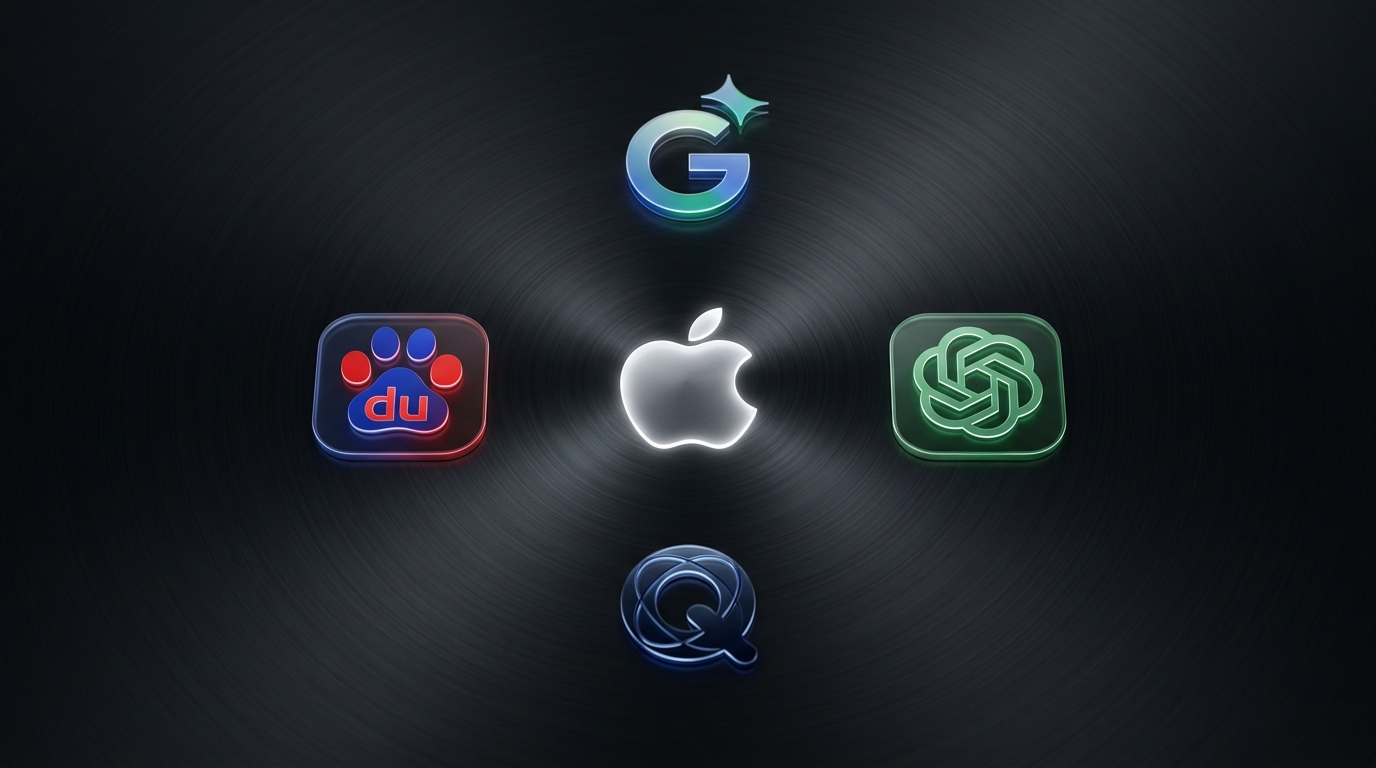
Apple's AI strategy is not "build the best model." It's "orchestrate the best available models within privacy and regulatory boundaries." The company controls the chip, the operating system, and the privacy architecture. It lets Google, OpenAI, Alibaba, and Baidu compete for the model layer.
The strategy has a cost. Global users won't get the same AI. The US gets Gemini and ChatGPT. China gets Qwen and Baidu. The EU gets restrictions. And Siri AI, the most significant AI feature Apple has shipped, is available only in English at launch.
Apple isn't losing the AI race. It's redefining what winning looks like—less about who has the best model, more about who controls where the model runs. The company is betting that distribution, privacy, and system integration matter more than model ownership.
P.S. The A20 Pro's dual 16-core Neural Engine delivers twice the AI processing power of the A19 Pro. That's the hardware bet: keep as much AI on-device as possible, so the cloud layer matters less. But Siri AI's most advanced features—personal context, screen awareness, cross-app actions—still rely on Private Cloud Compute. Apple's privacy story is real. Its on-device story is incomplete.
Frequently Asked Questions
Q: What are Apple's Foundation Models?
A: Apple's Foundation Models are a hybrid system: on-device AFM Core for basic tasks, AFM Core Advanced for complex local workloads, cloud-based AFM Cloud (custom-built with Google Gemini technology) for high-load requests, and ChatGPT as an optional extension. In China, Alibaba's Qwen and Baidu provide localized support.
Q: Does Apple build its own AI models?
A: Apple builds the on-device models and the orchestration layer that decides which model runs where. The cloud models are custom-built with Google's Gemini technology. In China, Apple uses Alibaba's Qwen and Baidu. Apple's role is distribution and privacy, not frontier model development.
Q: What can Siri AI do?
A: Siri AI can understand personal context (retrieving information across Messages, Mail, and Photos), recognize screen content, and perform cross-app operations through App Intents, supporting roughly 300,000 apps at launch. A standalone Siri app syncs conversation history across devices.
Q: When is Siri AI available?
A: Siri AI launches first in English beta. French, Japanese, and Korean follow in October. It supports 16 languages, including Simplified Chinese, but does not support mainland China or the EU at launch.
Q: Why doesn't Siri AI launch in China or the EU?
A: Apple attributes the EU limitations to regulatory disputes over the Digital Markets Act. China's Apple Intelligence has cleared regulatory registration but the launch date remains unannounced. Users in China will access Qwen through Apple Intelligence, not Siri AI.
Q: What is Apple's AI strategy?
A: Apple's strategy is not to build the best model. It's to orchestrate the best available models within privacy and regulatory boundaries. Apple controls the chip, the operating system, and the privacy architecture. It lets Google, OpenAI, Alibaba, and Baidu compete for the model layer.
Q: What is the A20 Pro's AI capability?
A: The A20 Pro chip features a dual 16-core Neural Engine, delivering twice the AI processing power of the A19 Pro. It powers on-device AI tasks, while more complex features rely on Private Cloud Compute.
Q: What features are unavailable in the EU and China?
A: Apple Reference Image (preserving verifiable original information for camera captures) and SynthID support (identifying AI-generated content) are unavailable in the EU and China. Apple attributes the EU limitations to regulatory disputes.
Q: How does Apple's AI strategy differ from OpenAI's?
A: OpenAI builds frontier models and sells API access. Apple builds the distribution layer—the chip, OS, and privacy architecture that decides which model runs where. Apple doesn't compete on model quality. It competes on integration and privacy.
Q: What does Apple's AI strategy mean for users?
A: Global users won't get the same AI. US users get Gemini and ChatGPT. Chinese users get Qwen and Baidu. EU users get restrictions. Siri AI, the centerpiece of the announcement, is available only in English at launch. Apple's AI experience is no longer uniform across markets.