
On July 24, Anthropic released Claude Opus 5. It costs the same as Opus 4.8: $5 per million input tokens, $25 per million output. Its performance in several key benchmarks matches or exceeds Fable 5 — the flagship model that costs twice as much at $10/$50.
In Frontier-Bench v0.1, Opus 5 scored 43.3% to Fable 5's 33.7%. In GDPval-AA, Opus 5 scored 1,861, ahead of Fable 5's 1,747.
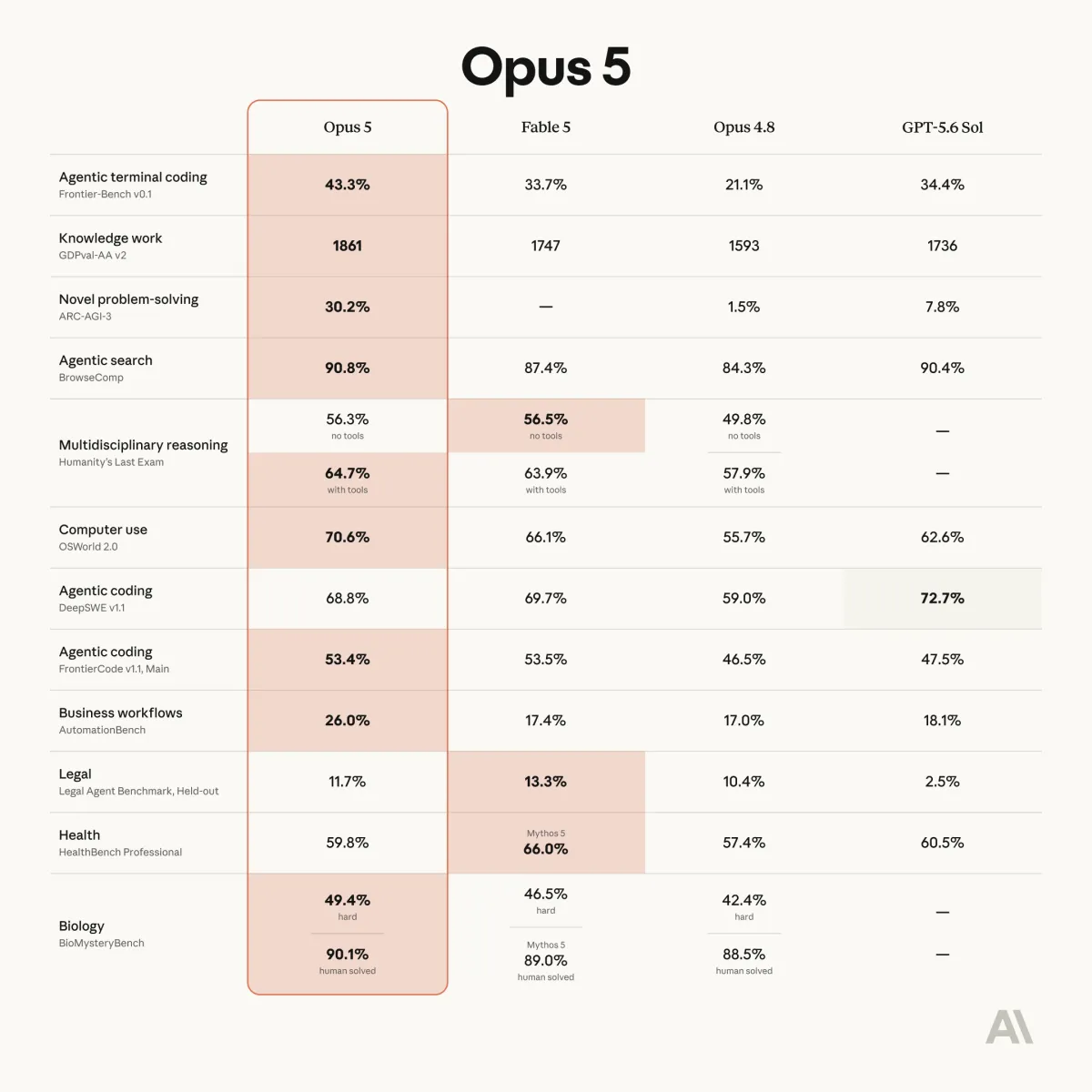
The ARC-AGI-3 numbers are the most striking. Opus 5 scored 30.2% — nearly four times higher than GPT-5.6 Sol's 7.8%, and twenty times higher than Opus 4.8's 1.5%. This benchmark measures the ability to solve problems the model has never seen before. The jump quantifies the shift from pattern matching toward independent reasoning.
On CursorBench 3.2, Opus 5 at maximum reasoning strength falls just 0.5% behind Fable 5 — at half the cost per task. On OSWorld 2.0, Opus 5 beats Fable 5's best score at roughly one-third the cost.
Anthropic describes Opus 5 as its "most aligned model" — the least deceptive behavior, the hardest to jailbreak. Its overall misalignment score of 2.3 is the lowest in Anthropic's recent lineup. The model also introduces configurable "effort" settings. Users can trade reasoning depth for token efficiency. Even at the lowest setting, Opus 5 completes more tasks than any other model.
When Fable 5 launched on June 9, it justified its premium price. Forty-five days later, Opus 5 matches or beats it in the benchmarks that actually matter to users — at less than half the cost. Anthropic chose to undercut itself rather than wait for competitors to do it. Opus 5 injects flagship-level capability into the mid-tier product line, directly countering the pricing pressure from open-source models like Kimi K3. Fable 5 holds the "extreme reasoning" niche, but Opus 5 owns the volume.
P.S. If you are a developer, Opus 5 means you can use near-flagship capability without increasing your budget. If you are an enterprise buyer, the model raises a more fundamental question: when a secondary model outperforms the flagship in most daily scenarios, what exactly are you paying the flagship premium for?
Frequently Asked Questions
Q: How does Claude Opus 5 compare to Fable 5?
A: Opus 5 matches or exceeds Fable 5 in most benchmarks — scoring 43.3% vs 33.7% on Frontier-Bench, 70.6% vs 66.1% on OSWorld 2.0, and coming within 0.5% on CursorBench 3.2 — all at half the price ($5/$25 vs $10/$50 per million tokens).
Q: What is ARC-AGI-3 and why does Opus 5's score matter?
A: ARC-AGI-3 measures fluid intelligence — solving entirely novel problems with no instructions. Opus 5 scored 30.2%, nearly four times GPT-5.6 Sol's 7.8% and twenty times Opus 4.8's 1.5%. It is the strongest signal yet that AI is moving from pattern matching toward independent reasoning.
Q: Should I use Opus 5 or Fable 5 for coding?
A: Default to Opus 5 for most coding work. Its CursorBench 3.2 score sits within 0.5% of Fable 5 at half the cost, and it beats Fable 5 on OSWorld 2.0 at one-third the cost. Reserve Fable 5 for vision-heavy tasks, FrontierCode, and long-context work spanning millions of tokens.
Q: What are Opus 5's effort settings?
A: Opus 5 introduces configurable reasoning depth. Higher effort delivers maximum intelligence, while lower effort is faster and cheaper per token. At the lowest effort setting, Opus 5 still completes more tasks than any other model.
Q: Where does Fable 5 still beat Opus 5?
A: Fable 5 retains a narrow lead on DeepSWE v1.1 (69.7% vs 68.8%), Legal Agent Benchmark (13.3% vs 11.7%), and state-of-the-art vision and long-context memory tasks. Its FrontierCode score is a near-tie at 53.5% vs 53.4%.
Q: Is Opus 5 safer than Fable 5?
A: Anthropic describes Opus 5 as its most aligned model — the lowest misalignment score (2.3) in its recent lineup and the hardest to jailbreak. Its cybersecurity classifiers are 85 percent less restrictive than Fable 5, so teams hitting false-positive refusals on legitimate work will find Opus 5 more practical.
Q: Why did Anthropic release a model that undercuts its own flagship?
A: Because open-weight models like Kimi K3 are exerting downward pricing pressure. Anthropic chose to cannibalize itself before competitors did. Fable 5 retains the extreme-reasoning niche, while Opus 5 owns the volume — injecting flagship-level capability into the product line most developers actually use.
Q: How much does Claude Opus 5 cost?
A: Five dollars per million input tokens, twenty-five dollars per million output tokens — the same as Opus 4.8. That is exactly half of Fable 5's pricing at ten dollars per million input and fifty dollars per million output.