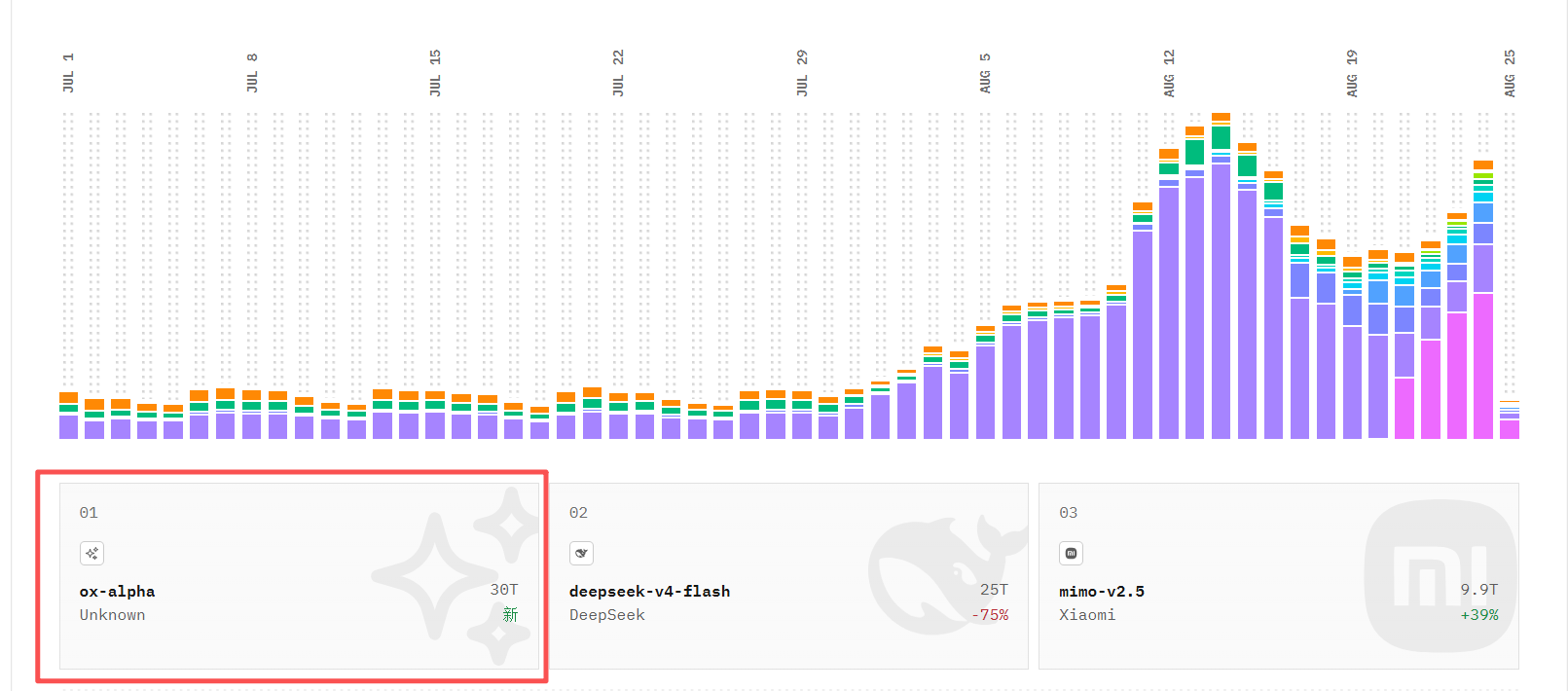
On August 20, a model called Ox Alpha appeared on OpenRouter with no name, no provider, and no price tag. By August 24, it had attracted over 260,000 developers, processed 20 trillion tokens, and tied DeepSeek V4 Flash for the top spot on OpenRouter's weekly token volume charts. Stripe CEO Patrick Collison called it "very impressive." The only thing missing is anyone willing to claim it.
Ox Alpha is a "stealth model"—an anonymous preview released by an unnamed third-party provider. Its specs are aggressive: about 1.05 million tokens of context window, up to 131,000 tokens of output, support for text, image, and video input, and native tool calling. It was made free for one week, with OpenCode preparing 100 trillion tokens of daily capacity.
The hook is simple: here is a powerful model. Try it. Tell us what you think. We'll tell you who we are later.
80% on 10 Tasks. 63% on 100. The Gap Matters.
The initial buzz came from a small test. Developer Ben Davis ran Ox Alpha on 10 DeepSWE software engineering tasks, where the model must read a codebase, locate bugs, write patches, and pass tests. Ox Alpha passed eight—an 80% pass rate. Claude Fable 5 scored 65%; GPT-5.6 Sol scored 52%.
The problem is sample size. Ten tasks are barely enough to measure anything. A single task passing or failing shifts the score by 10 percentage points. When other developers ran larger DeepSWE subsets, Ox Alpha's score settled around 63%—closer to Claude Opus 4.8 than to any decisive victory over Fable 5.
On pure reasoning benchmarks like INDUCTION, Ox Alpha fell behind GPT-5.6 Luna and DeepSeek V4 Pro, landing just above Gemini 3.7 Flash. The model is strong. It is not the breakthrough the early numbers suggested.
The Fingerprints Point to Z.ai. The Silence Is Telling.
The community has converged on one suspect with high confidence: Z.ai (formerly Zhipu AI). The evidence is technical.
Tokenizer analysis showed a constant 75-token difference between Ox Alpha and Zhipu's GLM-5.3 across 25 prompts. Video encoding tests matched GLM-5V-Turbo token-for-token, while MiMo, Qwen, and GLM-4.6V showed different patterns. One researcher ran 95 language and code test prompts—every one matched Zhipu's GLM vocabulary exactly. A Java stack trace pointed to Z.ai infrastructure. Error code 1214 matched their API.
The history supports the guess. In February, Zhipu anonymously released "Pony Alpha" on OpenRouter, later confirmed as a GLM-5 test version. In its GLM-5 technical report, Zhipu called this a "blind test"—a deliberate attempt to let the model be judged on capability alone, without brand bias.
But tokenizer matches don't prove model identity. They point strongly toward Zhipu's GLM-5 family, but Zhipu has not confirmed. Google DeepMind researchers have also hinted Ox Alpha could be Gemini-related. As of now, there is no official answer.
Stealth Launches Are the New Press Release
Ox Alpha is the fifth stealth model to appear on OpenRouter in six months. Pony Alpha (Zhipu), Hunter Alpha (Xiaomi MiMo), Elephant Alpha (Ant Group), HappyHorse (Alibaba)—all followed the same pattern: anonymous release, community speculation, eventual recognition.
The strategy is deliberate. A branded model launch relies on press releases and benchmark claims. A stealth model generates organic buzz by being discovered. Developers get curious. They test it. They post results. They argue about who built it. The speculation phase extends the news cycle far longer than a traditional announcement.
The anonymity also serves a practical purpose: it lets the team iterate without the pressure of a formal product announcement. If the model has issues, those can be addressed before the official launch. If it performs well, the team can build momentum.
Who Owns Your Code When No One Owns the Model?
For developers, using Ox Alpha means trusting an unknown provider with their code. The model is free, but enterprises must decide whether to feed proprietary code to an unnamed system. Data retention policies are unclear—OpenRouter states prompts and completions are retained by the provider but not used for training. For companies with strict data governance, that may not be enough.
The provider also faces a strategic choice. Claiming the model publicly ends the speculation and builds brand recognition. But it also invites direct comparison to competitors like DeepSeek and Qwen, which already have established communities. Staying anonymous keeps the focus on the model, not the brand—but that focus is temporary.
What It Means
Ox Alpha's appearance is part of a broader shift in how AI models are introduced. Traditional launches rely on controlled messaging. Stealth releases rely on distributed trust—the community validates the model through use, not through a company's press release.
The bet is that if the model is strong enough, developers will adopt it regardless of who built it. Ox Alpha's 260,000 users in four days suggest that bet has paid off. What remains unclear is whether the provider can convert that initial interest into long-term adoption once the anonymity is lifted.
P.S. The 80% DeepSWE number was a rallying cry. The 63% number is closer to the truth. But neither number matters as much as the fact that 260,000 developers tried an anonymous model in four days. The model is strong. The timing is right. The only question left is who is brave enough to say "this is ours."
Frequently Asked Questions
Q: What is Ox Alpha?
A: Ox Alpha is an anonymous AI model that appeared on OpenRouter on August 20, 2026, with no named provider, no official release announcement, and no price tag (free for one week). It supports text, image, and video input with a context window of about 1.05 million tokens and native tool calling.
Q: Is Ox Alpha actually good?
A: Yes, but the early "beats Fable 5" narrative was based on a small sample. On 10 DeepSWE tasks, Ox Alpha passed 8 (80%). On larger 100+ task runs, the score settled around 63%—closer to Claude Opus 4.8 than to Fable 5. It's a strong model, but not a clear frontier breakthrough.
Q: Who built Ox Alpha?
A: The strongest evidence points to Z.ai (formerly Zhipu AI). Tokenizer analysis, video encoding patterns, API error codes, and infrastructure traces all match Zhipu's GLM-5 family. However, Zhipu has not officially confirmed, and some Google DeepMind researchers have hinted it could be Gemini-related.
Q: Why would a company release a model anonymously?
A: Anonymous releases generate organic buzz. Developers test the model, share results, and speculate about its origin—often generating more attention than a traditional press release. It also allows teams to iterate without the pressure of a formal product announcement.
Q: How many developers tried Ox Alpha?
A: Over 260,000 developers in its first four days, processing more than 20 trillion tokens. It tied DeepSeek V4 Flash for the top spot on OpenRouter's weekly token volume charts.
Q: Is Ox Alpha safe for enterprise use?
A: Data retention policies are unclear. OpenRouter states prompts and completions are retained by the provider but not used for training. For companies with strict data governance, using an anonymous model with no clear data policy is a significant risk.
Q: What is a "stealth model"?
A: A stealth model is a model released anonymously on platforms like OpenRouter or Hugging Face, with no named provider. The team behind it remains unknown until the company chooses to claim the model—or the community uncovers its identity through technical fingerprints.
Q: What are the security concerns around anonymous models?
A: Enterprise developers feeding proprietary code to an unnamed system with unclear data handling policies face potential data leakage risks. The 46% tool-call failure rate (in one community test) also raises reliability concerns.
Q: What is the "stealth model" pattern?
A: Ox Alpha is the fifth stealth model on OpenRouter in six months, following Pony Alpha (Zhipu), Hunter Alpha (Xiaomi), Elephant Alpha (Ant Group), and HappyHorse (Alibaba)—all later confirmed to be from major Chinese AI labs. The pattern may become a standard playbook for AI model launches.
Q: What happens next?
A: The provider must eventually claim the model. The question is whether the 260,000 developers will stay engaged once the anonymity is lifted, or whether the "mystery" was the main attraction.