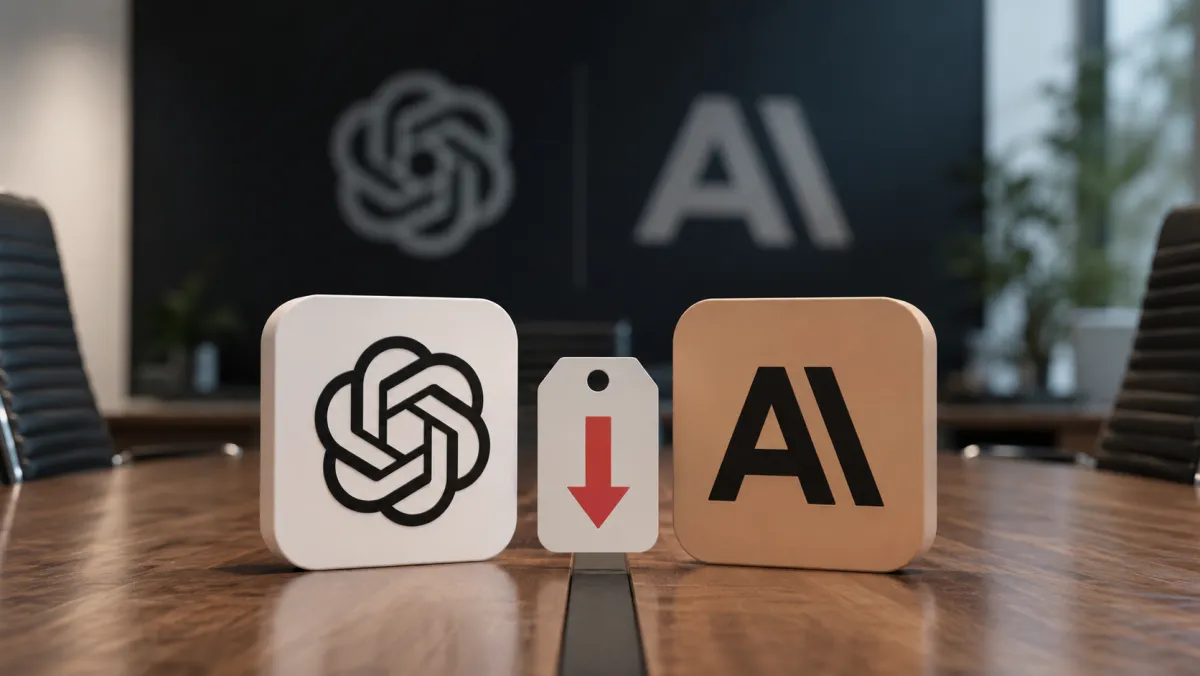
On August 21, OpenAI cut GPT-5.6 Sol API prices by more than 20% for the next three months: input tokens drop from $5 to $4 per million, output tokens from $30 to $20 per million . This is OpenAI‘s second price cut in a month—Luna, its low-cost model, was slashed 80% in July, while mid-tier Terra dropped 20% .
Google followed by pricing Gemini 3.7 Flash at half its predecessor’s rate, with the discount lasting until January 2027 . And Anthropic, which had planned to raise Sonnet 5 prices by 50% on September 1, canceled the increase entirely—keeping the launch price as the permanent rate .
The price war isn‘t a convergence of independent decisions. It’s a cascade triggered by one reality: customers are no longer defaulting to the most expensive model.
The Frontline: OpenAI vs. Anthropic
The battle lines were drawn in July. On July 9, OpenAI launched GPT-5.6 Sol at $5 input, $30 output per million tokens—input priced at half of Anthropic‘s Fable 5 . Two weeks later, Anthropic countered with Claude Opus 5: $5 input, $25 output, exactly half of Fable 5’s pricing .
Anthropic framed it as “half the price, near-frontier intelligence.” On CursorBench 3.2, Opus 5‘s top score trailed Fable 5 by just 0.5% but cost half as much per task . On OSWorld 2.0, Opus 5 beat Fable 5’s best performance while costing about a third as much .
This wasn‘t a discount. It was a restructuring of the value proposition: “You don’t need to pay for the flagship to get frontier-level results.”
Chinese AI Models Forced the Price War
Silicon Data shows that since mid-July, token prices paid to major U.S. AI models have dropped by nearly a quarter . The reason is Chinese open-weight models.
OpenRouter data shows Chinese models now account for roughly 63.5% of global token volume, with U.S. models holding just 35.5%. DeepSeek V4 Flash runs at $0.28 per million output tokens—1/105th of Anthropic‘s Fable 5 . Alibaba’s Qwen family has crossed 2 billion downloads on Hugging Face . Developers described the choice as “buying a house” with Chinese models versus “renting” with American ones.
A researcher at Chinese investment bank Zhongtai Securities summarized the dynamic: “OpenAI and Google are cutting prices to defend share. Chinese companies are raising prices to capture value.” The U.S. is playing defense.
Why Enterprises Stopped Buying the Best
The price war is driven by a deeper change: enterprises no longer default to the most powerful model available.
When AI enters workflows—multiple turns, tool calls, agent coordination—token costs compound into real operational budgets. Uber’s CTO disclosed that the company burned through its entire annual AI budget in four months . WPP’s CEO said the company now has more AI agents than employees, and much of the token spend never made it into the original budget .
The purchasing logic has shifted from “highest benchmark score” to “successful task unit cost.” OpenAI began emphasizing “Useful Intelligence per Dollar” around the launch of GPT-5.6 . The metric that matters now is not who scores highest, but who delivers completed work at the lowest cost.

The Commoditization of Models
Enterprise DNA, a consulting firm focused on AI deployment, noted that the speed of U.S. price cuts “could reshape the frontier AI model market” . Just half a year ago, frontier models commanded a premium; now they feel more like an infrastructure commodities race .
As token budgets tighten and leading models converge in performance, the industry is approaching a consensus: models are interchangeable. Customers are already routing queries based on daily price quotes—OpenAI’s brand loyalty is eroding . For dominant players, scale and operating efficiency matter more than novelty.
The window for high-margin AI businesses is closing. Price wars compress margins, and the cost of training the next generation of models isn’t falling as fast. But for enterprises building on AI, the window to do ambitious work at lower cost is opening wider by the week.
P.S. The market hasn’t missed the implications. Tech stocks have been volatile since the price cuts, and major U.S. media have warned of a “race to the bottom.” The price war is here. The question is how long the industry can sustain it—and who will be left standing at the end.
Frequently Asked Questions
Q: What price cuts have OpenAI, Google, and Anthropic made?
A: OpenAI cut GPT-5.6 Sol output tokens from $30 to $20 per million (33%) and GPT-5.6 Luna by 80% (from $1 to $0.20). Google priced Gemini 3.7 Flash at half its predecessor's rate. Anthropic canceled a planned 50% Sonnet 5 price increase, keeping the launch price as the permanent rate.
Q: What caused the U.S. AI price war?
A: The primary driver is competition from Chinese open-weight models, which offer comparable performance at much lower prices. OpenRouter data shows Chinese models now account for roughly 63.5% of global token volume, while U.S. models hold just 35.5%. DeepSeek V4 Flash costs 1/105th of Anthropic's Fable 5.
Q: Which companies cut prices first?
A: OpenAI launched the price war with GPT-5.6 Sol on July 9, pricing input at half of Anthropic's Fable 5. Anthropic countered two weeks later with Claude Opus 5 at half of Fable 5's pricing. Google and Anthropic followed with their own cuts.
Q: How much cheaper are Chinese models?
A: DeepSeek V4 Flash runs at $0.28 per million output tokens—approximately 1/105th of Anthropic's Fable 5 ($50). Alibaba's Qwen family has crossed 2 billion downloads on Hugging Face, indicating widespread adoption.
Q: Why are enterprises moving away from flagship models?
A: Token costs compound in multi-turn workflows and agent systems—they become real operational budgets. The metric that matters now is not benchmark scores but "successful task unit cost." A researcher noted: "When token budgets are no longer unlimited, price becomes the primary decision factor."
Q: What is the "commoditization" of AI models?
A: As model capabilities converge and prices drop, enterprises increasingly treat models as interchangeable commodities—routing queries based on daily price quotes rather than brand loyalty. The industry is approaching a consensus that "models are interchangeable."
Q: How does OpenAI's price cut impact Anthropic?
A: OpenAI's Sol price cut puts direct pressure on Anthropic's Fable 5, which is priced higher. Anthropic responded by canceling a planned Sonnet 5 price increase and launching Opus 5 at half of Fable 5's pricing.
Q: What does the price war mean for AI startups?
A: Price compression squeezes margins and makes it harder to justify high-cost training runs. Large players can absorb price cuts through scale and cloud subsidies; smaller model providers may struggle to compete on cost.
Q: What is the "race to the bottom"?
A: U.S. media and analysts have warned that aggressive price cuts could lead to a "race to the bottom" where margins become unsustainable. The trend is likely to continue: enterprise adoption of AI is already at a high level and token demand is growing, but customers now expect lower prices.
Q: What is the long-term outlook for AI pricing?
A: The price war is not finished. Enterprise expectations have reset: customers now expect lower prices and the premium era for frontier AI models is ending. The industry is entering a period of sustained price competition.