Meta launched Muse Code on August 5. It's a terminal-based coding agent, powered by Muse Spark 1.2, designed to handle "complete software engineering tasks across large repos," according to CEO Mark Zuckerberg .
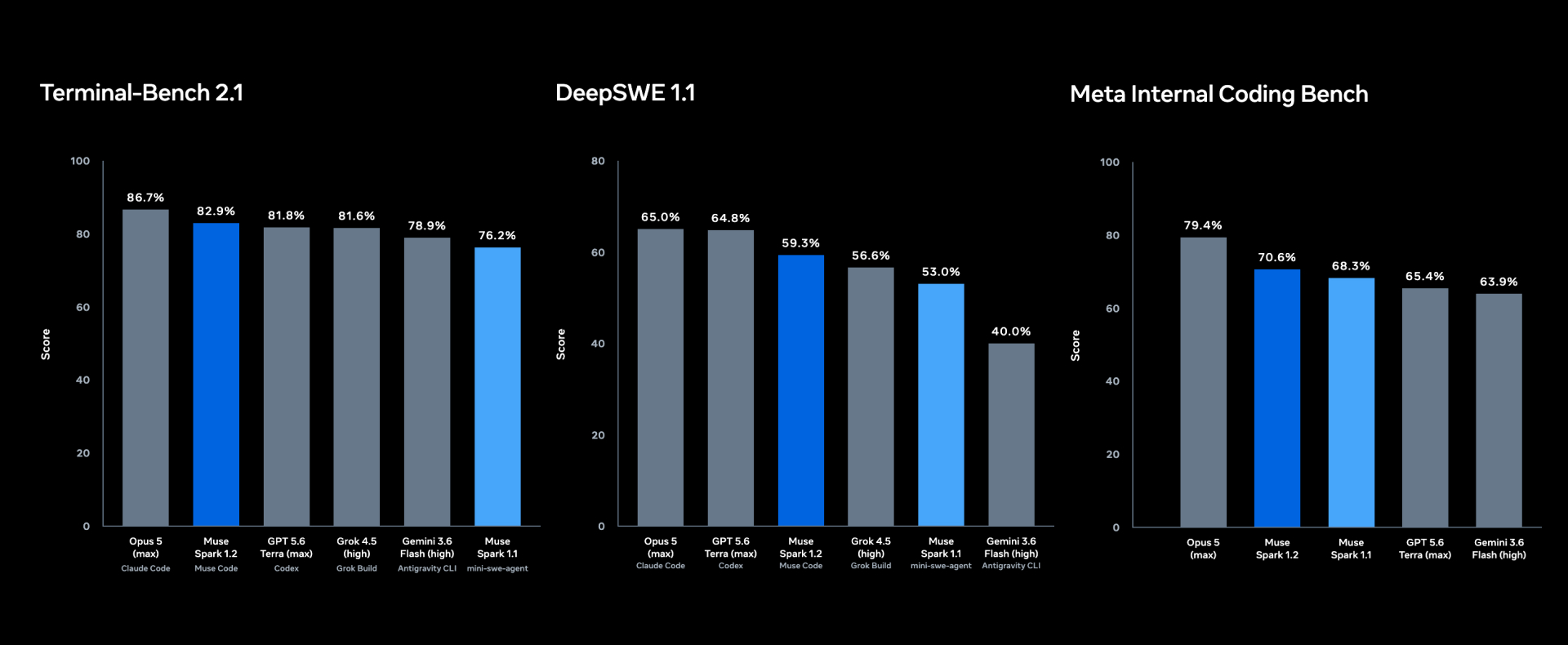
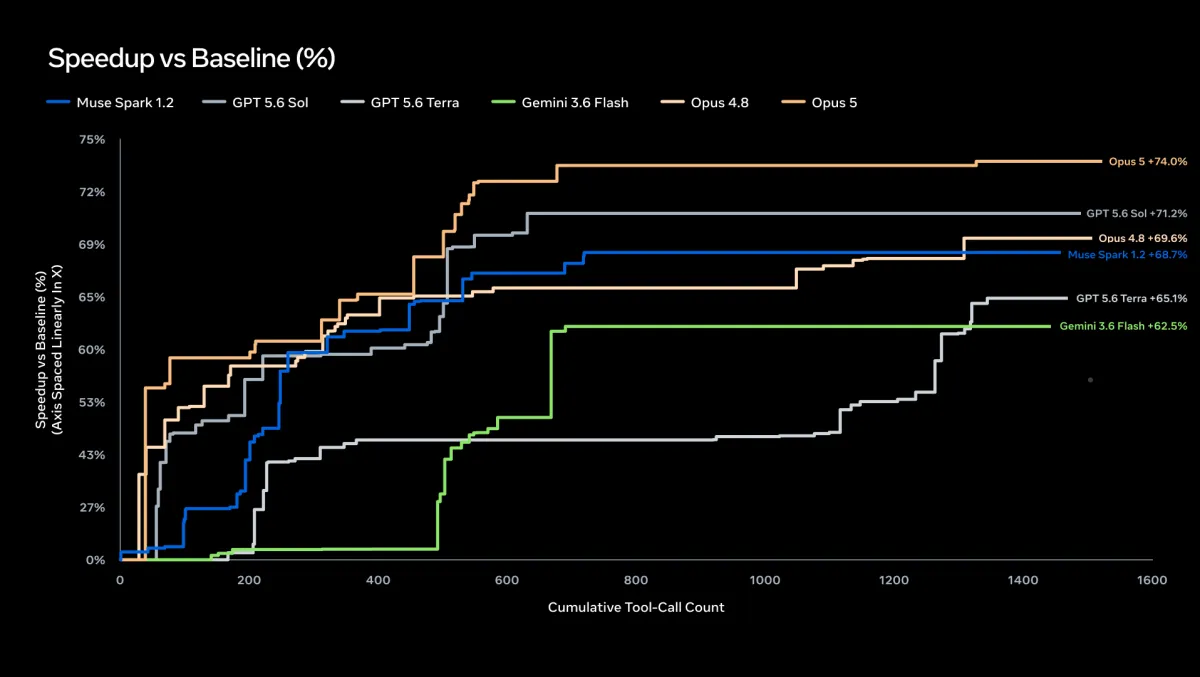
The benchmarks are middling. On TerminalBench 2.1, Muse Spark 1.2 scored 82.9% — better than OpenAI's Codex (81.8%), but behind Anthropic's Claude Code (86.7%). On DeepSWE 1.1, it scored 59.3%, behind both Claude Code (65.0%) and Codex (64.8%) .
Meta's AI chief Alexandr Wang was candid: "We think that for a lot of workflows and a lot of use cases, this can be an incredibly good option, especially from a cost perspective" .
That's the real story. Not the performance. The price.
The Price Is the Product
Muse Code's standard pricing matches Muse Spark 1.2's API rates: $1.25 per million input tokens and $4.25 per million output tokens .
But the "contributor tier" changes the math entirely. Users who agree to let Meta use their prompts and completions for model training pay $0.10 per million input tokens and $0.20 per million output tokens — over 20 times cheaper than the standard tier .
For context, Anthropic's Claude Sonnet 5 charges $15 per million output tokens. OpenAI's Codex is bundled with ChatGPT subscriptions, making direct comparison difficult, but the per-token economics are significantly higher .
Meta is betting that developers will trade data for dollars. The tool is good enough, and the price is low enough, that the trade-off becomes rational.
The Architecture
Muse Code handles large projects by launching sub-agents in parallel, working in isolated worktrees . Zuckerberg claimed that in testing, it built six features for a game simultaneously with "no collisions" .
The tool keeps a log of its actions, so it can resume after a crash rather than restart .
That's a practical feature that addresses a real pain point: long-running agent sessions that fail near completion.
The Zero-Data Retention Signal
Meta also announced it is "beginning to accept zero-data retention requests" — meaning it won't retain developer data for model improvement . Wang called this "a large enterprise feature that is important to many people" .
This is significant for a company whose core business model is built on user data. Meta is signaling that it understands enterprise trust requires separation between its advertising business and its developer tools.
Why This Matters
Meta is not trying to beat Claude Code or Codex on capability. It's trying to be cheap enough that developers try it, and good enough that some stay.
The contributor tier is a data acquisition strategy disguised as a discount. Meta needs real-world coding data to improve Muse Spark. It's paying developers in token credits for training data.
The question is whether developers will accept the trade-off. For hobbyists and small teams, $0.20 per million tokens is cheap enough to experiment. For enterprises with proprietary code, the standard tier is a safer bet — but still cheaper than Anthropic's models.
P.S. Meta's Muse Code strategy is the same as its Muse Image strategy: flood the market with a "good enough" product at a disruptive price, collect usage data, and improve. The difference is that coding agents have higher switching costs than image generators. Developers who build workflows around Muse Code may not leave — even when prices rise. That's the real bet.