On August 28, Tencent released Hy4 preview, its latest open-source large language model. The specs: 770B total parameters, 49B activated, 1M context length. Open-source. Free to download. Already live in WorkBuddy, CodeBuddy, Yuanbao, and ima.
The release is methodical. Tencent has been iterating Hy roughly every two months since rebuilding its infrastructure in February. Hy4 preview is the latest step. This is not a one-off release. It is a rhythm.
295B to 770B in Six Months—and the Gap Is Closing
The numbers tell a simple story. Hy3 was 295B total parameters. Hy4 preview is 770B—2.6x larger. Activated parameters doubled from 24B to 49B. Context length jumped to 1M. Each iteration is not just larger—it is a step function in capability.
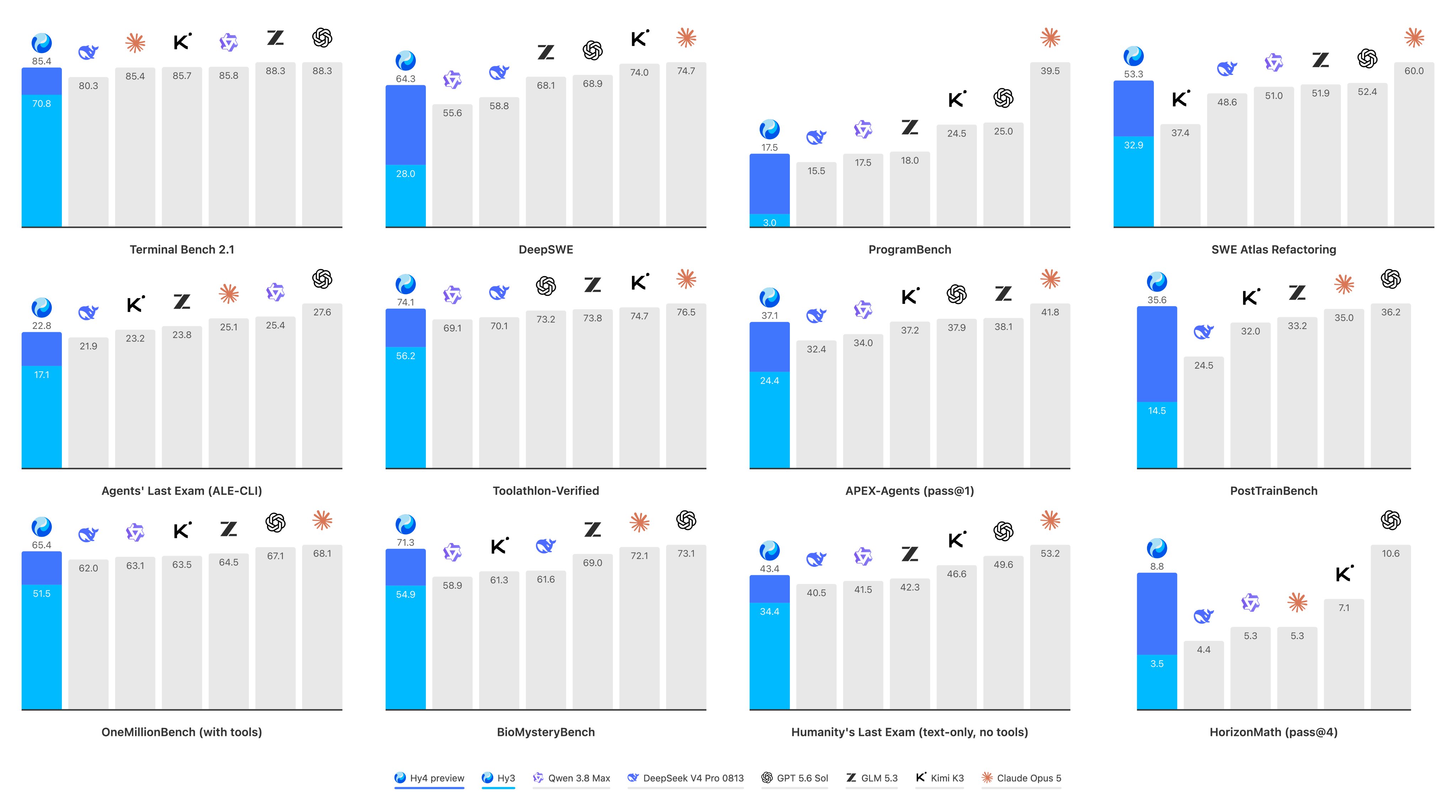
The benchmark results show real progress. On Terminal Bench 2.1, Hy4 preview scored 85.4—14.6 points higher than Hy3, surpassing DeepSeek V4 Pro and tying Claude Opus 5. On DeepSWE, it jumped from 28.0 to 64.3, more than doubling its software engineering capability. On Toolathlon-Verified, it scored 74.1, surpassing Qwen 3.8 Max and GPT-5.6 Sol.
Internal blind tests with 163 Tencent experts and 203 engineering tasks confirmed the gains: Hy4 preview scored 2.99/4.00, slightly ahead of GLM 5.3 (2.92) and Kimi K3 (2.94).
The architecture is distinctive: MoE with 256 routed experts, 49B activated per token, Gated DeepSeek Sparse Attention with IndexCache, and iHC residual connections. It is not the biggest model on the market. But it is the biggest model Tencent has released—and it arrived six months after the last one.
Hy4 Helped Build Hy4. The Recursive Loop Has Started.
The most unusual detail in the release is this: Hy4 preview participated in its own development. Tencent says the model contributed to training methods, data strategy, evaluation systems, and operator optimization across the full R&D pipeline. It proposed solutions, ran experiments, and iterated on results. The code, logs, and feedback fed back into the next round.
This is not full recursive self-improvement. But it is an early version of the loop Ilya Sutskever's SSI is betting on—models that can change themselves. Hy4's version is contained: it optimized its own inference infrastructure. The model identified bottlenecks in the inference system, proposed operator fusion and communication optimizations, and delivered a 31.8% end-to-end throughput improvement across different context lengths and concurrency levels.
The significance is not the number. It is the direction: Tencent is building models that can help build the next version of themselves.
Live in Tencent Products. $0.83/M Tokens.
Hy4 preview is not a research project. It is already live. The model is integrated into WorkBuddy and CodeBuddy, Tencent's AI assistants for software development and office productivity. The company claims it can generate a playable game prototype from a single sentence, build a full Unity demo, and create complex front-end projects.
One demo shows Hy4 preview generating a Google earnings page in WorkBuddy—taking 17 minutes to deliver a structured summary with tables, charts, and annotations. Another shows it auditing 72 documents for invoice compliance, pulling the relevant rule from three regulatory documents, and making a determination. In game development, it uses MCP to connect to Unreal Engine 5 and build a shooter demo purely through conversation.
The pricing is aggressive: 6 yuan per million input tokens, 18 yuan per million output tokens, 0.3 yuan for cached hits. That is roughly $0.83/$2.50 per million tokens on OpenRouter. At that price, the barrier to trying Hy4 preview is negligible.
The Two-Month Release Rhythm Is the Real Threat
Tencent's iteration speed is the signal that matters most. Since February, the company has been releasing major Hy versions every two months. Hy4 preview is the third iteration. If the pattern holds, Hy4's full release and Hy4.1 are coming soon.
The strategy is clear: release early, release often, collect real-world feedback, iterate. This is the opposite of the "big release every 12-18 months" cadence that defines OpenAI and Anthropic. Chinese AI labs are not trying to beat the frontier with a single breakthrough. They are trying to beat it by iterating faster.
Hy4 preview is not the best model on the market. It is the fastest-improving model in its weight class. And that might be the more important metric.
P.S. The model has known limitations. It still lacks native multimodality—no vision support until the full release. It is still labeled "preview," not production-ready. But the progress from Hy3 to Hy4 preview in six months is dramatic. If Tencent keeps this pace, the gap between Hy and the frontier models will shrink faster than anyone expected. The question is not whether Hy4 preview can beat Fable 5 today. It is whether Hy4.1 can beat it six months from now.
Frequently Asked Questions
Q: What is Tencent's Hy4 preview?
A: Hy4 preview is Tencent's latest open-source large language model, released on August 28, 2026. It has 770 billion total parameters, 49 billion activated parameters, and a 1 million token context window. The model is available on Hugging Face and GitHub.
Q: How does Hy4 preview compare to Hy3?
A: Hy4 preview is 2.6x larger than Hy3 (295B total parameters) and has doubled activated parameters from 24B to 49B. It scored 85.4 on Terminal Bench 2.1—14.6 points higher than Hy3—and more than doubled its DeepSWE software engineering score from 28.0 to 64.3.
Q: How does Hy4 preview perform against competitors?
A: In internal blind tests with 163 Tencent experts across 203 engineering tasks, Hy4 preview scored 2.99/4.00, slightly ahead of GLM 5.3 (2.92) and Kimi K3 (2.94). On Toolathlon-Verified, it scored 74.1, surpassing Qwen 3.8 Max and GPT-5.6 Sol.
Q: What is the "recursive self-improvement" claim?
A: Tencent says Hy4 preview participated in its own development, contributing to training methods, data strategy, and evaluation systems. The model also autonomously optimized its own inference infrastructure, delivering a 31.8% end-to-end throughput improvement by identifying bottlenecks and proposing operator fusion optimizations.
Q: What is the pricing for Hy4 preview?
A: The API pricing is 6 yuan per million input tokens, 18 yuan per million output tokens, and 0.3 yuan per million cached input tokens. On OpenRouter, this is roughly $0.83 input and $2.50 output per million tokens.
Q: What is the two-month release cadence?
A: Tencent has been releasing major Hy versions every two months since February 2026. Hy4 preview is the third iteration, following Hy3 and Hy3.1. The company appears to be using a "release early, release often" strategy to iterate faster than competitors.
Q: Is Hy4 preview production-ready?
A: It is labeled as a "preview" release, not a full production version. It also lacks native multimodality—vision support will come with the full release. However, it is already deployed in Tencent products like WorkBuddy, CodeBuddy, Yuanbao, and ima.
Q: What is the architecture of Hy4 preview?
A: Hy4 preview uses a MoE (Mixture of Experts) architecture with 256 routed experts and 49B activated parameters per token. It includes Gated DeepSeek Sparse Attention with IndexCache and iHC residual connections.
Q: What can Hy4 preview actually do?
A: Tencent claims it can generate a playable game prototype from a single sentence, build a full Unity demo, audit 72 documents for invoice compliance, and generate structured business summaries with tables and charts. It uses MCP (Model Context Protocol) to connect to external tools like Unreal Engine 5.
Q: What is the significance of the two-month cadence?
A: Chinese AI labs are iterating faster than their Western counterparts. While OpenAI and Anthropic release major models every 12-18 months, Tencent is releasing major versions every two months. The strategy is not to beat the frontier with a single breakthrough, but to close the gap through rapid iteration.