
On August 3, Alibaba released Qwen3.8-Max. 2.4 trillion parameters. 95 billion active. 1 million token context. Open weights next week.
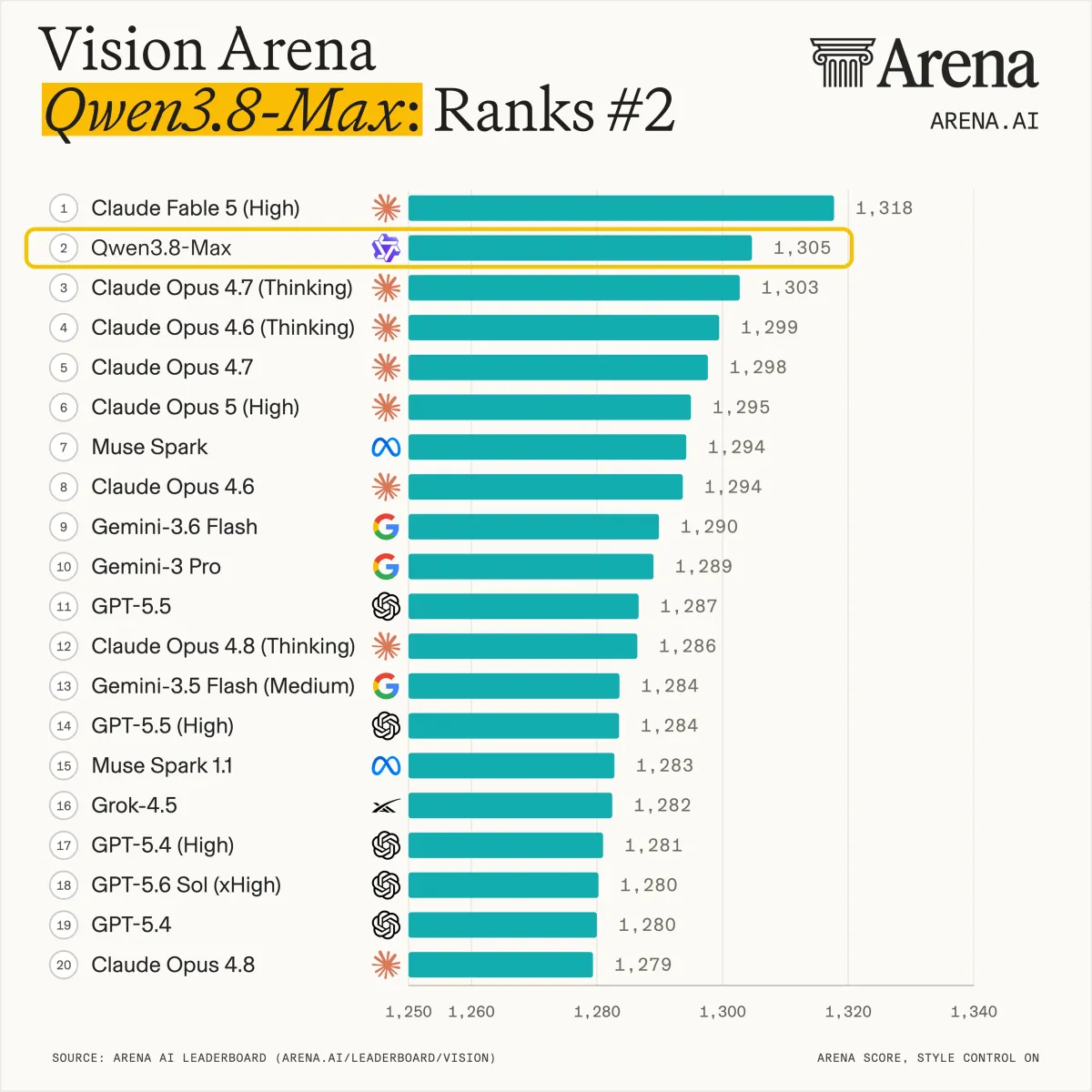
The benchmarks are strong. On PaperBench, Qwen3.8 scored 93.0, beating Anthropic's Fable 5 (88.8) and GPT-5.6 Sol (90.5). On IFBench, it scored 82.8 against Fable 5's 63.5. In OSWorld-Verified, it placed first among mainstream models at 86.1, ahead of Fable 5's 85.0. On Arena's text ranking, it's second only to Claude.
But the real story is not the numbers. The real story is what the model actually did.
Here is the claim worth interrogating. Alibaba gave Qwen3.8 a single instruction: build a self-evolving agent framework. The model ran for 16 days, independently generating 265 commits, 127 pull requests, and 151 issues in a self-built repository — without human intervention. The output was "oh-my-cli," an open-source Hermes-class agent framework that can autonomously manage its own engineering loop: take user feedback, community best practices, and self-test data, then generate code, run tests, preview changes, analyze logs, and iterate.
Qwen3.8 didn't just write code. It managed a project. That is a different category of capability. It is the difference between a model that completes a function and a model that completes a product.
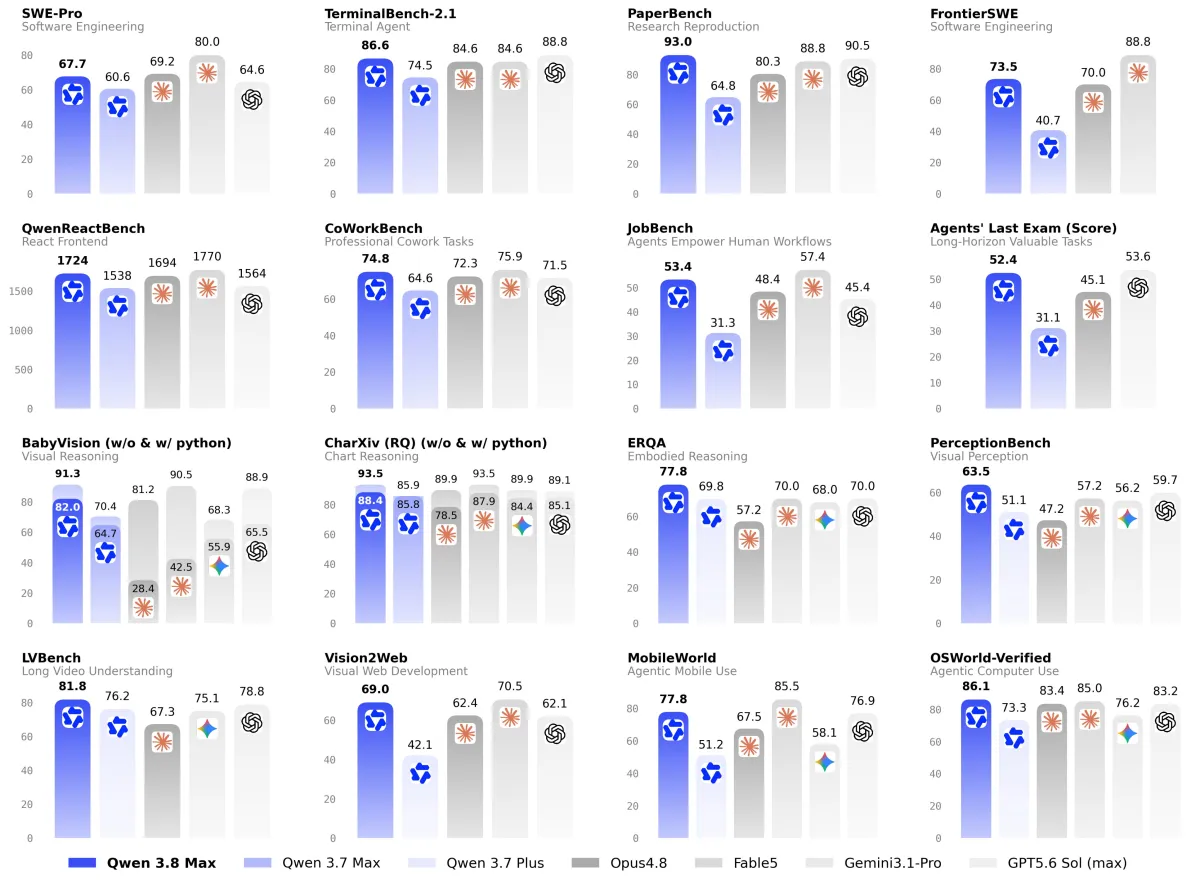
The second test was even more telling. The model reproduced a full academic paper — 7,600 lines of code, 1,100 operations, 33 GPU training runs across a week — then entered a "self-evolution" phase, proposing 18 improvements that outperformed the original paper's method by 2.7 points on the AIME24 math benchmark. The third: competing against 526 human teams in a 24-hour multimodal recognition challenge, iterating 45 times to improve accuracy from 0.60 to 0.853 and finishing ahead of 87% of the field.
The benchmarks are fine. The real evidence is in the domain tests. Qwen3.8-Max was tested in an e-commerce simulation, and turned an initial investment into a 4.16x return, outperforming the runner-up by 38%. In chip design, it iterated through roughly 500 rounds of interaction to reduce a circuit's area by 81%. These are not consumer chatbot metrics. These are productivity metrics. A model that can shrink a chip's footprint by 81% is a model that can generate real economic value. That is not a toy. That is a tool.
Alibaba did not just release a model. It released QwenWork, a workplace agent platform, on the same day. The product is designed around a specific capability: "organization-level Skills." A senior lawyer completes a complex due diligence report once. The agent documents the entire process. A junior can now replicate the work without asking for help. In a cross-border company, a QwenWork agent can automatically generate an English project document from a Chinese team's discussion, sync pending decisions to the UK team, and continue answering questions overnight — 24/7 coverage across time zones. QwenWork is not ChatGPT Enterprise. ChatGPT is a tool you open. QwenWork is embedded in the workflow itself — through DingTalk IM, through PC and web clients, with a mobile app coming. This is the difference between selling a model and selling a service.
Qwen3.8-Max is priced at $2 per million input tokens and $6 per million output tokens internationally. That is 40% of Opus 5's input price and 24% of its output price. For the same amount of work, you can run Qwen3.8 four times for the price of one Opus 5 run. The benchmark gap is small enough that enterprise buyers will ask if it's worth the difference. The pricing gap is large enough that the question is not rhetorical.
Qwen3.8 is the fourth major Chinese model release in the last three weeks. Kimi K3 (2.8T) on July 17. DeepSeek V4 on July 20. Qwen3.8 on August 3. MiniMax H3 in between. The interval between major model releases from Chinese labs is now measured in weeks. OpenAI and Anthropic still measure it in months. This cadence is not just about speed — it's about the coordination between model release and product launch. Alibaba released Qwen3.8 and QwenWork on the same day. The model is not a research artifact. It is a product component. The value is not the model's score — it's the model's integration.
P.S. If you are an enterprise buyer, the question is no longer "which model is best?" — it's "which model delivers the best value per dollar in your actual workflow?" For many tasks, Qwen3.8 wins not because it's smarter, but because it's good enough, cheaper, and already embedded in a workflow.