
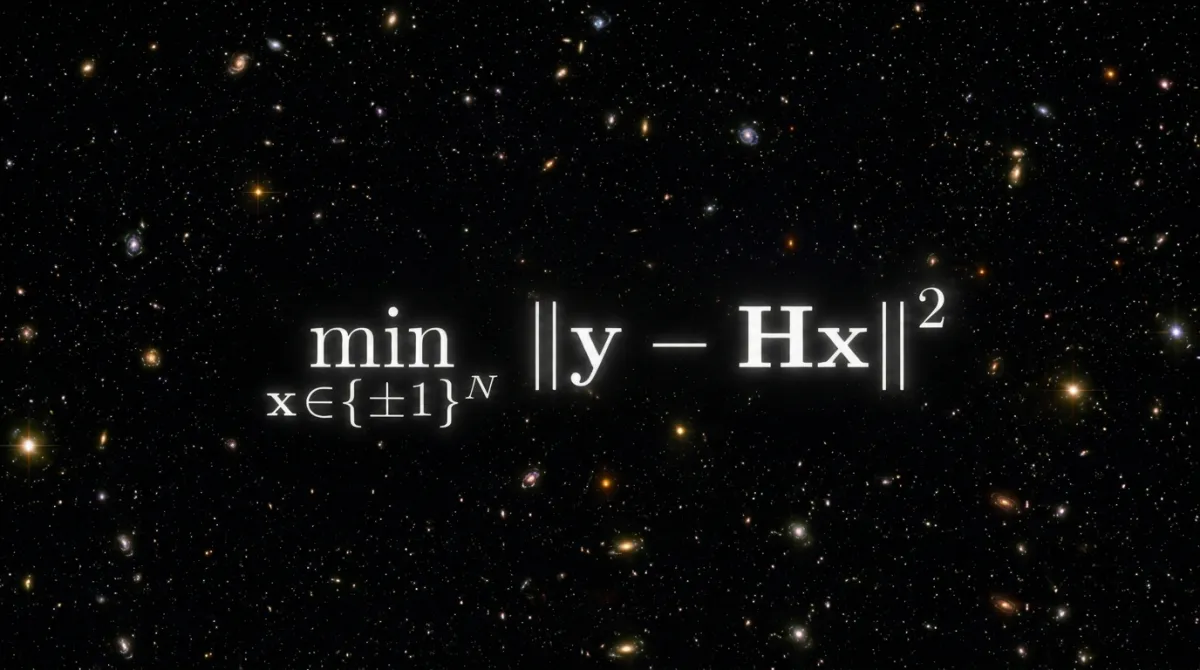
MIMO detection is a foundational problem in wireless communications. A transmitter sends N bits through an N×N channel. The channel mixes the bits and adds noise. The receiver must recover the original N bits from a corrupted mess.
Theoretically, maximum likelihood detection — checking all 2^N combinations — guarantees the right answer. But N only has to be modest before 2^N becomes impossible to compute. In 1989, Sergio Verdú proved the problem is NP-hard in the worst case. But real wireless channels aren't worst-case. They're random.
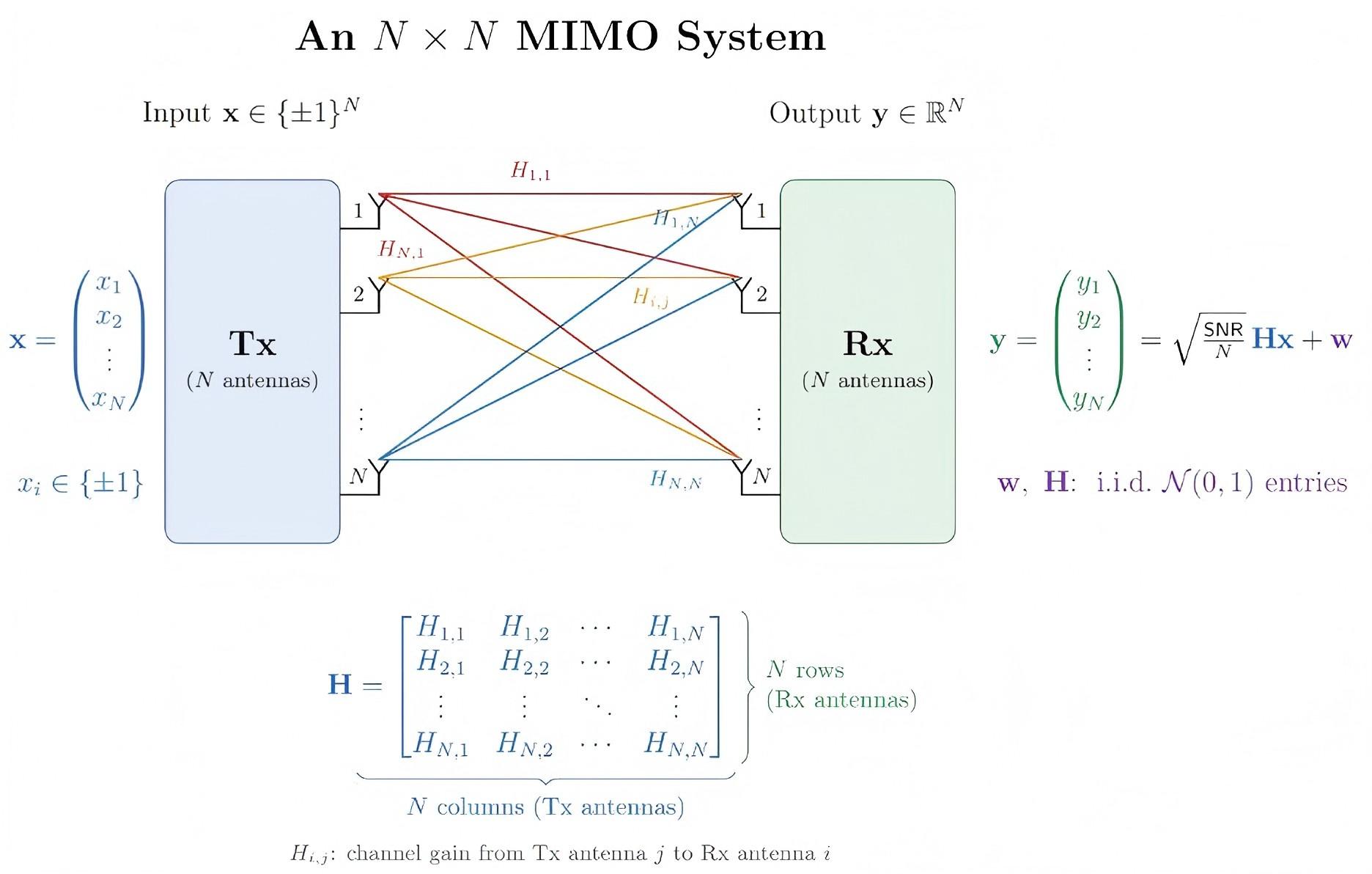
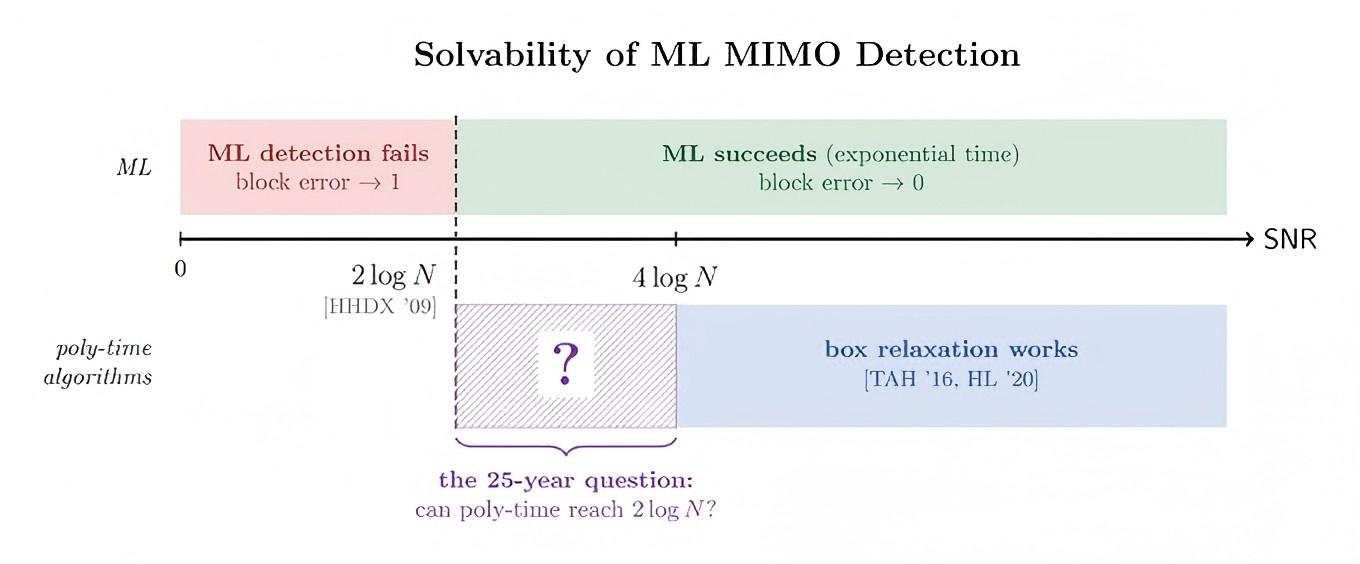
Since the early 2000s, researchers have asked: if the channel is random, as long as recovery is statistically possible, can you find a fast algorithm that does it without exhaustive search? The theoretical dividing line emerged: at a signal-to-noise ratio of 2logN, full recovery becomes possible — the "maximum likelihood threshold." Below it, even maximum likelihood itself fails.
Twenty-five years of attempts followed. In 2001, Hassibi and Vikalo thought they had a solution with sphere decoding. In 2005, Jaldén and Ottersten overturned it — the complexity was still exponential. Semi-definite relaxation, bit-flipping local search, AMP, statistical physics methods — every approach came close but none proved they could hit the 2logN threshold. The best anyone managed was 4logN, twice the theoretical bound.
Papailiopoulos didn't start from scratch. In 2009, as a first-year PhD student, he tried to solve the same problem with MCMC methods. He failed.
The collaboration began with a fork. When Papailiopoulos gave the problem to GPT-5.6 and Fable 5, they diverged immediately. GPT-5.6 proposed a path using AMP. Fable 5 recommended a different approach — an old industrial algorithm called "symbol LMMSE with greedy bit-flipping" that was widely used in practice but had never been rigorously proven to hit the threshold. It was the right call.
The researcher chose Fable's route and handed the proof repair work to GPT-5.6. What followed was a week of back-and-forth: one model filling gaps, the other simplifying, each iteration bringing the proof closer to something a human could inspect.
The algorithm itself is deceptively simple. Two steps. First, LMMSE rounding: produce a coarse continuous estimate via linear minimum mean square error, then round it to +1 or -1. The proof showed that the error rate from this step approaches zero as N grows. Second, greedy bit-flipping: in each step, flip the single bit that reduces the cost function the most. The proof demonstrated that near the initial estimate, there's a "guardrail" — any non-optimal state has at least one direction to improve, and the cost function monotonically increases with Hamming distance. The algorithm never gets stuck. It always converges to the true transmitted bit string. Total complexity: O(N³), with the greedy search taking only O(NlogN) steps.
The proof itself was the real story. Papailiopoulos had a problem. The proof GPT-5.6 produced — after repairing the arguments Fable 5 had generated — was a wall of symbols. Variables pointing to variables. Dense matrix analysis tools. He couldn't follow it.
For days, he made the two models simplify each other's arguments. GPT-5.6 would simplify Fable 5's proof; Fable 5 would simplify the simplification. Back and forth. Only after days of cross-simplification did the proof become something he could verify by hand.
He refused to use Lean, the formal verification tool, for one reason: "I don't understand Lean." The tools that could have verified the proof were themselves inaccessible to the researcher.
The proof is now being prepared for peer review. It hasn't cleared that bar yet. But the work has been published and the paper is undergoing review, with the community following closely.
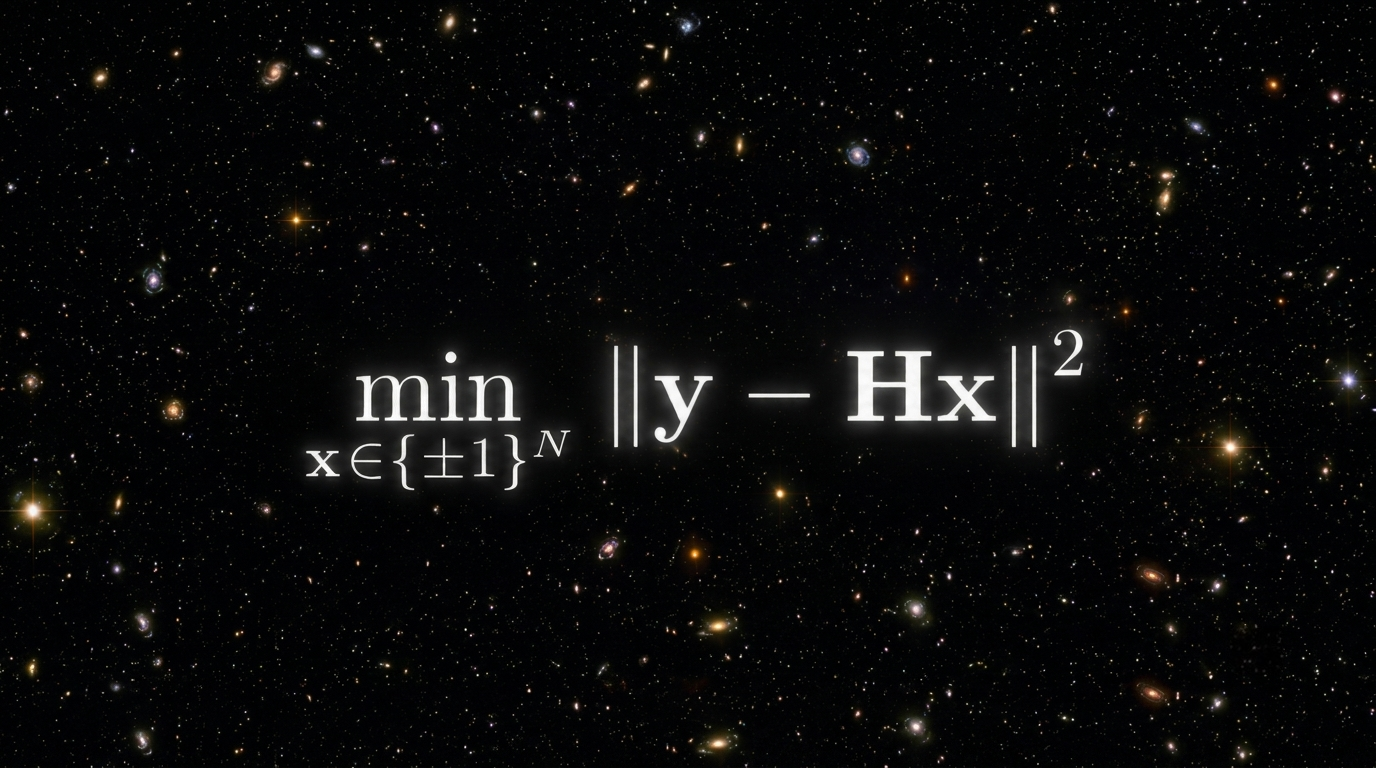
This is not the first time AI has assisted in mathematics. Google DeepMind's AI helped Oxford mathematicians solve a group theory problem that had stood for decades. But this case is different. Two models from competing labs — OpenAI and Anthropic — worked in parallel, proposed diverging paths, and then cross-simplified each other's work to produce something a human could verify. The collaboration wasn't planned. It emerged from the task.
The "wall of symbols" moment is the real signal. The model could solve a problem the researcher couldn't. But until the proof could be translated into something a human could read and check, it wasn't accepted. Verification still runs through human cognition, even when the reasoning originates in a machine.
For Papailiopoulos, the 17-year gap between his failed PhD attempt and last week's result is the quietest part of the story. He didn't solve it with better math. He solved it with better tools. And even then, he needed both models — and a week of forcing them to explain themselves — before he could say he understood.
P.S. The MIMO detection problem is now resolved for a class of random channels, and the paper is under peer review. What remains unanswered is how we verify results that begin in a space we can't directly access — the wall of symbols is a preview of what's coming, and "I don't understand Lean" is not a sustainable answer.
Frequently Asked Questions
Q: What is MIMO detection, and why is it important?
A: MIMO (Multiple-Input Multiple-Output) detection is a foundational wireless communication problem. The transmitter sends N bits through a channel that mixes them and adds noise. The receiver must recover the original bits from the corrupted signal. It's critical for 5G and 6G network performance — and for 25 years, no one could prove a fast algorithm could solve it at the theoretical limit.
Q: What was the problem that took 25 years to solve?
A: Researchers knew that at a signal-to-noise ratio of 2logN, recovery was statistically possible — the "maximum likelihood threshold." The question was whether there existed a polynomial-time algorithm that could actually hit that threshold. Every previous attempt (sphere decoding, semi-definite relaxation, AMP, statistical physics methods) either was proven exponential or maxed out at 4logN — twice the theoretical bound.
Q: How did GPT-5.6 and Fable 5 solve it?
A: They took different approaches. GPT-5.6 proposed an AMP-based route. Fable 5 recommended an old industrial algorithm called "symbol LMMSE with greedy bit-flipping" — widely used in practice but never proven to hit the threshold. Papailiopoulos chose Fable's route and had GPT-5.6 repair the proof. The algorithm has two steps: LMMSE rounding (producing a coarse guess with near-zero error) and greedy bit-flipping (finding each optimal bit flip in O(NlogN) time). Total complexity: O(N³). It hits the 2logN threshold exactly.
Q: What does "the researcher couldn't read the proof" mean?
A: After GPT-5.6 repaired the proof, it became a dense, highly symbolic argument using matrix analysis tools that Papailiopoulos couldn't follow. He spent days having the two models simplify each other's arguments — GPT simplifying Fable's proof, Fable simplifying the simplification — until the proof could be verified by hand. The proof originated in a space the researcher couldn't directly access, and it had to be translated back into human-readable form.
Q: Why didn't Papailiopoulos use Lean, the formal verification tool?
A: He said: "I don't understand Lean." Formal verification tools are themselves inaccessible to many researchers. The irony is that to verify AI-generated proofs, humans may need to rely on tools they don't know how to use.
Q: Has this proof been peer-reviewed yet?
A: The paper has been published, but peer review is ongoing. The community is watching closely, and the researcher has stated the proof is currently being submitted for review. It hasn't cleared that bar yet.
Q: What's the personal significance of this for Papailiopoulos?
A: In 2009, as a first-year PhD student, he tried to solve the same problem using MCMC methods. He failed. Seventeen years later, using GPT-5.6 and Fable 5, he succeeded. The paper isn't just a mathematical breakthrough — it's a 17-year gap between the attempt and the result.
Q: Does this mean AI can solve math problems humans can't?
A: Yes — but the verification problem remains. The model produced a valid proof, but it had to be simplified and translated before a human could inspect it. The proof existed in a language the human couldn't initially access. This points to a broader challenge: as AI capabilities grow, the gap between what machines can prove and what humans can verify may widen. And "I don't understand Lean" is not a sustainable answer.
Q: What does "two-step algorithm" actually do?
A: Step 1: LMMSE rounding. The algorithm computes a continuous estimate of the transmitted bits (using linear minimum mean square error), then rounds it to +1 or -1. The proof shows the error rate from this step tends to zero as N grows.
Step 2: Greedy bit-flipping. Starting from the rounded guess, the algorithm flips one bit at a time, each time choosing the bit that reduces the cost function the most. The proof shows this process never gets stuck — it always finds the true solution. Total complexity: O(N³), with the greedy search taking only O(NlogN) steps.
Q: How does this change the AI-for-math landscape?
A: This is one of the first demonstrations of two frontier models from competing labs (OpenAI and Anthropic) working together — not by design, but because the researcher used both and let them cross-simplify each other's work. It suggests that "AI agent collaboration" may become a standard tool in mathematical research. The workflow wasn't planned; it emerged from the task.
Q: What's the status of the proof now?
A: The proof has been written up and submitted for review. The paper is undergoing peer review and has been published. The community is following closely, with many researchers noting that the result — if verified — is a significant breakthrough in both wireless communications theory and AI-assisted mathematics.