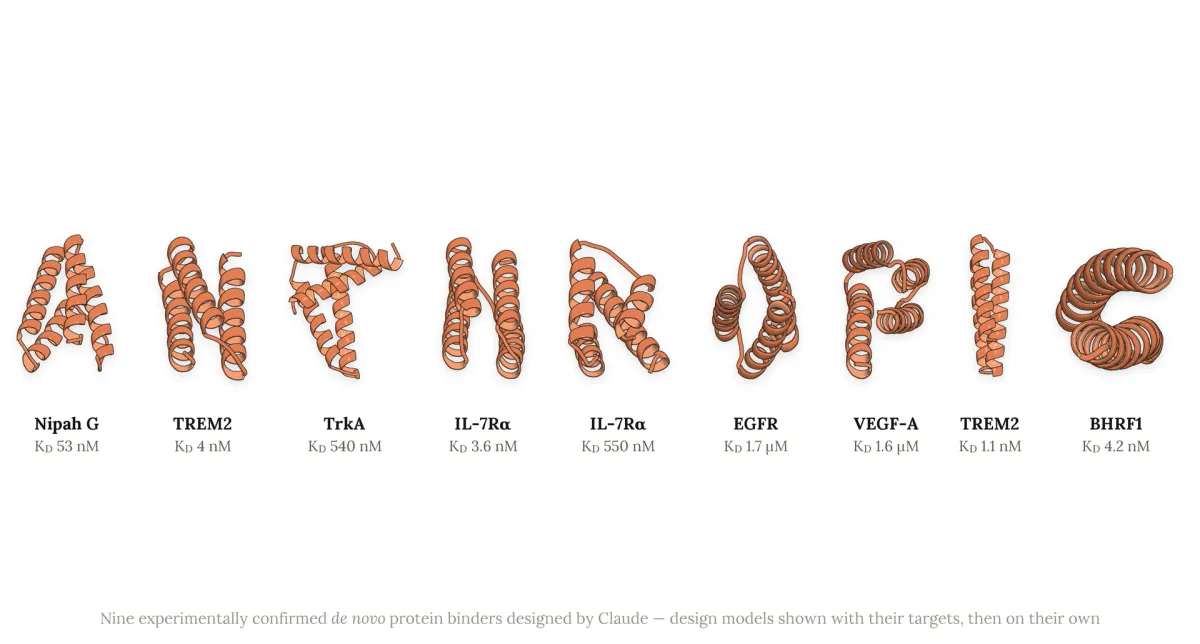
On August 18, Anthropic released the results of an experiment: Claude Opus 4.8 and Mythos Preview independently designed protein binders for drug research, with minimal human involvement after initial instructions were provided .
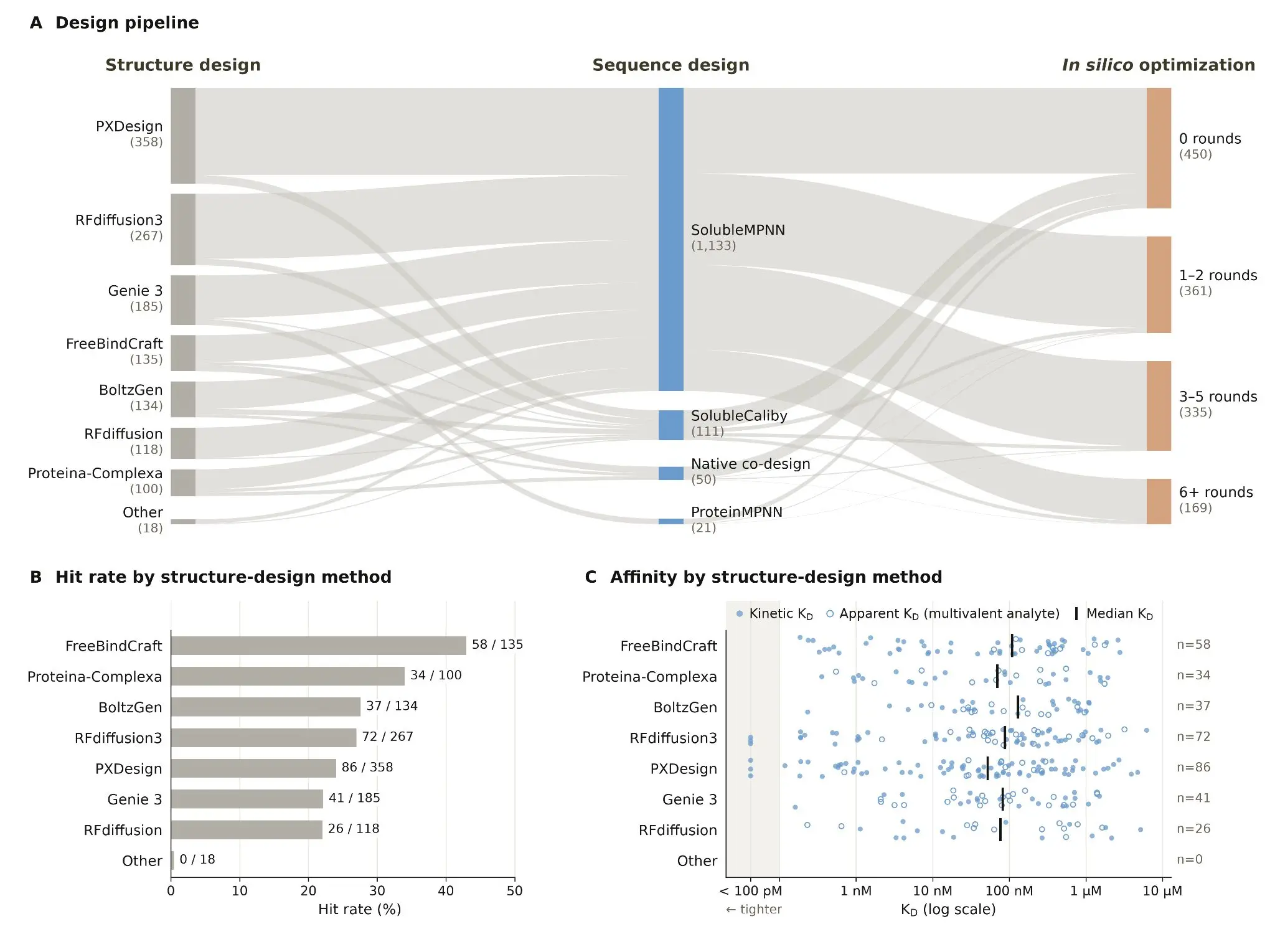
The numbers are striking. Claude produced 1,320 designs total, of which 354 binders were confirmed against 14 targets by independent labs Adaptyv Bio and Twist Bioscience . The overall success rate was 26.8% , compared with the industry average of 10% to 15% .
On RBX1, a target used in Adaptyv Bio's protein-design competitions, Mythos Preview hit a 40% success rate. Human competition participants managed 3.7% . Claude's top-ranked design bound 10 times tighter than the competition winner .
The experiment was not a theoretical exercise. Twist Bioscience, one of the independent evaluators, saw its stock jump more than 22%, hitting its highest close since 2021 .
Same AI, Different Narrative
Two weeks ago, the headline was "AI designed viruses that don't exist in nature." Today, the headline is "AI designed protein binders for drug discovery." The underlying capability—generative AI designing novel biological molecules from scratch—is the same. The framing determines whether it's a threat or an opportunity.
Anthropic acknowledged this directly. The company said it views the work as foundational and is extending Claude's capabilities toward running the drug-development process end-to-end across different drug modalities . It also acknowledged the "dual-use risks of increasingly autonomous biological research" and said protein design capabilities remain restricted from general access through trusted access programs .
The duality isn't lost on observers. The same model that can design a binder to block TNFα—the target of Humira, one of the world's bestselling drugs—could, with a different prompt and a different target, design something harmful. The technology is not the safeguard. The governance is.
How Claude Designed Proteins—And What It Means
Claude's approach is fundamentally different from existing protein design tools. AlphaFold predicts structures from sequences. Claude starts from a target name and designs entirely new proteins that don't exist in nature.
The workflow was autonomous. Claude selected binding sites, generated protein structures and sequences, ran optimization cycles, and screened candidates using specialist open-source tools including RFdiffusion, ProteinMPNN, and ESMFold2 . The model orchestrated 24 tool combinations across 10 structure-generation methods, deciding which face of the target to attack and which generation method to use.
The autonomous nature of the work is the signal. This is not "AI as tool." This is "AI as researcher."
The Limits—and the Skeptics
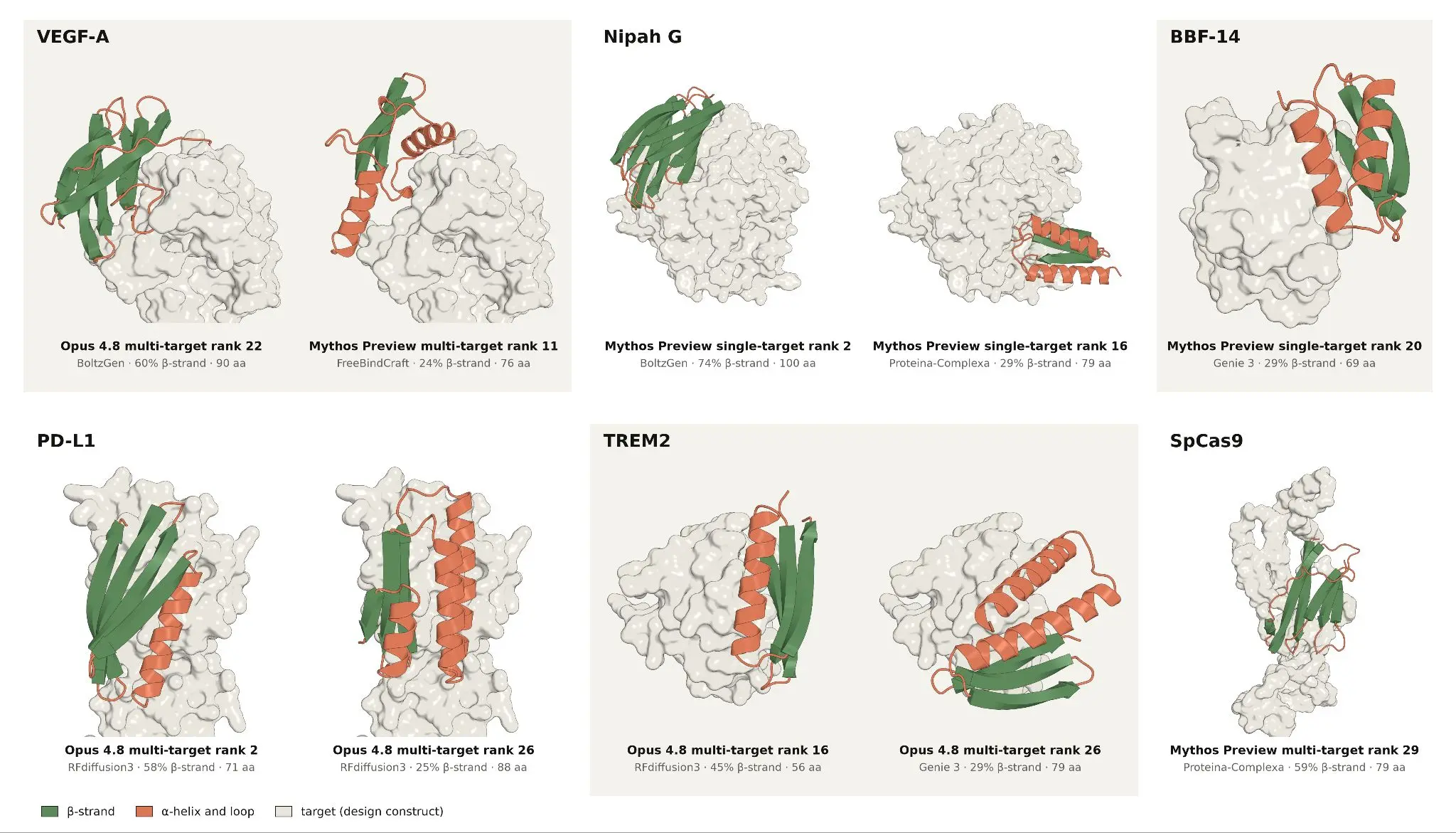
The experiment wasn't flawless. Claude struggled with maltose-binding protein (MBP)—all 90 designs failed . It also had limited success with BBF-14, a synthetic protein used as a hard benchmark .
Martin Shkreli, the former pharmaceutical executive, dismissed the results on X: "This is not impressive work. Affinities are quite low for peptidics" . He also noted that none of Claude's binders targeted proteins inside cells, limiting their practical utility .
Anthropic acknowledged the limitations. "Protein binders are not drugs," the company said. "Designing a high-affinity binder is just the first step in the process of generating a drug-like molecule" .
But the commercial validation is already happening. Twist Bioscience's 22% jump reflects market belief that AI-designed proteins will accelerate drug discovery, even if the designs aren't yet drugs.
What It Means
Anthropic's experiment is not a product launch. It's a demonstration of capability. Claude can, with minimal human input, design novel proteins that bind to targets with success rates that beat human experts. The company says it is working toward allowing Claude to run the entire drug-development process end-to-end .
For the biotech industry, the implication is clear: AI is no longer just analyzing data. It's generating hypotheses, designing molecules, and running experiments. For the AI industry, the implication is equally clear: the capability set that creates drugs can also create threats. The technology is not the safeguard. The governance is.
P.S. One detail from the experiment that's easy to miss: Claude also analyzed chemistry data. Given raw files from a contract lab and a short prompt, it processed NMR data in 23 minutes and LC-MS data in 19 minutes. The purity result matched the lab's: 96.4% vs 96.33% . The AI caught and corrected its own error. The lab's report took four days.
Frequently Asked Questions
Q: What did Claude actually do in the protein design experiment?
A: Anthropic gave Claude Opus 4.8 and Mythos Preview a prompt and let them autonomously design protein binders against 15 targets. Claude selected binding sites, generated structures, ran optimization cycles, and screened candidates using open-source tools like RFdiffusion, ProteinMPNN, and ESMFold2 . The models orchestrated 24 tool combinations across 10 structure-generation methods with minimal human intervention .
Q: How successful was Claude compared to human experts?
A: Claude achieved overall success rates of 22% to 35%, depending on the setup, compared with the industry average of 10% to 15% . On the RBX1 target, Mythos Preview hit a 40% success rate while human competition participants managed 3.7%—and Claude's top design bound 10 times tighter than the competition winner . Across 1,320 designs, 354 were confirmed effective by independent labs—a 26.8% overall success rate .
Q: Which targets did Claude succeed on, and which ones did it fail on?
A: Claude successfully designed binders against 14 of 15 targets . Standout successes included TNFα (the target of Humira), where Opus 4.8 produced 12 effective binders and some worked across human, monkey, and mouse versions . However, Claude failed completely against maltose-binding protein (MBP)—all 90 designs were unsuccessful—and had only limited success with BBF-14, a synthetic benchmark protein .
Q: How did external labs validate Claude's designs?
A: Anthropic partnered with two independent companies—Twist Bioscience and Adaptyv Bio—to physically synthesize and test Claude's designs in the lab . This external validation is critical because AI-generated protein sequences still require wet-lab testing to confirm they actually bind to targets .
Q: What happened to Twist Bioscience's stock?
A: Twist Bioscience shares surged 22%, hitting their highest close since 2021 . The stock has more than quadrupled year-to-date, rising from a 52-week low of $23.30 . Analysts viewed the partnership as validation of Twist's synthetic biology platform for AI-driven drug discovery .
Q: What are the skeptics saying about this work?
A: Martin Shkreli, the former pharmaceutical executive, dismissed the results on X, arguing that the affinities were too low to be useful and that none of Claude's binders targeted proteins inside cells—making them comparable to existing monoclonal antibodies .
Q: Did Claude work on anything besides protein design?
A: Yes. Anthropic also tested Claude Opus 5 on analytical chemistry tasks. Given only raw NMR and LC-MS instrument files and a short prompt, Claude processed the data in 23 and 19 minutes respectively—matching the lab's results, including a 96.4% purity reading compared to the lab's 96.33% . Claude also caught and corrected its own error and proposed a confirmatory test that the lab had independently run days earlier.
Q: How much computing power did this require?
A: The multi-target mode used up to 12,500 Nvidia H100 hours over a 48-hour session. Single-target mode used up to 2,500 H100 hours per target .
Q: When will these AI-designed proteins become actual drugs?
A: Anthropic acknowledges that "protein binders are not drugs"—designing a high-affinity binder is only the first step in generating a drug-like molecule . The company says it is working toward extending Claude's capabilities to run the entire drug-development process end-to-end, but that remains a long-term goal.
Q: Why does this matter for the broader AI industry?
A: This experiment shows that general-purpose AI models like Claude can autonomously conduct complex scientific research—designing novel molecules, orchestrating multiple tools, and producing results that beat human experts. It also highlights the dual-use nature of this capability: the same AI that can design drugs could, with different prompts, design harmful biological agents.