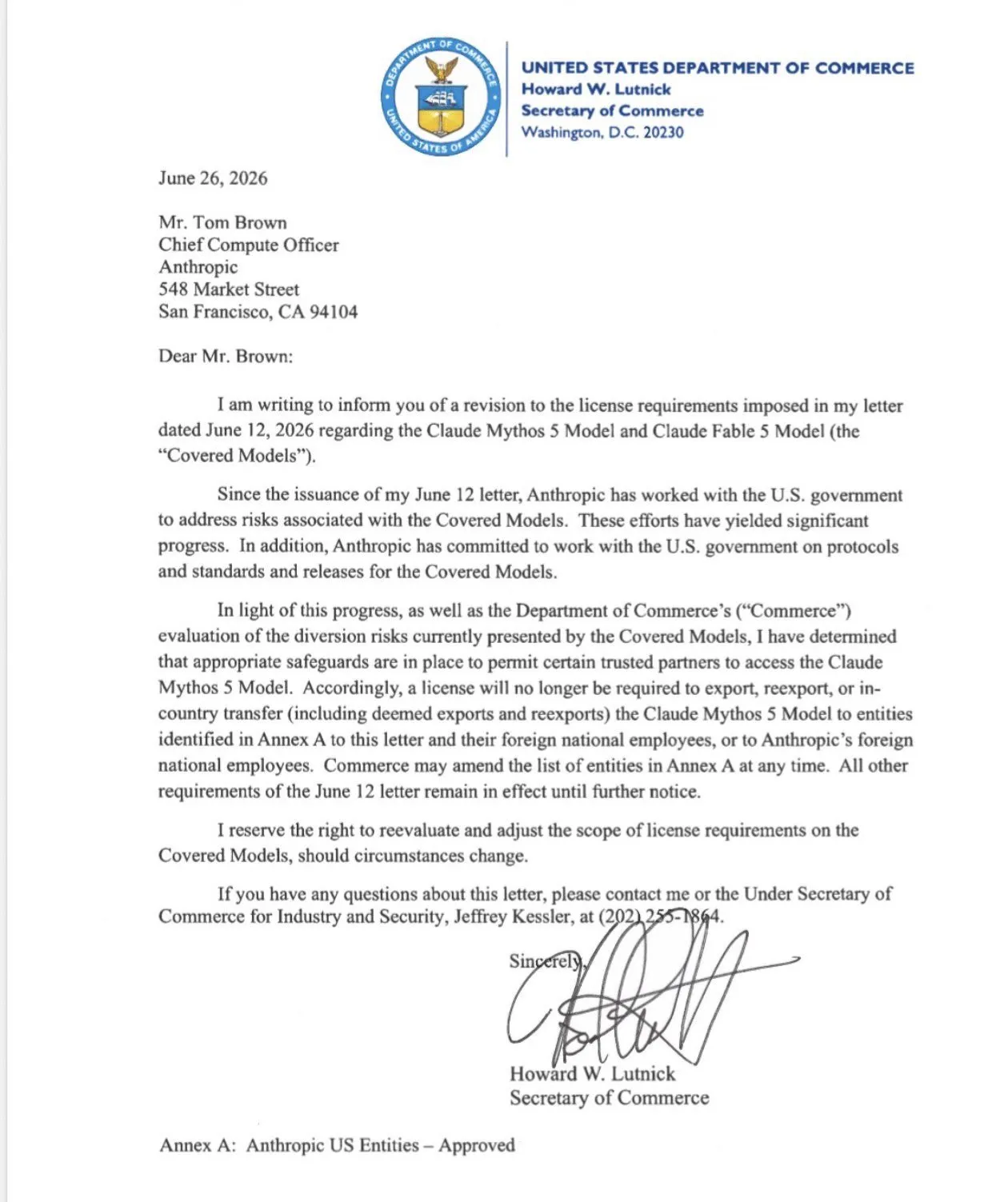
On June 26, Commerce Secretary Howard Lutnick sent a letter to Anthropic‘s chief compute officer Tom Brown, writing that “appropriate safeguards are in place to permit certain trusted partners to access the Claude Mythos 5 Model.” The letter cited “significant progress” in the intense, daily talks between the government and the company since the June 12 block.
More than 100 U.S. institutions — including Fortune 500 companies and federal agencies — are now approved to use Mythos 5 for defensive cybersecurity purposes. Approved entities and their foreign employees, as well as Anthropic’s own foreign staff, are exempt from export license requirements.
But Fable 5 remains restricted. The Commerce Department‘s letter did not mention any change to Fable 5’s status. Anthropic said it continues to work with the government to“make Fable 5 available for general use again.”
One model is back. The other isn‘t. Same company. Same underlying architecture. The difference is who gets to use it and for what purpose.
The Same Week, Two Companies, One Model
On the same day, OpenAI released GPT-5.6 Sol — but only to about 20“trusted partners,” with the government approving access customer by customer. The administration views GPT-5.6’s capabilities as on par with Mythos, and treated it accordingly.
Two weeks ago, the US government forced Anthropic to pull both Fable 5 and Mythos 5 offline after Commerce Secretary Howard Lutnick imposed export restrictions on both models. The administration cited a“jailbreak” risk, though Anthropic argued the same capability exists in other public models like GPT-5.5.
Now, the model has settled. Mythos 5 is back — but only for approved partners. GPT-5.6 is out — but only for approved partners. Fable 5 is still offline. The pattern is not subtle. The government isn‘t banning frontier AI. It’s deciding who can use it. That‘s a different kind of control. Export controls were a blunt instrument. Customer-by-customer approval is a surgical one.
The IPO Calculus
Anthropic is preparing to go public. On June 1, the company filed confidentially for an IPO, valued at $965 billion — ahead of OpenAI’s $852 billion valuation. A regulatory dispute with the US government is a direct risk to any IPO prospectus. The government‘s willingness to lift the block on Mythos 5 — even partially — is a signal that both sides need a resolution that doesn’t look like a loss.
Commerce Secretary Lutnick publicly praised Anthropic‘s response, noting in his letter that the company“has been working with the US government to address the risks associated with the controlled models” and has made“significant progress.” This is the language of de-escalation, not punishment.
But Trump also effectively acknowledged the tension. The same week Anthropic’s models were restricted, the President signed an executive order establishing a voluntary 30-day pre-release review framework. The order explicitly disclaimed any“mandatory licensing, preclearance, or permitting requirement.” But the administration has now tested two enforcement models in two weeks — export controls for Anthropic, customer-by-customer approval for OpenAI — without ever calling either a licensing scheme.

What This Actually Means
Mythos 5 is back. Fable 5 is still offline. GPT-5.6 is out, but only for government-approved partners. Two weeks ago, the government forced Anthropic to shut down access. Today, it is approving access one customer at a time. The pattern is consistent. The mechanism is evolving.
For Anthropic, the Mythos 5 restoration is a step forward. But the Fable 5 question remains open. For OpenAI, GPT-5.6‘s release is a milestone — but it’s also a milestone in how AI models are now released. The next question is whether this becomes a permanent framework or a temporary fix. The administration‘s 60-day deadline for formalizing the executive order’s framework is August 1. By then, the shape of the new AI release process should be clear.
P.S. Mythos 5 is back. Fable 5 isn‘t. OpenAI’s GPT-5.6 is out, but only for government-approved partners. Two weeks ago, the government forced Anthropic to shut down access. Today, it is approving access one customer at a time. The pattern is consistent. The mechanism is evolving. The question isn‘t whether the government is regulating AI. It’s whether it‘s building a licensing system it promised it wouldn’t.