On July 11, Zhipu founder Tang Jie released an internal memo titled "The Wave Is Here." The timing is telling. The company's stock has surged 13x since its Hong Kong IPO in January. The market is on a high. Most AI companies are racing to monetize.
OpenAI just launched ChatGPT Work. Meta is charging for Muse Spark. Anthropic's ARR hit $60 billion. Tang's message to his employees: we're going the other way. "Since AGI is the endpoint, short-term gains or industry trends are just scenery along the road."
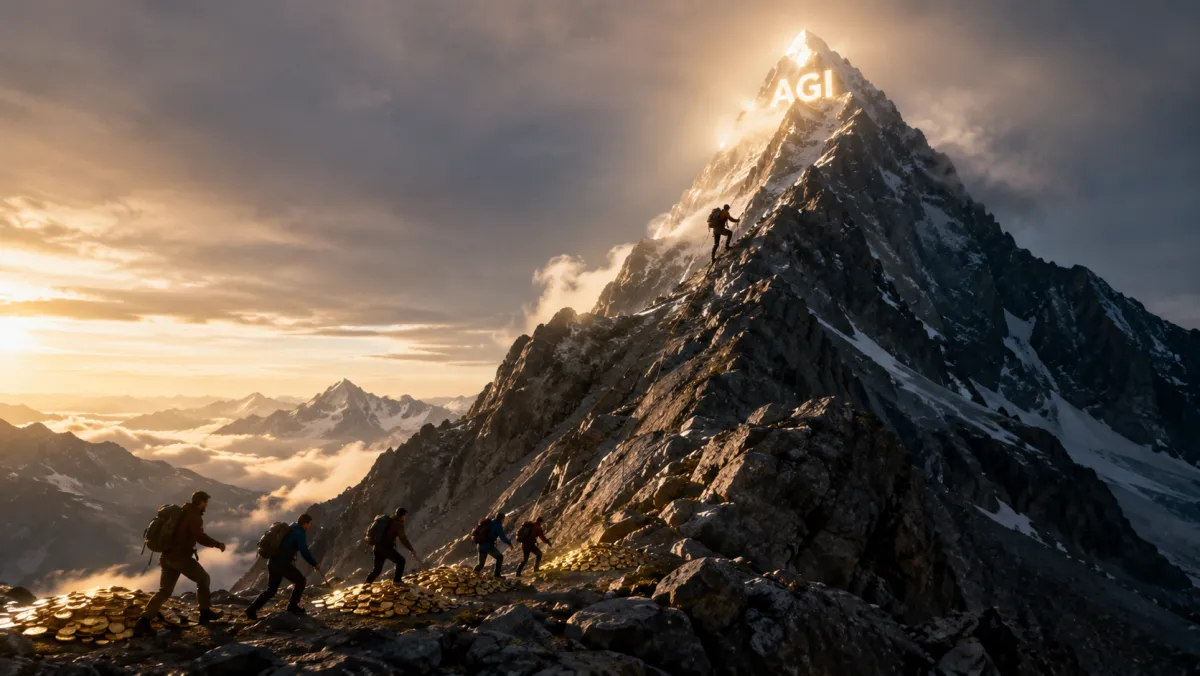
The company just launched a "Touch High" plan. Two years of strategic investment. No short-term monetization. All chips on AGI. "Not reaching the summit is failure." This is the most counterintuitive move in AI right now. And it's a signal worth paying attention to.
Tang's memo maps the path to AGI. Three peaks that define the coming battle. First: Long Horizon Tasks. Models that plan and execute over weeks, months, even years. Not answering a question, but orchestrating a project. Tang's example: a model that autonomously designs a novel anticancer drug molecule, breaking it into thousands of executable subtasks.
Second: Autonomous Agent Systems. Beyond the "one-person company" to the "no-people company." Tens of thousands of specialized agents collaborating, debating, reviewing code, scheduling resources. 24/7. Self-driving levels of digital productivity.
Third: Self-Evolution. AI training AI. Models writing their own code, generating their own training data, training themselves. Tang notes that overseas leaders building million-chip compute clusters aren't just training models — they're building self-training infrastructure.
"What happens after we cross these three peaks? AI will begin to learn what 'I' is — self-awareness. Beyond that, it touches human emotion. Further still, consciousness itself. From perception to cognition, from cognition to AGI, from AGI to ASI — this path is open. The wave is here, and it is irreversible."
Tang saved the most important point for last. The fourth pillar: Extreme Safety Governance. "This is the one I want to emphasize the most." The company plans to invest $10 billion (100 billion yuan) in mechanistic interpretability. Not safety by policy. Safety by understanding. Mapping the actual neuron-level logic behind model decisions.
"Superintelligence achievement and superalignment research must advance together. History shows that when a technology reaches a scale capable of changing civilization, safety is no longer an accessory — it is the fundamental condition for the technology's survival and permitted application."
Tang cites Google DeepMind's "From AGI to ASI" report: even if models stop at human-level, compute scaling alone will squeeze out superintelligence. One billion AGI instances in five years, replicating experience at zero cost. That's ASI by sheer scale. This isn't compliance. It's survival.
The memo comes with a product to back it up. Zhipu just open-sourced GLM-5.2 under the MIT license. Fully open. Anyone can use it, modify it, commercialize it. No restrictions. One hand reaching up. One hand laying the road down.
"Touch High" is also a direct response to the market. Zhipu's stock at HK$1,640, roughly $800 billion market cap. A week of lock-up volatility. Questions about where the next $31 billion in recent fundraising will go. Tang's answer: we're spending it on the future. Not protecting a valuation.
Zhipu's competitor MiniMax released its own internal memo the day before. MiniMax's CEO Yan Junjie pledged to take no salary until AGI is achieved. Different companies. Different languages. Same signal: the foundation model race isn't over.
P.S. Three years from now, we'll know who was right. The most dangerous thing in AI might not be betting on AGI — it might be playing it safe while everyone else climbs.