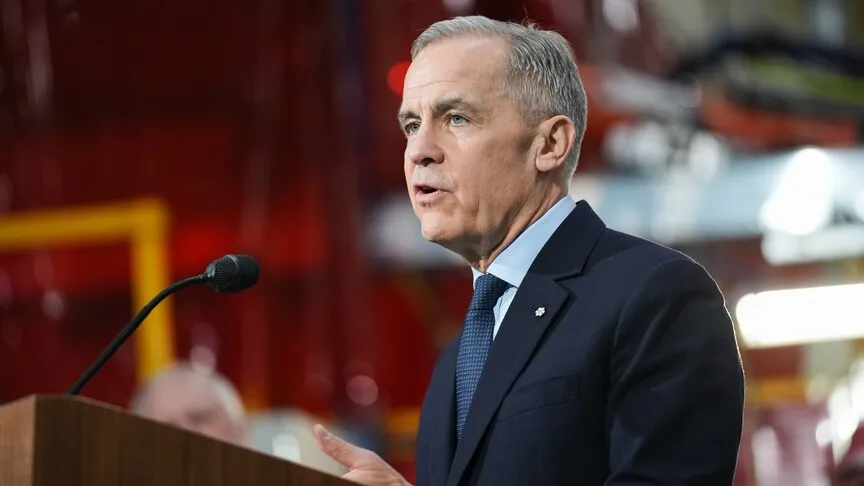
Mark Carney did not travel to France to make friends. The Canadian Prime Minister arrived at the G7 summit with a message that his hosts did not want to hear.
Speaking to reporters in Ireland before the summit, Carney pointed directly at the US government‘s recent decision to block non-Americans from accessing Anthropic’s most advanced AI models. His assessment was blunt. “Nobody‘s done anything wrong,” he said, “but we will have done something wrong if we just accept this, don’t take the lesson, don‘t build out and diversify.”
Carney wasn’t speaking as a politician. He was speaking as a former central banker who ran the Bank of Canada and the Bank of England. “We have similar things in terms of model risk,” he said, drawing a direct line between the 2008 financial crisis and the current concentration of AI power.
Banks failed because they were all exposed to the same underlying risks. The same logic applies to AI. When every country relies on the same few American models, the entire system is fragile. One policy change. One export control order. One lawsuit. Any of them could cut off access overnight.
The Gathering Storm
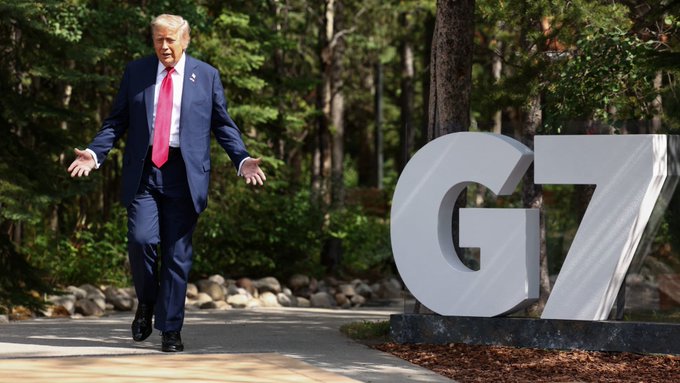
Carney‘s comments were not made in a vacuum. The G7 summit has been preparing to discuss AI governance, but the member nations are deeply divided. European countries want tighter regulation — energy reporting, environmental disclosures, binding safety requirements.
The Trump administration is resisting, arguing that overregulation will cede leadership to China. The Center for Strategic and International Studies predicted that AI would be“the biggest friction point” at the summit, with“real fireworks” expected. One senior UK official reportedly set expectations so low that his only hope for the trip was that“the wifi on the plane would work.”
France, the host country, is already locked in a trade dispute with the US over digital services taxes. Germany is pushing for“digital sovereignty.” And Canada is publicly warning its closest ally about the dangers of dependency. The alliance is not fracturing. But the fault lines are visible to anyone paying attention.
The New Sovereigns
While leaders argue, a different kind of movement is taking shape outside the summit halls. Cohere, the Canadian AI company, and Aleph Alpha, the German AI startup, announced a transatlantic alliance in April. The deal includes $600 million in committed funding from the Schwarz Group, which will also lead Cohere‘s upcoming Series E round. The combined entity is valued at roughly $20 billion, with dual headquarters in Toronto and Berlin.
The positioning was explicit. Cohere and Aleph Alpha are marketing themselves as a“sovereign alternative” to US tech giants —“a true counterweight” for organizations that“refuse to cede control over AI to any single vendor or jurisdiction.”
In France, Mistral AI has built its entire identity around being the non-American option. CEO Arthur Mensch has repeatedly framed his company‘s mission as“AI should be a tool for empowerment, not dominance.” European industrial champions like ASML are backing the effort.
In Japan, Sakana AI is working with the country’s largest banks to build domestic AI infrastructure. The company has participated in government roundtables on data sovereignty. Its“Sovereign AI” strategy is front and center.
None of these players can yet compete with OpenAI or Anthropic on raw capability. But they don‘t need to. They just need to be good enough that their home markets aren’t completely dependent on American models. That bar is lower. And they are clearing it.
The Numbers Behind the Fear
The scale of US dominance is staggering. According to the Stanford AI Index, American companies attracted roughly $286 billion in private AI investment in 2025 — more than the next ten countries combined. Mistral AI is negotiating a new round that would value the company at roughly $23 billion. That‘s about 40 times smaller than Anthropic’s latest valuation.
The gap is not closing. But the fear is not about catching up. It‘s about being locked out.
Carney’s warning reflects a basic calculation. The global AI services market is projected to exceed $1 trillion annually, with sovereign AI demand accounting for roughly $600 billion, according to McKinsey. Countries that don‘t have their own models, their own infrastructure, their own data controls, will have to rely on someone else’s.
The US just demonstrated that access can be revoked at any time, for any reason, with no notice. That is not a hypothetical risk. It is a procurement criterion.
What Happens Next
The G7 summit will not produce a joint declaration on AI. The divisions are too deep. But the conversation happening outside the official agenda matters more.
Carney‘s warning will be heard. European leaders who already worried about“tech sovereignty” will find their concerns validated. And the market for non-American AI will continue to grow.
Cohere and Aleph Alpha have their alliance. Mistral has its European backing. Sakana has Japan’s largest banks. None of them will dethrone OpenAI or Anthropic this year. But they don‘t need to. They just need to be viable alternatives for governments and enterprises that can no longer put all their trust in American AI.
The US showed its hand. Now everyone else is building a backup plan.
P.S. Carney used the word“redundancy.” In engineering, it means backup systems. In finance, it means diversified exposure. In AI, it means something neither the US nor China has yet provided: a genuine choice. The G7 summit won‘t solve that. But the fear that it needs to be solved just became a lot more urgent. The leaders leaving France this week may not agree on much. But they’ll all be thinking about the same question: what happens when it‘s our turn to get cut off?