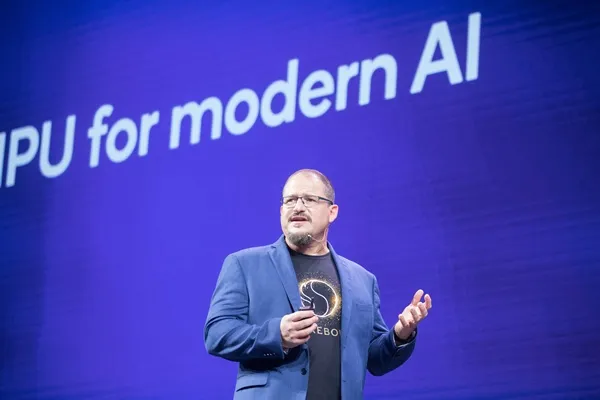
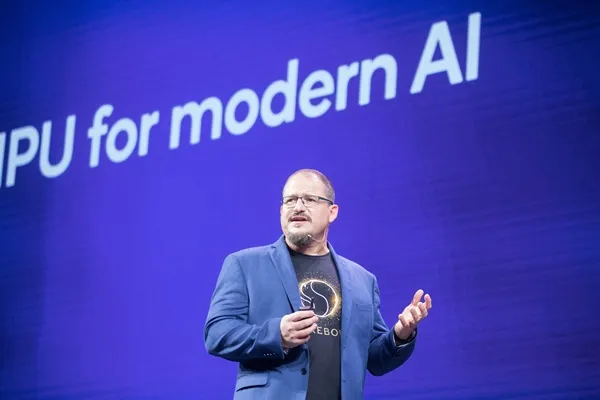
Cristiano Amon didn‘t announce a new chip on Monday. He announced a new worldview.
In an interview on CNBC’s “The Tech Download,” the Qualcomm CEO made a series of statements that, taken together, amount to the most direct challenge to the smartphone era from any major tech executive. His core argument is that the app-based interface — the foundation of the mobile economy for nearly two decades — is about to be replaced by AI agents that act as personal assistants, understanding user intent and performing tasks without requiring users to navigate apps .
“Apps are not dead,” Amon said, “but apps are going to change. AI agents are going to become the new apps” .
That‘s not a prediction about the future. It’s a roadmap for what Qualcomm is building right now. The company is actively designing more than 40 new AI-powered devices across a wide range of form factors — smart jewelry, camera-equipped earbuds, pins, and watches — all built to serve as always-on, context-aware personal agents . “Right now, we have over 40 designs of those devices,” Amon said. “And I‘m telling you, the types of form factors are very, very broad” .
What This Actually Means
Think about how you use your phone today. You open an app, you navigate through menus, you search, you tap. It’s a system of containers. You go to the app to get something done. Amon is describing a world where you don‘t go to the app. You tell your agent what you need, and the agent orchestrates the apps behind the scenes.
His example: an AI agent could instantly pull up your bank transaction details without you needing to open the banking app and search for them yourself . In an agent-centric world, the smartphone doesn’t disappear — but it becomes a different kind of device. The center of gravity shifts away from the app as the primary unit of interaction and toward the agent as the layer that sits above everything .
Amon‘s bet is that the agent becomes the “new app.” And he’s putting Qualcomm‘s money and engineering resources behind making that vision real.
The Smart Glasses Bet
Amon also made a bold prediction about smart glasses. He told CNBC that current annual shipments are already in the “tens of millions” and that in a few years, that number could climb to“hundreds of millions,” ultimately growing into a market comparable in size to smartphones .
The implication is clear. Qualcomm sees a world where the smartphone is no longer the center of the consumer electronics universe. It may still be important, but it will be one device among many — not the gateway to everything.
“The core idea is: this is a device you wear, a device that is always with you, a device that perceives the world around you so it has context,” Amon explained. “That gives you the ability to access an agent at any time and talk to it” .
The Tenstorrent Deal: Qualcomm’s AI Infrastructure Play
The 40+ devices and the agent vision are the consumer-facing part of the strategy. The other half is happening in the data center.
According to The Information, Qualcomm is in talks to acquire AI chip startup Tenstorrent for $8 billion to $10 billion . Tenstorrent was founded by chip architect Jim Keller, whose resume includes designing processors at Apple and Tesla . The company‘s processors use a dataflow computing approach that moves data based on when computation is ready, rather than following a fixed clock cycle. In AI inference tasks — running already trained models — this can potentially reduce power consumption and latency compared to NVIDIA’s GPUs .
This is not a small move. Tenstorrent has raised over $1 billion from investors including Samsung Securities, Fidelity, and Hyundai Motor Group . A $10 billion acquisition would be one of the largest AI chip deals in recent years. It would give Qualcomm a much more complete AI chip portfolio, spanning interconnect (from its previous acquisition of Alphawave Semi), inference, and potentially training workloads, putting it in more direct competition with NVIDIA, AMD, and Intel .
Qualcomm‘s current forward P/E ratio is roughly 18, compared to NVIDIA’s 35 and AMD‘s 28 . The market has been skeptical that Qualcomm can break into the AI chip space. A successful Tenstorrent acquisition — and proof that Keller’s architecture can compete — would be the most direct answer to that skepticism.
The Investor Angle
Qualcomm‘s stock rose 4.29% on Monday following the CNBC interview and the Tenstorrent acquisition report . That’s a market vote of confidence. But the longer-term question is whether Qualcomm can actually execute on this vision.
The company is already making moves beyond mobile. Its AI-optimized Snapdragon chips are already in use in data centers, with AWS offering a Qualcomm-based AI100 Ultra accelerator . The Tenstorrent acquisition, if completed, would accelerate that push. But it would also put Qualcomm in direct competition with NVIDIA‘s next-generation Rubin platform expected in 2027 — a fight that will require not just good technology, but a compelling ecosystem to go with it .

The Bottom Line
Amon’s vision is clear. He sees a world where AI agents become the primary interface for consumers, where smart glasses rival smartphones in scale, and where Qualcomm is no longer“just” a mobile chip company but a full-spectrum AI hardware provider spanning devices and data centers.
The 40+ devices are the consumer proof point. The Tenstorrent deal is the infrastructure proof point. Whether the market ultimately agrees with Amon‘s timeline or not, the direction of travel is unambiguous. The industry is moving toward a world where the app is no longer the center of gravity — and Qualcomm is determined to be the company powering the transition. That’s not a product announcement. It‘s a warning shot.
P.S. Amon says apps “are going to change,” not disappear. That’s the safe thing to say to the companies whose apps you still need to support. But when you‘re designing 40+ devices that bypass apps entirely, the writing is on the wall. It’s not that apps are dying. It‘s that they’re being demoted — from the main event to the supporting cast.