The last mile of industrial automation isn't a warehouse robot that moves boxes. It's a hand that knows when to stop pouring coffee as the pot grows lighter.
RLWRLD, a South Korean physical AI startup, is building the software that makes that possible. Their foundation model, RLDX-1, is designed specifically for five-finger, force-aware robot hands. It can perceive weight shifts, detect contact the moment it happens, and remember where it put something seconds ago.
The company has raised $41 million in seed funding — a massive amount for a seed-stage hardware-adjacent startup. The investors are not just venture firms: SK Telecom, LG Electronics, CJ Logistics, Lotte, KDDI, ANA, and Mitsui Chemical all participated.
These companies also gave RLWRLD access to their operational floors. The data flywheel is already turning.
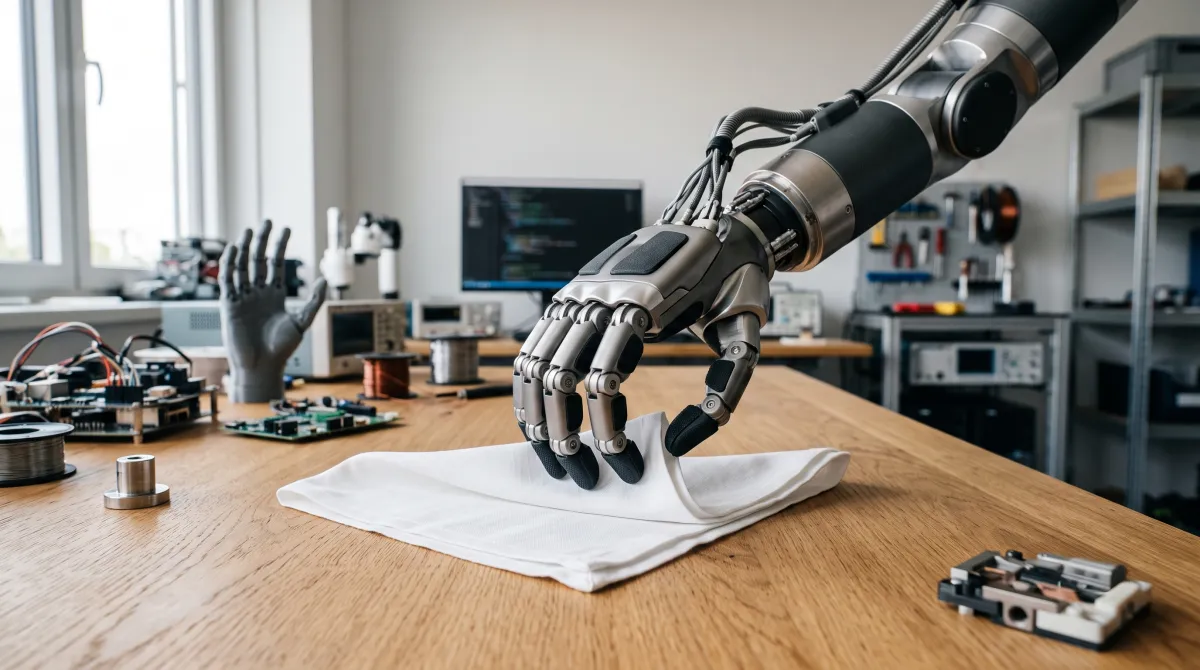
The problem RLWRLD is solving is deceptively simple. Robots are good at repeating the same motion millions of times. They are terrible at tasks that require fine motor skills, situational awareness, and physical feedback. A robot can move a pallet across a warehouse. It cannot rotate a hex nut between its fingertips.
McKinsey estimates that robot-capable tasks account for only 13 percent of U.S. work hours. Most physical work still demands dexterity that technology cannot reliably replicate.
RLWRLD's approach starts on the factory floor. Before collecting data at scale, an assessment team goes into the actual worksite, films the work, breaks it down task by task, and maps where human-like dexterity is the real bottleneck. The team then captures real worker motions using body cameras on the head, chest, and hands — not in a lab, but on the actual service floor.
The result is a 4D+ data pipeline: spatial, temporal, and physics interaction data from real workplaces.
RLWRLD's architecture reflects this data-centric philosophy. The model is built on a Multi-Stream Action Transformer (MSAT), where each sensory modality gets its own processing stream. Vision, torque, motion, and memory are processed in parallel, then fused through joint self-attention. This prevents any single modality from dominating the training process, a common failure mode in vision-language-action models.
The model ships as an 8.1-billion-parameter open-source foundation model. It is hardware-agnostic, supporting single-arm, dual-arm, and humanoid embodiments. It achieves state-of-the-art results on eight simulation benchmarks, including RoboCasa and LIBERO, outperforming Nvidia's GR00T N1.6 and Physical Intelligence's π₀.₅.
On RoboCasa GR-1 Tabletop, RLDX-1 reaches 58.7 percent success rate, outperforming the next-best frontier model by up to 18 percent.
The partnership with Nvidia is the most important signal. RLWRLD and Nvidia jointly launched DexBench, a global standard framework for measuring robotic dexterity across five dimensions: Grasp Diversity, Spatial Precision, Temporal Precision, Contact Precision, and Context Awareness.
DexBench is built on 18 atomic tasks drawn from actual industrial workflows — assembly, sorting, packaging — and links benchmark scores to deployment readiness. It is being integrated into Nvidia's Isaac Lab-Arena environment, creating a unified validation pipeline that spans simulation and real-world deployment.
Nvidia's robotics ecosystem lead called RLWRLD "a core partner in the physical AI ecosystem Nvidia is building."
RLWRLD has already identified more than 40 job groups, 400 tasks, and 4,500 atomic actions across its partner sites. The company is now moving from assessment to deployment, with more than 10 "Robotics Transformation" projects in progress.
DexBench is being adopted by Lotte, SK Telecom, CJ Logistics, Fuji, ANA, and Mitsui Chemical. The next-generation model, RLDX-2, is already in development. South Korea's government named humanoids a "K-Moonshot" national priority and launched a multi-institute "One-Team" system to accelerate physical AI development.
There are two unanswered questions. First, can RLWRLD scale from pilot projects to commercial deployment? Second, does it matter if a robot can fold a banquet napkin if the economics of a five-finger hand are still 10 times the cost of a simple gripper? RLWRLD says yes. The market will decide.
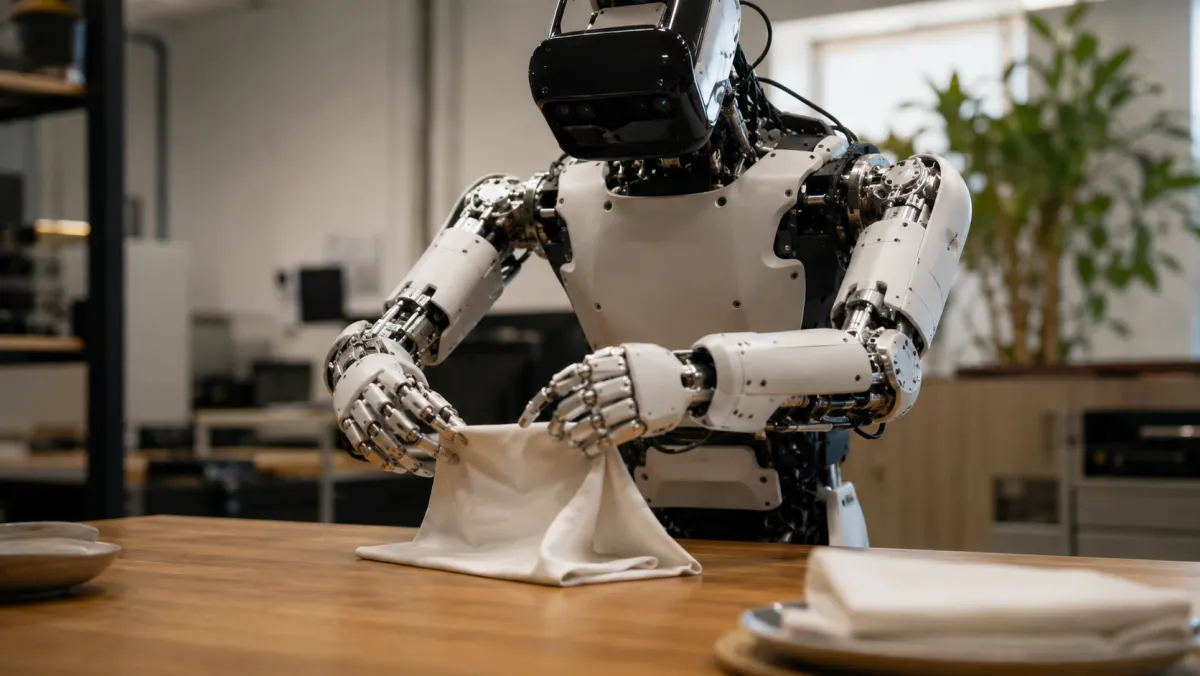
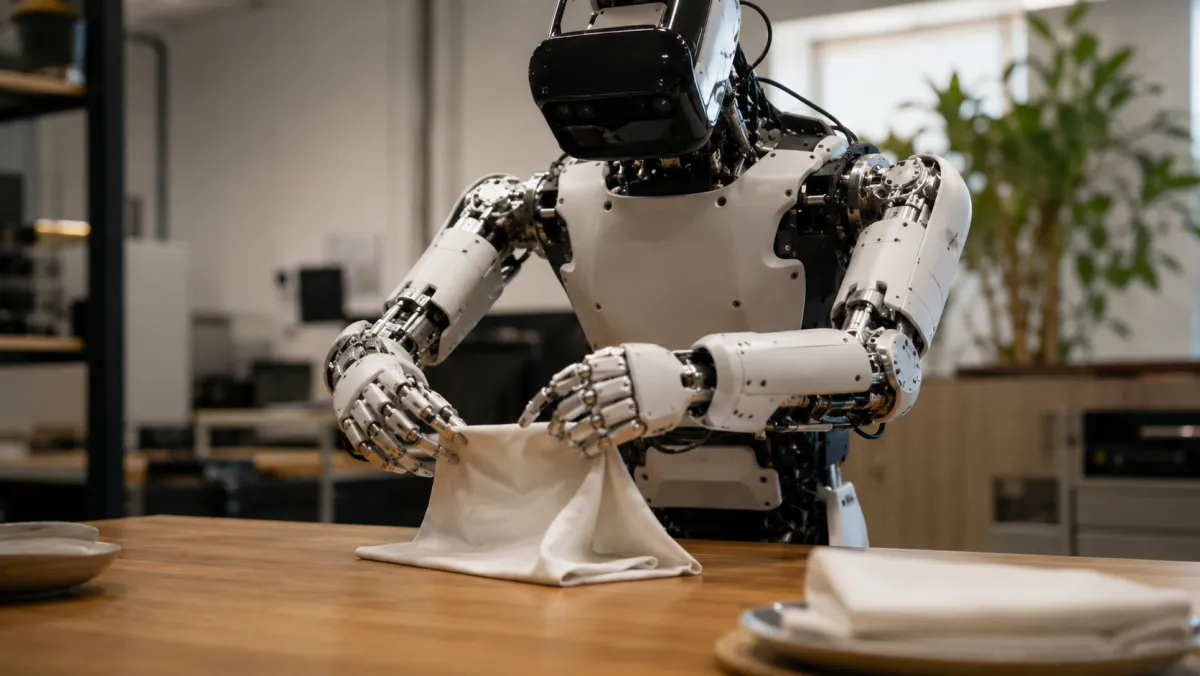
P.S. If you're an engineer building physical AI, the question isn't "can we make a robot hand that can fold a napkin?" It's "can we capture enough real-world data to make that skill transferable to a factory, a warehouse, and a hotel?" RLWRLD's bet is that the data is the moat, not the model. The hotel napkin folder is the data factory.
Frequently Asked Questions
Q: What is a robot wrangler?
A: A robot wrangler is a human responsible for setting up, overseeing, and troubleshooting robots in real-world environments . The job involves tasks like swapping batteries, cleaning sensors, upgrading software, rescuing stuck robots, and occasionally completing deliveries when robots fail . In Los Angeles, wranglers make about $21-$26 an hour, roughly $54,000 a year at the top end . Many wranglers are former gig workers whose jobs were replaced by the robots they now service .
Q: Who are the big 4 in robotics?
A: The "Big Four" industrial robotics companies are Fanuc (Japan), ABB (Switzerland), KUKA (Germany, now owned by China's Midea Group), and Yaskawa (Japan) . They collectively control approximately 60% of the global industrial robot market, dominating automotive manufacturing, electronics assembly, and general industrial automation . Fanuc is the largest, with over 750,000 robots installed worldwide .
Q: Who is the highest paid robot engineer?
A: According to Indeed salary data for the United States (updated July 2026), Meta pays robotics engineers the highest average salary at $248,500 per year . Other top-paying companies include Tailored Management ($242,320), Zoox ($235,600), and Scale AI ($232,875) . The national average for robotics engineers is $126,916 per year . In China's competitive market, core algorithm roles can pay 1 million yuan ($138,000) annually for fresh PhD graduates, with top performers reaching 2-3 million yuan .
Q: What is Elon Musk's AI robot called?
A: Elon Musk's humanoid robot is called Optimus (formerly known as the Tesla Bot) . It stands nearly six feet tall and weighs 154 pounds . Musk has said Optimus could be Tesla's "biggest product ever" and eventually cost $20,000 to $25,000 to produce . Tesla has stopped producing the Model S and Model X to make room for an Optimus production line in Fremont, California . The first robots will be used internally at Tesla's "Optimus Academy" to collect training data, with consumer sales expected by 2027.