
If you‘ve used ChatGPT’s voice mode, you‘ve felt it. The assistant is slower. Less thoughtful. More likely to give a shallow answer. It feels like you’re talking to a different — and dumber — version of the same AI.
That‘s because you are. OpenAI’s text models have raced ahead to GPT-5.5-level reasoning. But the voice stack has been running on older, less capable models. The gap between“text intelligence” and“voice intelligence” has been real, and it‘s been holding voice adoption back.
OpenAI is about to fix it. The company is preparing to launch GPT-Bidi-1, a next-generation bidirectional audio model that can listen while it speaks, absorb interruptions, and adjust its response mid-sentence. Instead of freezing when you say“actually, wait,” it picks up the thread and adapts.
How It Works: From Walkie-Talkie to Conversation
Current voice assistants are walkie-talkies. You talk. They listen. They process. They respond. If you speak during their response, the system freezes. No real conversation happens — just turn-taking.
BiDi changes the architecture. The model processes your microphone input and generates audio output in parallel. It‘s always listening, even while talking. When you interrupt, it recalculates context and adjusts its response in real time.
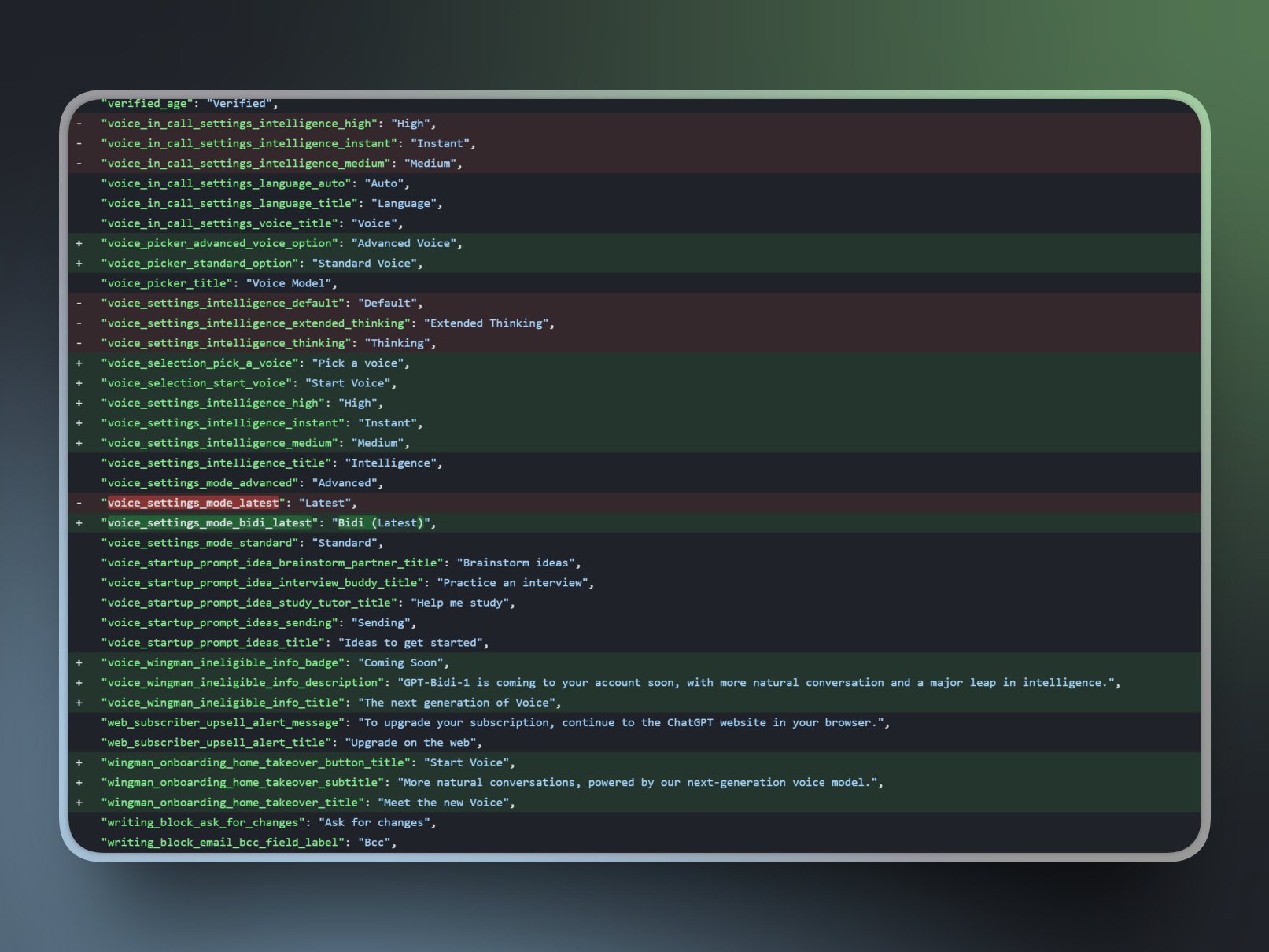
Three intelligence levels will mirror the text side: High, Medium, and Instant — letting users trade speed for depth depending on the task. Quick translation? Use Instant. Complex technical debate? Use High.
The rollout looks close. Signs of GPT-Bidi-1 have appeared in both web and mobile code. Users may get a toggle between the current Advanced Voice Mode and the new“Bidi (Latest)” mode.
What This Really Means
The immediate benefit is natural conversation. But the strategic implication is bigger. OpenAI is betting that voice — not text — becomes the primary way people interact with AI. That‘s why the company is reorganizing teams, building an audio-first hardware pipeline, and working with Jony Ive on a family of voice-first devices.
The challenge: voice has lagged behind screens for decades. Most ChatGPT users still type, not speak. OpenAI needs to change that behavior. A model that actually holds a conversation — not just processes commands — is how you do it.
One more detail: the model will be better at calling external tools and adapting to customer service scenarios — like switching from a return request to an exchange without resetting. That’s not a demo. That‘s real business value.
The Gap That’s Finally Closing
Text AI has been brilliant. Voice AI has been a step behind — less reasoning, less depth, less usefulness. The gap was a choice, not a limitation. OpenAI prioritized text first.
GPT-Bidi-1 closes that gap. When voice catches up to text, the barrier to AI adoption drops. Speaking is easier than typing. And easier means more users, more use cases, and more devices.
The One Thing That Matters
Most people think voice AI is just“AI that talks.” It’s not. Voice AI is“AI you talk to.” That distinction only matters if the model can actually hold a conversation. GPT-Bidi-1 is the first time OpenAI has built a voice model that can do that.
P.S. The name“Bidi” stands for bidirectional. It listens while it talks. Interrupt it mid-sentence and it adjusts, no awkward pauses. It sounds simple. It‘s taken years to build. And it’s the thing that turns AI from a tool you type at into something you actually talk to.