
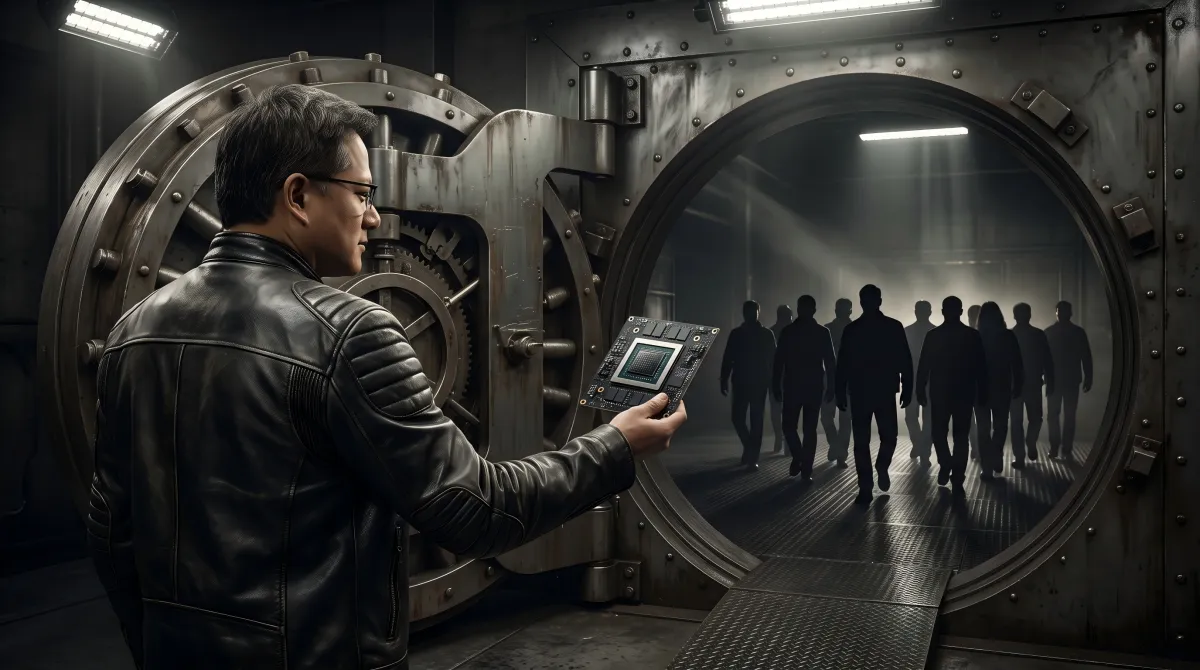
Nvidia is in talks with OpenAI to guarantee roughly $250 billion for its Ohio data center project. The site, developed by a SoftBank energy subsidiary, could total $500 billion including internal chips.
This is not an equity investment. It is a credit guarantee. Nvidia's role has shifted from "selling chips" to "acting as a bank."
OpenAI lacks an investment-grade credit rating and cannot secure financing of this scale on its own. Nvidia's guarantee reassures lenders. The guarantee covers lease and construction debt, but not the chips themselves.
The capital loop is classic: Nvidia guarantees → OpenAI obtains financing to lease Nvidia hardware → the data center, once built, procures Nvidia chips. Jensen Huang is backing Sam Altman's AI ambitions with his own balance sheet.
Nvidia spent years building the CUDA moat. But the real driver is not the software stack — it's the financing layer. When Nvidia guarantees lease projects, it becomes embedded in the capital structure of every major AI facility.
That is harder to replace than any codebase.
Earlier reports suggested Nvidia was "scaling back" its $100 billion funding support for OpenAI. The $250 billion guarantee tells a different story: Nvidia didn't scale back — it changed the mechanism. Instead of direct equity, it is using project financing to lock in future chip orders while consuming less capital.
Huang has said investments in AI companies boost his business and generate returns. But critics worry this could artificially inflate demand and push AI valuations into bubble territory.
The site itself tells a larger story. It sits on the former Portsmouth uranium enrichment plant in Pike County, Ohio — a Cold War facility that produced weapons-grade uranium for the US nuclear program before closing in 2001.
Ten gigawatts is roughly the output of a large nuclear power plant, enough to power about 8 million US homes. The first phase is expected online in 2028, delivering about 800 megawatts.
The project is funded separately by Japan under a recent trade agreement. Commerce Secretary Howard Lutnick has been involved in power allocation decisions. AI infrastructure is no longer just about better models — it's about who controls infrastructure, supply chains, and energy systems.
Nvidia is not alone in this model. Google previously backed roughly $35 billion in TPU lease obligations for Anthropic across five data centers.
The trend is called "credit wrapping" — investment-grade tech giants use their balance sheets to help smaller companies finance infrastructure.
Huang's logic: "trillion-token factories" require data centers at unprecedented scale, and heavy infrastructure faces massive capital and energy bottlenecks. Nvidia's guarantee, combined with government-backed power, clears both hurdles for OpenAI's expansion.
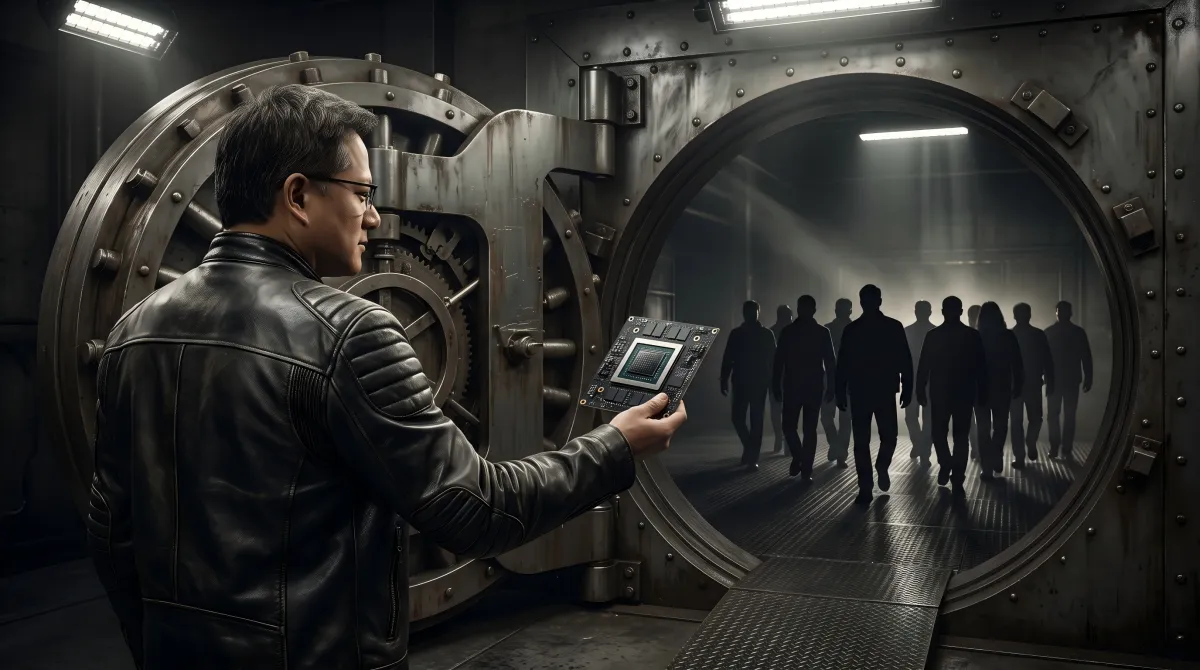
Michael Burry, the investor known for predicting the subprime crisis, posted on X: "Here we go again." Last week, he expanded his short position on Nvidia.
Jefferies global equity strategist Chris Wood warned that hundreds of billions in AI infrastructure investment could end in "large-scale capital destruction."
Nvidia itself warned in its annual report that its data center financing program could reduce near-term cash flow and increase credit risk. The CoreWeave deal capped exposure at $6.3 billion. This one could be orders of magnitude larger.
P.S. If you are watching AI infrastructure, the question is no longer "how many chips can Jensen sell?" — it's "how much debt can he guarantee?" The $250 billion number is still in negotiation, but the trend is irreversible: chip companies are becoming banks, and 2008 taught us what happens when debt chains get long enough.
Frequently Asked Questions
Q: How much did Nvidia just invest in OpenAI?
A:Nvidia has shifted from direct equity investment to providing a massive $250 billion financing guarantee for OpenAI's Ohio data center project, rather than making a new cash investment ; the guarantee would help OpenAI lease a 10-gigawatt site developed by SoftBank's SB Energy that could cost over $500 billion total, and Nvidia is also discussing a separate $350 billion chip financing arrangement .
Q: Did Nvidia invest $100 billion in OpenAI?
A:Yes, Nvidia initially announced plans to invest up to $100 billion in OpenAI in September 2025 , but CEO Jensen Huang later scaled this back, citing OpenAI's plans to go public, and in March 2026 Nvidia instead contributed $300 billion to a funding round that valued OpenAI at $730 billion .
Q: Is Nvidia no longer investing in OpenAI?
A:No — Nvidia's support has shifted from direct equity to project financing; it is now providing a $250 billion guarantee for OpenAI's data center lease, effectively acting as a credit backstop rather than an equity investor , and Huang has indicated this is likely Nvidia's "last" major strategic investment before OpenAI goes public .
Q: Did OpenAI secure $40 billion in funding at a $300 billion valuation?
A:Yes, in March 2025, OpenAI closed a $40 billion funding round led by SoftBank (with a $30 billion commitment) at a $300 billion valuation ; the round included a condition requiring OpenAI to restructure as a for-profit entity by the end of 2025 .
Q: Who owns 51% of OpenAI?
A:No single entity owns 51% of OpenAI; according to SEC disclosures, Microsoft holds the largest disclosed stake at approximately 27% after capital restructuring , and Nvidia holds about 3.47% , but no public company has disclosed a majority stake.
Q: Who are the biggest funders of AI?
A:The biggest funders of AI include SoftBank (which led OpenAI's $40 billion round with $30 billion), Microsoft (OpenAI's largest equity holder at ~27%), MGX from Abu Dhabi (which closed a $49 billion AI fund in June 2026), Sequoia Capital (the most active VC investor in AI for four consecutive years), and Nvidia, which is now acting as a financing guarantor rather than a pure equity investor.