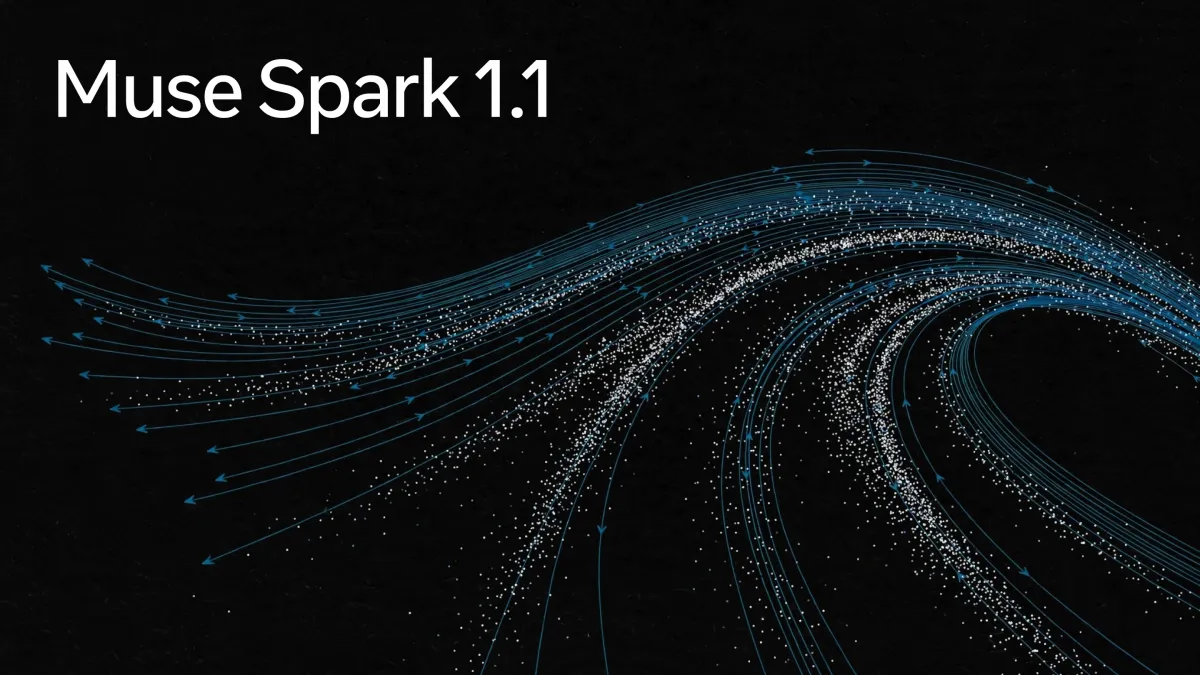
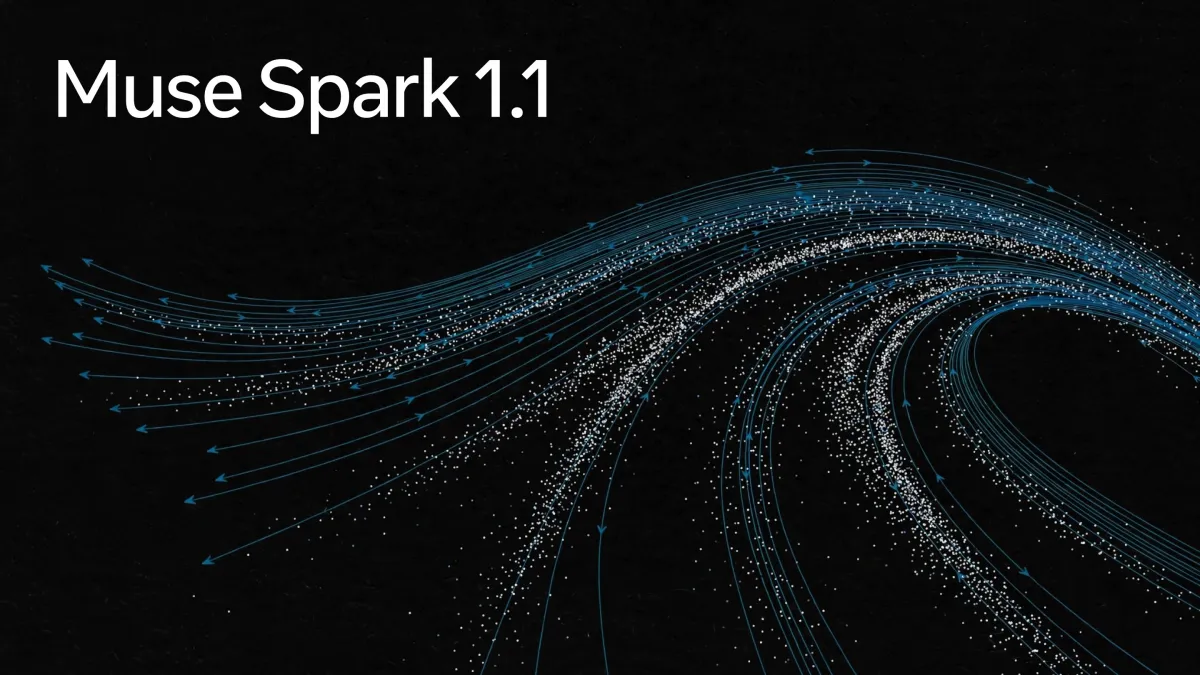
Meta released Muse Spark 1.1 today. The upgraded model writes and debugs code. It uses external tools. It understands text, images, and video. It handles complex multi-step tasks with minimal human intervention.
The company says it's its most capable model for real-world coding and agentic tasks. Third-party partners seem to agree. Replit CEO Amjad Masad said the combination of a million-token context window, deep multimodal support, and advanced coding capabilities "fundamentally changes how we think about scale."
Box's VP of AI Products said Spark 1.1 performed "head-to-head" with top-tier frontier models on internal enterprise evaluations. This is a serious model. But the real story isn't what it can do. It's what Meta is doing with it.
The timeline matters. Muse Spark 1.1 arrives just three months after the original Muse Spark launched in April. That's fast. The superintelligence team assembled last year is clearly moving at a different pace than the old Llama organization.
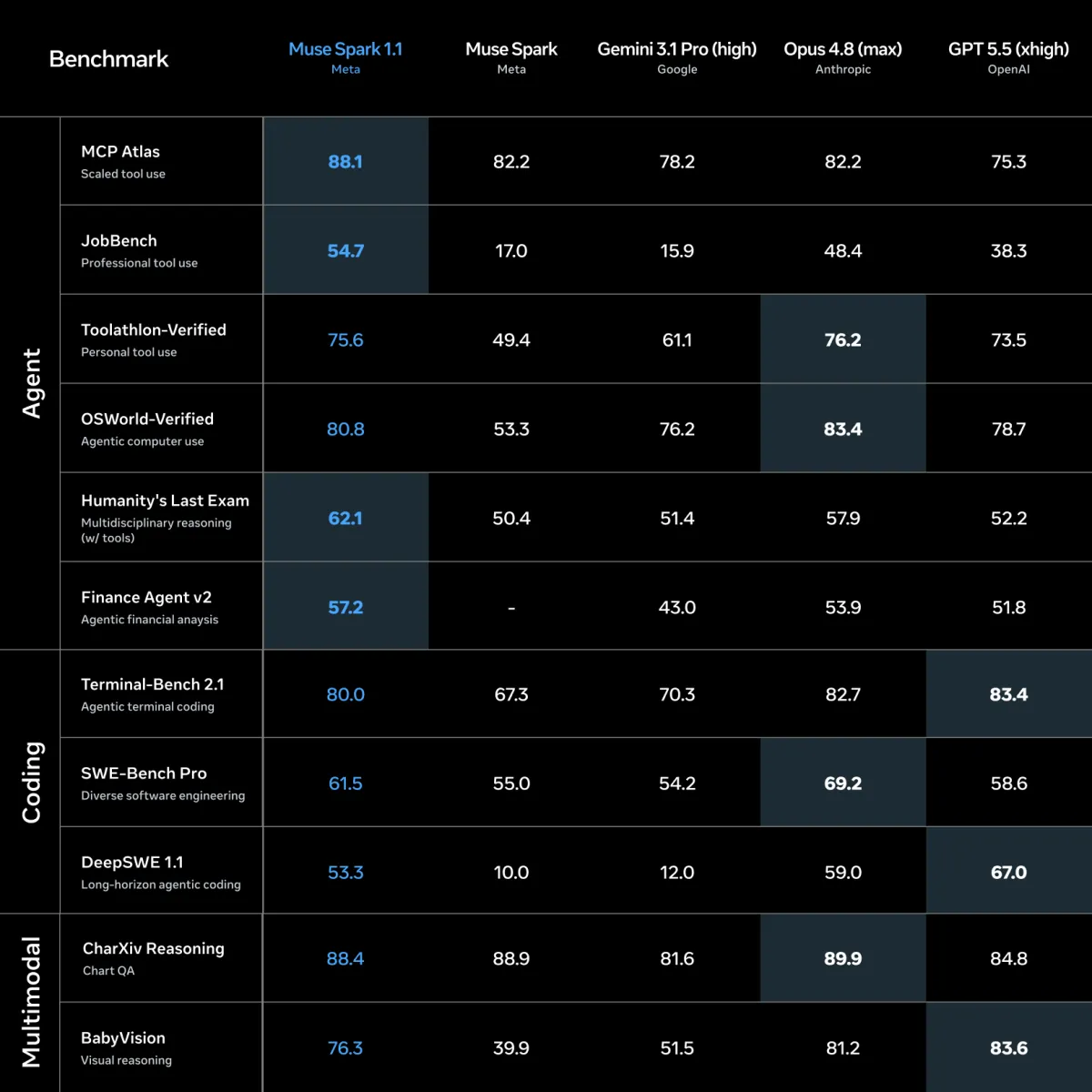
The performance numbers are strong. Internal tests show Muse Spark 1.1 outperforms its predecessor on Meta's Internal Coding Bench. It can autonomously diagnose bugs, implement new features in legacy enterprise code, and execute large-scale migrations.
In agentic evaluations, it's reportedly competitive with GPT-5.5 and Claude Opus 4.8. The architecture is ambitious. The model can function as both a "primary agent" and a "subagent" simultaneously. It breaks down complex tasks and delegates them to parallel subagents. That's the multi-agent design everyone in AI is racing toward.
The Price Tag That Changes Everything
Now let's talk about the API. Muse Spark 1.1 is available through the new Meta Model API. Developers in the U.S. can sign up for public preview. They get $20 in free credits. Then it switches to pay-as-you-go.
The price: $1.25 per million input tokens, $4.25 per million output tokens. That's above OpenAI's entry-level GPT-5 mini and Anthropic's low-cost Claude Haiku 4.5. It's below Anthropic's higher-end Claude Sonnet 4.6.
But here's the thing. Meta CEO Mark Zuckerberg said the company planned to price below competitors. That's not what happened. The company is charging a premium for access to its "most capable" model, not discounting it.
This marks a major shift for Meta. The company spent years championing open-source AI. Llama was its crown jewel. Free weights. Broad access. Developer-friendly. That was the narrative.
Now? Muse Spark is closed. The API is paid. The model is proprietary. The Llama-era ethos is gone. Meta says it still plans to release "increasingly advanced open-source models" in the future. But the company is no longer leading with that message. The priority is monetization.
Meta Is Now Just Another AI Vendor
The shift isn't hard to explain. Meta is spending up to $145 billion on AI infrastructure this year. That's roughly its entire net profit for fiscal 2025. The company needs to show returns. Paid APIs are the most direct path.
OpenAI does it. Anthropic does it. Google does it through its cloud platform. Now Meta is doing it too. The difference is the narrative. OpenAI was always commercial. Anthropic was always commercial. Meta spent years positioning itself as the open alternative.
Now it's just another AI vendor charging for API access. That's not necessarily wrong. It's a business. But it changes how developers should think about Meta.
The company is no longer the open-source champion. It's a commercial AI provider with a very large social media distribution network. The API is priced competitively, but not aggressively. The model is strong, but not dominant.
The strategy is clear: build the best model, charge for it, integrate it into Instagram and WhatsApp, and hope developers and users pay. For enterprises, this means another option in the AI procurement process. For developers, it means more API choices.
For Meta, it means finally turning AI into revenue. But the free Llama era is over. And that changes everything.
P.S. If you're a developer who built on Llama because it was open, you're now a customer. That's the shift. Meta isn't a community partner anymore. It's a vendor. And vendors charge.