A leaked promotion page briefly appeared on Kimi's API platform today. It promised a "Kimi K3 launch limited-time recharge campaign" starting July 15 at midnight China time. It was pulled within hours. The message was clear: K3 is coming. Probably today.
But the real news isn't the date. It's what the model is supposed to be — and what that means for the AI industry.
The reported specs are staggering. 2.5 trillion parameters. A 1-million-token context window. A new architecture optimized for long-horizon agent tasks. That's bigger than DeepSeek V4 Pro's 1.6 trillion. Bigger than Baidu's Wenxin 5.0 at 2.4 trillion. It puts K3 at the top of the Chinese parameter leaderboard, if the rumors hold.
But "biggest" isn't the same as "best." And that's where the story gets interesting.
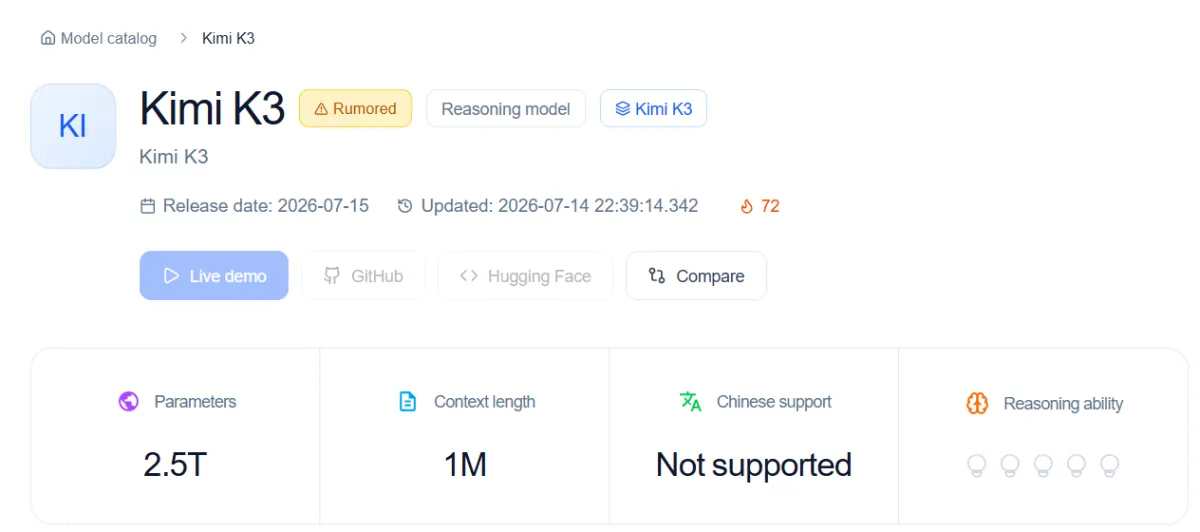
The architecture matters more than the count. Moonshot AI's founder Yang Zhilin revealed on Reddit that K3 will likely use KDA, an experimental hybrid attention architecture. In fairness, the team found KDA outperforms full attention models while staying efficient.
That efficiency is the key. The model runs on H800 GPUs — not the latest H100s or Blackwell chips. Moonshot's CTO admitted the team is "outnumbered" by US competitors on hardware. So they optimize. KDA is designed to help them bridge the hardware gap.
The 2.5T parameter count is a number. The KDA architecture is the actual bet.
Then there's the cost question. K3 reportedly has 1M token context window capabilities — but whether it will be available to ordinary users depends on compute costs. K2.5's API pricing is already 6.5x DeepSeek's. If K3 keeps that premium, its potential reach will be limited.
Moonshot's alternative: keep raising prices and focus on paying enterprise customers. That's what's working — their API ARR tripled from $100 million to $300 million in three months after a 60% price hike.
K3 continues that story. A bigger, smarter model with a "new architecture" narrative — but potentially priced out of reach for casual users.
The "2.5T" headlines will dominate Chinese tech media today. KDA is a more interesting story. And the pricing question may determine whether K3 actually competes with DeepSeek's efficiency or just becomes another premium API product.
P.S. If you're a developer reading this: wait for official benchmarks. "2.5T" without actual performance data is just a number — and if the pricing is 6.5x DeepSeek, that number will matter a lot less than the multiplier.