Jensen Huang did it again.
On June 1, COMPUTEX 2026 kicked off in Taipei. The NVIDIA CEO's keynote drew the usual crowd — but this time, he brought more than just faster silicon.
"The era of useful AI and agentic AI has arrived," Huang said from the stage.
It sounded like a tagline. But the numbers behind it told a more compelling story than his signature leather jacket.
Tokens as Assets: The New Oil of the AI Era
Huang introduced a new conceptual framework: Tokens are assets. Tokens are profit units. Tokens are GDP generators.
This wasn't just rhetorical flair. His logic: in an agentic AI-driven world, every token generated can create economic value. Companies won't just "use AI" — they'll "produce tokens." And that will become the new unit of economic output.
"The computing paradigm for the next decade is agents, not applications," he said.
Here's what that means. Traditional software logic: user opens an app → completes a task. AI agent logic: user states a goal → AI completes it automatically. That sounds like a UX upgrade. But the underlying shift is revolutionary — compute consumption goes from "per request" to "continuous," and tokens become the currency of this new paradigm.
1.4 Billion AI Coding Sessions: More Developers, Not Fewer
Huang also shared a number that made developers both excited and anxious.
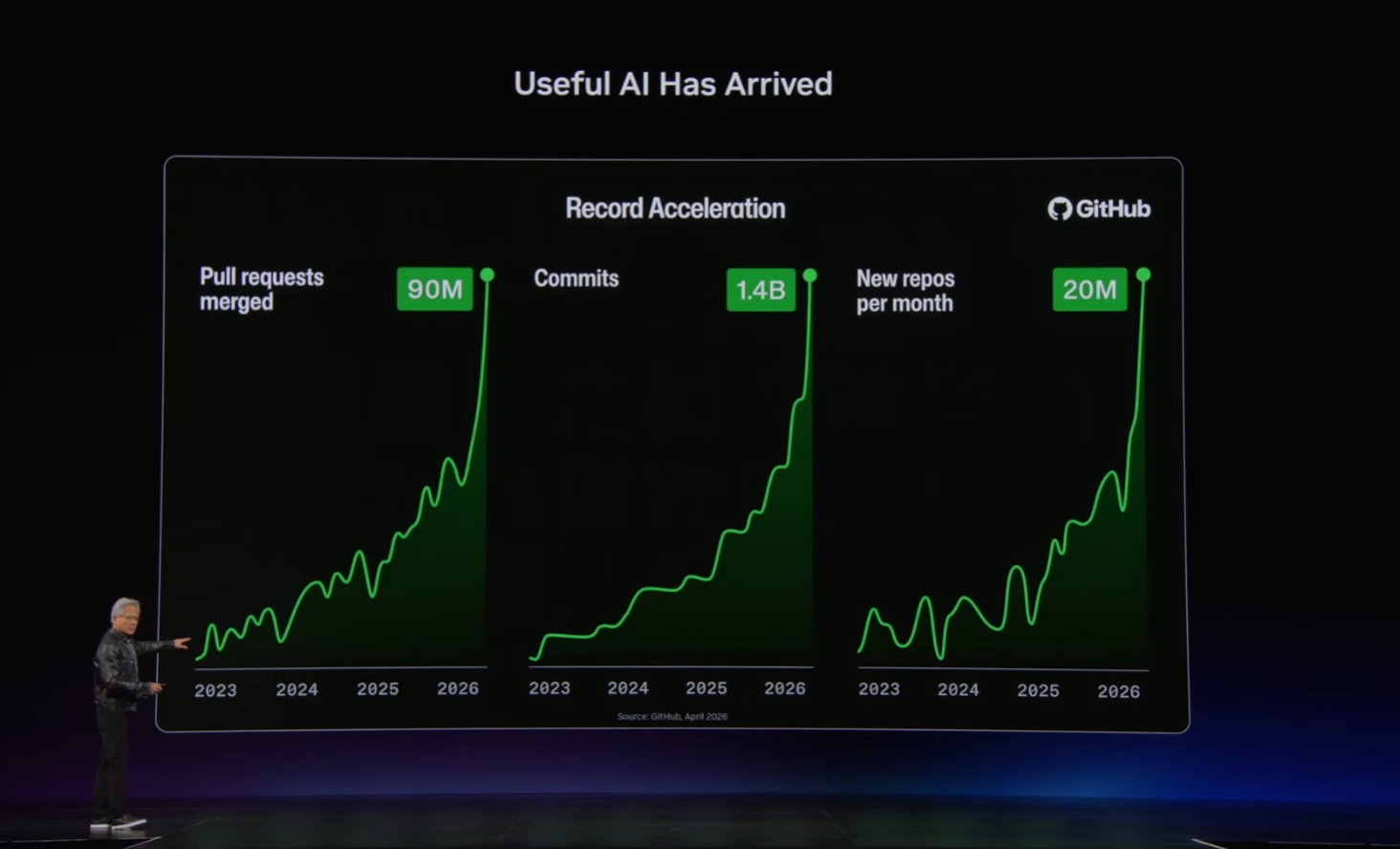
In the first few months of 2026, global AI coding usage jumped from 500 million to 1.4 billion sessions — a nearly threefold increase in just six months.
If you believed the "AI will replace programmers" narrative, this should mean massive job losses. Huang gave the opposite conclusion.
"Some say AI will reduce jobs — that is complete nonsense," he said.
What's his evidence? NVIDIA has observed that the spread of AI coding tools has actually enabled more people to participate in software development. The barrier dropped. But demand didn't shrink — in fact, the total number of software engineers is increasing, because companies can now do more.
"Every company is becoming a tech company," he said. "And tech companies need more engineers, not fewer."
This is counterintuitive but increasingly validated: AI isn't eliminating coding work. It's redefining what "coding" means. You used to need mastery of syntax and frameworks. Now you need to understand architecture and intent. The barrier shifted from "how to write" to "what to write" — and the latter requires more human judgment, not less.
NVIDIA Declares War on Intel: The PC Chip Shakeup
On the hardware side, the biggest announcement was this: NVIDIA is officially entering the PC chip market.
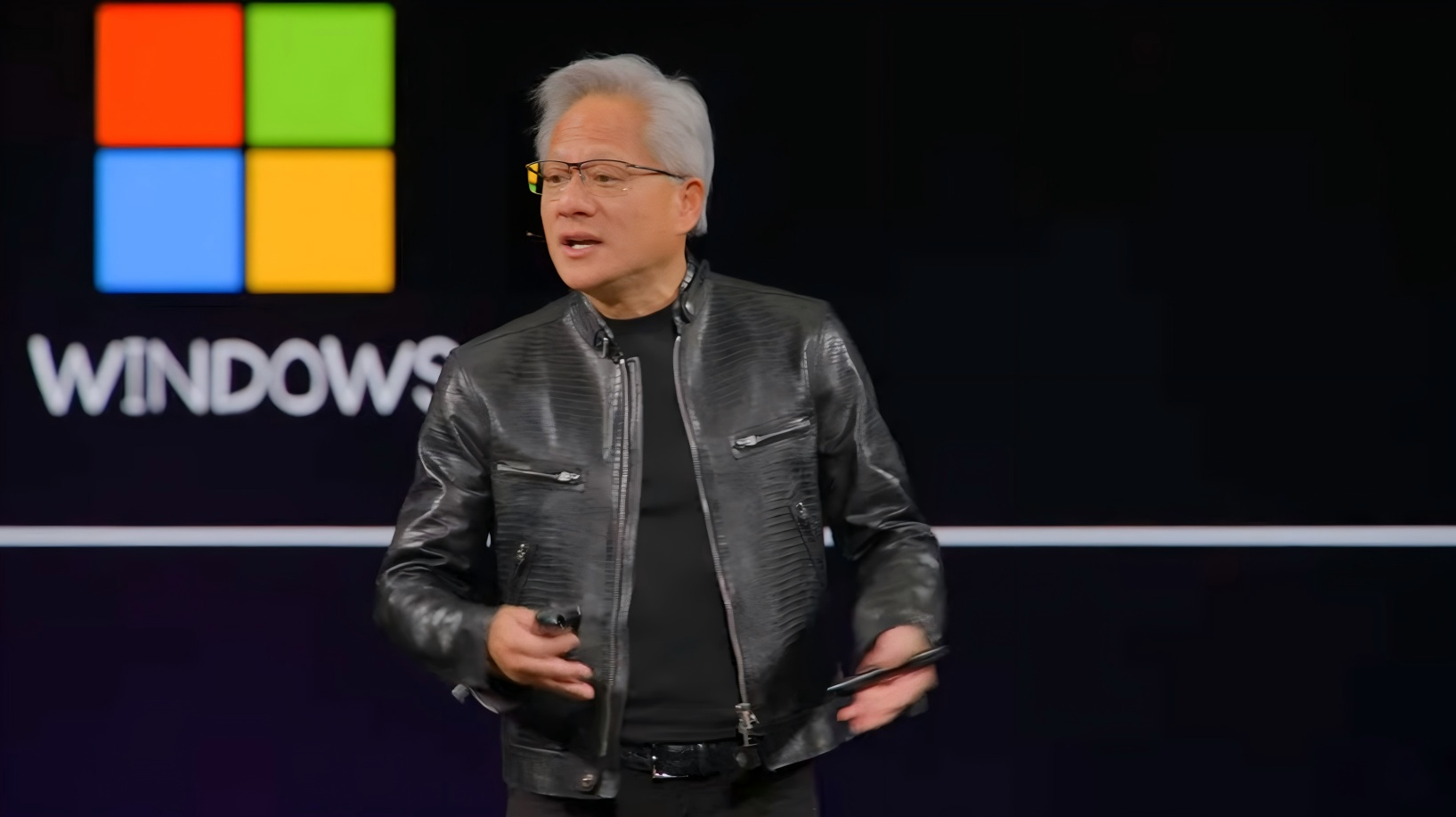
Huang unveiled the RTX Spark chip, built in partnership with Microsoft to create a Windows AI PC platform, alongside Arm to challenge the x86 duopoly of Intel and AMD.
What does this mean?
In plain English: your PC's brain used to be an Intel or AMD CPU. In the future, it might be NVIDIA's. When AI becomes the core function of a PC, whoever controls the AI chip controls the next generation of PC standards.
Huang also announced that the Vera Rubin platform is now fully in production, with the Vera CPU purpose-built for AI agents. On top of that, NVIDIA released Cosmos 3 and Alpamayo 2, and open-sourced its robot foundation models — a major step toward "physical AI."
The Market Votes with Its Wallet
No sooner had Huang finished speaking than the market started voting with real money.
NVIDIA's night session rose nearly 3%. In Taiwan, Quanta Computer jumped 9.9%, Wiwynn rose 9.8%, and ASUS gained 10%. In China's A-share market, the multimodal AI sector strengthened, with iSoftStone hitting the 20% daily limit.
Investors understood Huang's message: AI is not a bubble. It's infrastructure. And NVIDIA is laying the tracks.
Of course, skeptics remain. Some analysts warn: "The AI economy cannot deliver returns for every participant — a correction will come sooner or later." But at least for today, Jensen Huang is the one standing on stage, and the world is listening.
P.S. If you're still worried about AI taking your job, Huang's answer is: you're worried about the wrong thing. What you should worry about is everyone else using AI to code while you're still typing everything by hand.