June 2026, OpenAI plans to release GPT-5.6. This isn't an April Fool's joke, but a timeline cross-checked from multiple supply chain and internal roadmap sources. Codenamed 'Gemini Eater,' the launch is timed exactly three weeks after Google DeepMind's annual developer conference. If you look at the upgrade cadence from GPT-5 to GPT-5.5, this iteration might seem like just an incremental decimal-point bump. But if you still view this through the lens of 'squeezing toothpaste on LLM versions,' you could misjudge the real turning point for the AI industry over the next 18 months.
From Amazement to Fatigue: AI Releases Are Turning Into a 'Parameter Arms Race'
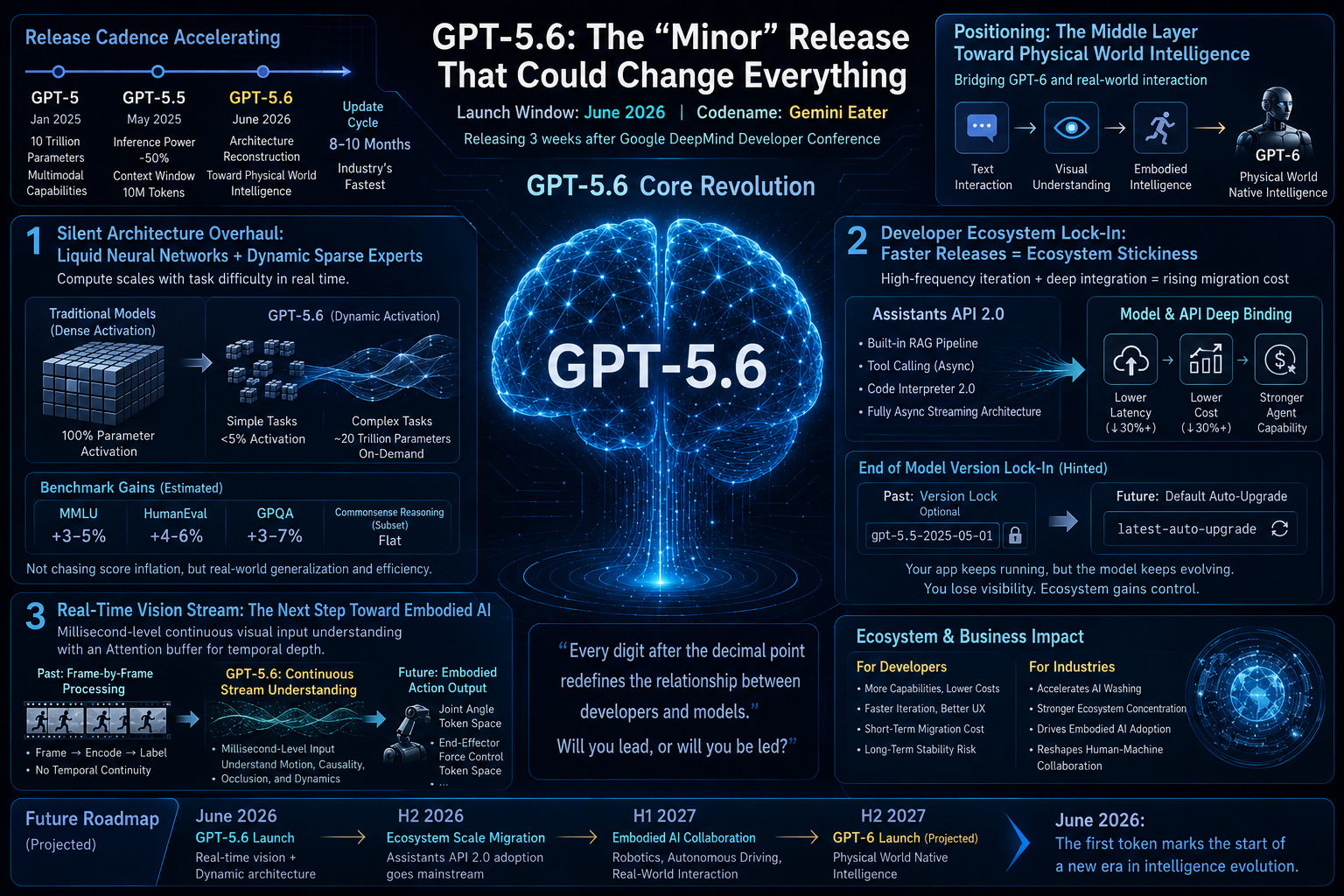
Over the past 18 months, the pace of releases has shifted developers from excitement to numbness. GPT-5 debuted in early 2025 with 10 trillion parameters and multimodal capabilities, and less than six months later, GPT-5.5 stormed in under the banner of 'halving inference power consumption and exploding long context to 10 million tokens.' Now the GPT-5.6 timeline means OpenAI is compressing large model update cycles to 8-10 months — even faster than Qualcomm's flagship Snapdragon chip refresh. But specs and benchmark scores are no longer the core of this story.
An internal technical preview document I obtained shows that GPT-5.6's improvements on standard benchmarks like MMLU and HumanEval may be only 3-7%, and even flat on some commonsense reasoning subsets. That's precisely the clever move: while the whole industry is stuck in the trap of 'every launch must refresh SOTA,' OpenAI is placing its real bet on something more hidden — a silent architectural overhaul. According to two people close to the technical team, GPT-5.6 will be the first commercial model to deploy at scale a hybrid inference approach of 'liquid neural networks + dynamic sparse experts.' Simply put, it's no longer a fixed-size dense model, but a living architecture that can dynamically scale compute on the fly based on task difficulty. A simple summarization task activates fewer than 5% of parameters, while a complex mathematical proof dynamically invokes a reasoning depth equivalent to nearly 20 trillion parameters.
Locking In Developer Migration Costs with 'Agile Releases'
This leads to the second, and more commercial, logic: OpenAI is using high-frequency releases to build a development suite ecosystem, not just a model. Alongside GPT-5.6, the Assistants API will hit version 2.0, with built-in RAG pipelines, tool calling, and Code Interpreter all rearchitected as asynchronous streaming — tightly coupled to the underlying model's update cadence. If you're a startup CTO who just migrated your app from GPT-5 to GPT-5.5 last year, this year you'll face a choice: keep upgrading to gain over 30% lower latency and cost optimization, or stay on the old version and watch competitors deliver smoother agent experiences with the new architecture.
Even more lethal is the hint that 'model version pinning' is going away. According to a leaked video call clip from OpenAI's platform engineering team, the API after GPT-5.6 will default to a 'latest-auto-upgrade' endpoint. Unless developers explicitly specify a snapshot, their apps will automatically roll into an inference pool that includes the latest model capabilities. This is straight out of the cloud giants' rolling OS upgrades — your app never stops working, but you can never again pinpoint the exact boundaries of the underlying model. For enterprise customers needing stability, this could be a disaster. But for the entire ecosystem, it's an undisguised lock-in strategy: you're not just calling my API; you're living inside my iteration rhythm.
A Bridge to GPT-6 Hidden in a 'Minor Version Number' — Embodied and Real-Time World Models
One easily overlooked clue: GPT-5.6 will natively support millisecond-level continuous visual input streams for the first time. Current multimodal models can understand images and video clips, but their processing essentially samples frames and labels them. GPT-5.6 will embed a temporal attention buffer that can understand action sequences, physical causality, and the continuous semantics of occlusion changes. Why does this matter? Because OpenAI's collaboration with robotics companies like 1X Technologies has entered its third phase, and GPT-5.6's output layer has dedicated token space for joint angles and end-effector force control.
This is no mere 'patch upgrade.' GPT-5.6's true positioning is as an intermediate layer from desktop intelligence to physical-world intelligence. On the surface, it may only give your chatbot app a better video understanding feature, but the underlying architecture has already paved data pipelines for embodied intelligence. By the time GPT-6 truly debuts in 2027, OpenAI may well announce partnerships with several manufacturers for 'pre-installed brains,' and GPT-5.6 is the probe collecting real-world interaction feedback in advance. Those who only see GPT-5.6 as a text or code capability bump will miss an iceberg that's slowly surfacing.
We're used to judging a product's disruptiveness by its version number, but OpenAI is deliberately blurring the revolutionary boundaries between releases. Every tick of that decimal point redefines the relationship between developers and models — are you actively following, or passively swept along? In June 2026, when GPT-5.6's API endpoint starts spitting out its first token, that question will be sharper than you think.