79% of Global Compute Is Running Without a Safety Net
First Street Foundation‘s latest study delivered a number the industry cannot ignore: 79% of global data center capacity is exposed to elevated acute climate hazards, including flooding, extreme winds, and wildfires. An additional 54% sits in chronic climate stress markets — areas facing extreme heat and drought.
The Asia-Pacific region faces the greatest exposure: 89% of data center capacity in the region is at risk from acute climate hazards, compared with 50% in the Americas and 46% across Europe, the Middle East, and Africa.
The fastest-growing markets — Northern Virginia, Johor in Malaysia, and Marseille in France — rank among the most exposed.
First Street Chief Economist Jeremy Porter noted that most valuation models still use historical data to assess climate risk, but“the climate is no longer behaving the way the historical record would predict.”
Zurich Insurance has classified severe weather as the largest source of claims for its U.S. data center insurance book. The World Economic Forum estimates that by 2055, extreme weather could cost the data center industry $3.3 trillion in cumulative losses.
For the AI industry, this is not an environmental issue. It is a supply chain crisis unfolding in real time.
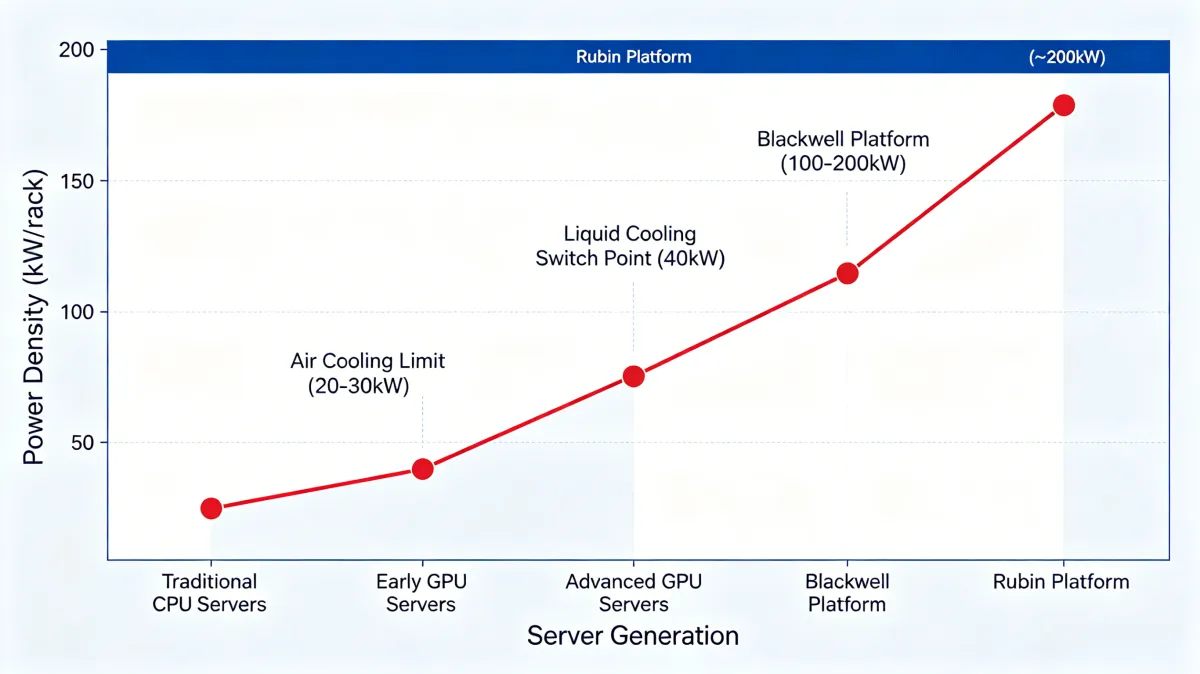
Air Cooling Hits Its Ceiling at 20-30kW
Traditional data centers, built around CPU servers with modest power density, were largely served by air cooling. But the AI era has changed the equation entirely.
NVIDIA‘s Blackwell architecture has pushed GPU power consumption well above previous generations, and new platforms like GB200 and GB300 are driving rack densities even higher. AI training servers now routinely exceed 30kW per rack, with some pushing toward 100kW and beyond. Conventional air cooling architectures are hitting their practical limits.
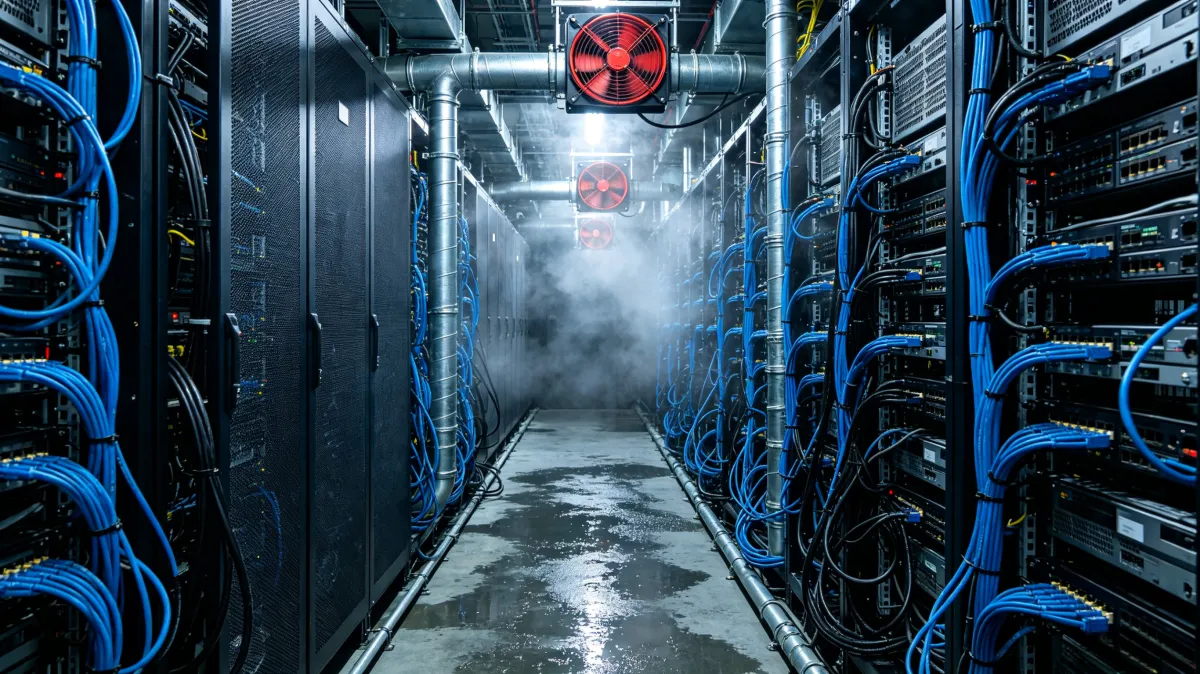
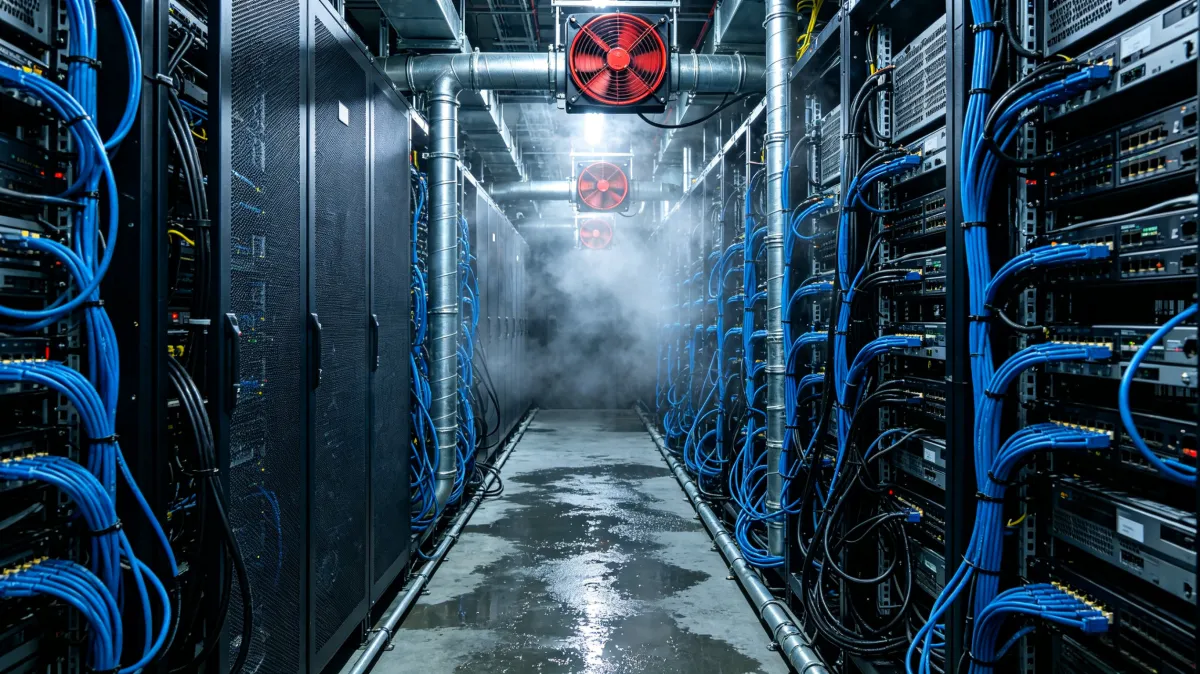
At these ultra-high heat flux densities, air cooling faces multiple failure modes: localized hot spots, fan power that exceeds compute power, GPU fan resonance, dust ingress, and noise levels exceeding 85 decibels.
Industry analysts estimate that roughly 40kW per rack is the threshold where liquid cooling becomes mandatory. Cologix, a data center provider, notes that traditional facilities handle up to 45kW per rack, but AI workloads now demand densities up to 135kW — with projections reaching 200kW per rack.
NVIDIA Rubin‘s 45°C Signal: A Commercial Tipping Point
On June 21, NVIDIA detailed the 100% liquid-cooled Rubin platform in an official blog post — the first HPC platform to achieve full liquid cooling across every chip and networking component, with no fans anywhere in the system.
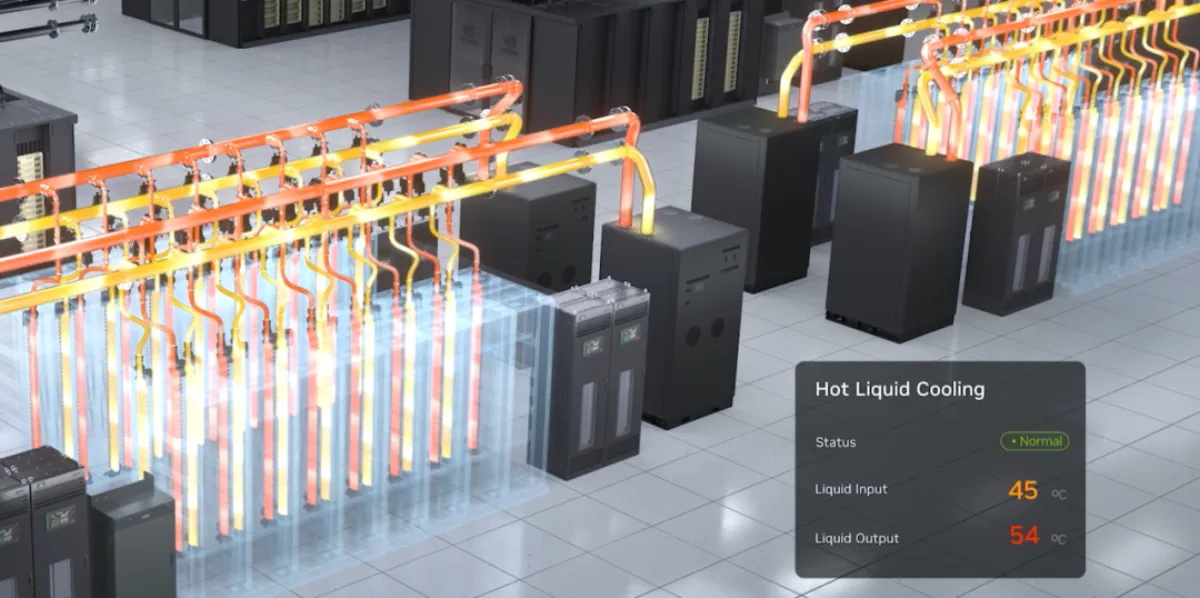
The most counterintuitive design choice: coolant inlet temperature of 45°C, exiting at roughly 55°C. Traditional data centers require very low ambient temperatures for effective cooling. NVIDIA‘s logic is simpler: as long as cold plates keep chip surface temperatures within operating limits, the coolant doesn’t need to be cold.
The direct result is a simultaneous reduction in energy and water use. Historically, cooling alone has accounted for up to 40% of data center electricity consumption. NVIDIA‘s approach, by raising coolant temperatures, allows dry coolers to reject heat directly to the outdoors without activating energy-intensive mechanical chillers in many climates. Facility cooling water consumption drops from roughly 2.6 million gallons per megawatt per year for conventional cooling-tower-based systems to near zero.
Every 1°C increase in coolant temperature reduces cooling energy costs by about 4%. A 50-megawatt hyperscale facility can save over $4 million annually in cooling-related energy and water costs after moving to liquid-cooled infrastructure.
The coolant composition is 75% water and 25% propylene glycol — leveraging water‘s excellent thermal conductivity while using propylene glycol for corrosion inhibition, system lubrication, and biological protection.
The Rubin platform also represents a larger statement: 100% liquid cooling is no longer experimental. Motivair President and CEO Richard Whitmore put it bluntly: “Once the watts per chip crossed a certain level, liquid cooling became mandatory.”
Liquid Cooling Is Reshaping the Supply Chain
Liquid cooling is transforming how data centers are designed, built, and operated.
At the Data Center World 2026 workshop in Washington, D.C., industry leaders described the shift as“the industry moving from traditional data centers — where IT and facility teams operate in silos, optimizing against each other around competing metrics — to fully integrated‘AI factories‘ where the entire system is judged by one metric: tokens-per-watt.”
The modern AI factory is a five-layer stack: energy, infrastructure, chips, models, and applications — all of which must scale together. Cooling is no longer a facility concern; it is deeply linked to chip performance and total factory token throughput.
Cadence‘s Reality Digital Twin approach demonstrates the tangible impact: optimizing operating parameters — cooling set points, workload distribution, and GPU operating points — can deliver up to 30% more tokens and 17% improvement in tokens-per-watt.
The value of full-stack optimization at scale is measurable. At a 1 GW AI factory, efficiency gains can translate into billions of dollars in additional annual revenue.
AI vs. Air Conditioning: A Battle for the Grid
When extreme heat drives up residential air conditioning demand, utilities prioritize residential customers. AI data centers find themselves competing for the same grid — and air conditioning always wins.
In May, PJM Interconnection, the grid operator serving data-center-heavy Northern Virginia, received emergency authorization from the Department of Energy to restrict power to data centers due to an“unusual heat event.”
The emerging pattern is clear: AI workloads are not steady. They are“bursty” — power draw can spike from baseline to peak in milliseconds as inference requests surge. Traditional cooling systems lag behind, creating thermal runaway risks.
As Johnson of Subzero Engineering notes, by 2026, the data center“will no longer function as a static host for digital infrastructure; instead, it will behave as a dynamic, adaptive system — one that evolves in real time alongside the workloads it supports.”
P.S. When NVIDIA heats its coolant to 45°C, it is not solving a cooling problem. It is redefining the physical boundaries of AI infrastructure. Cooling is moving from a cost line to a capability line. The next bottleneck for AI is not at the chip fab, not at the grid — it‘s at the heat exchanger.