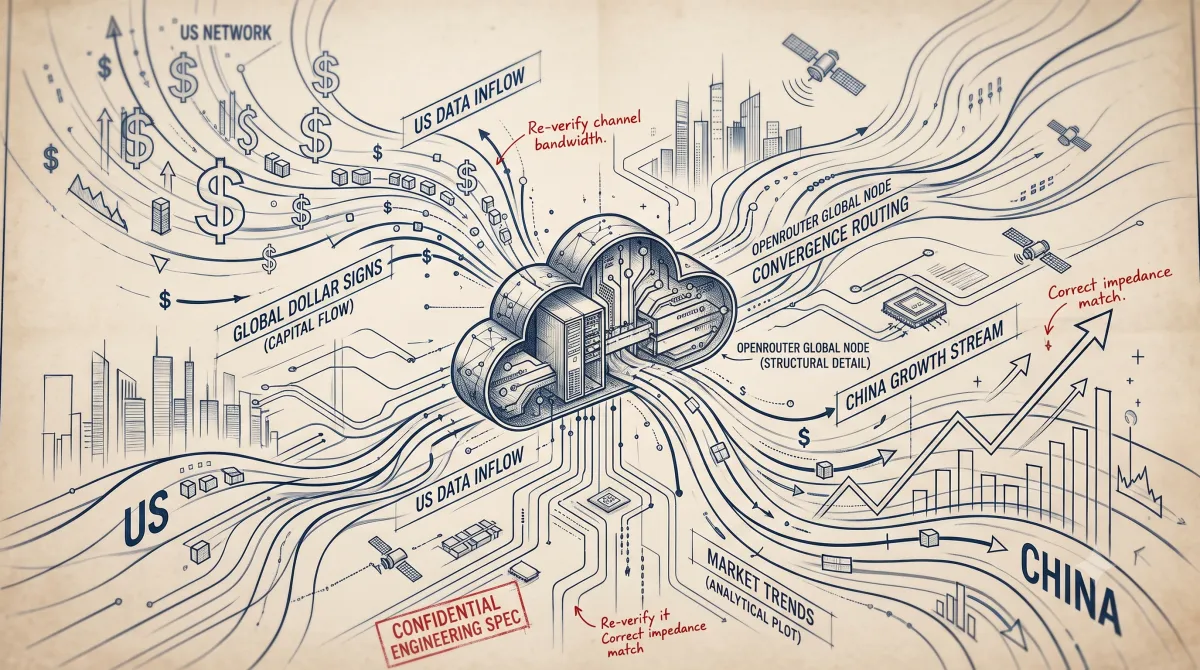
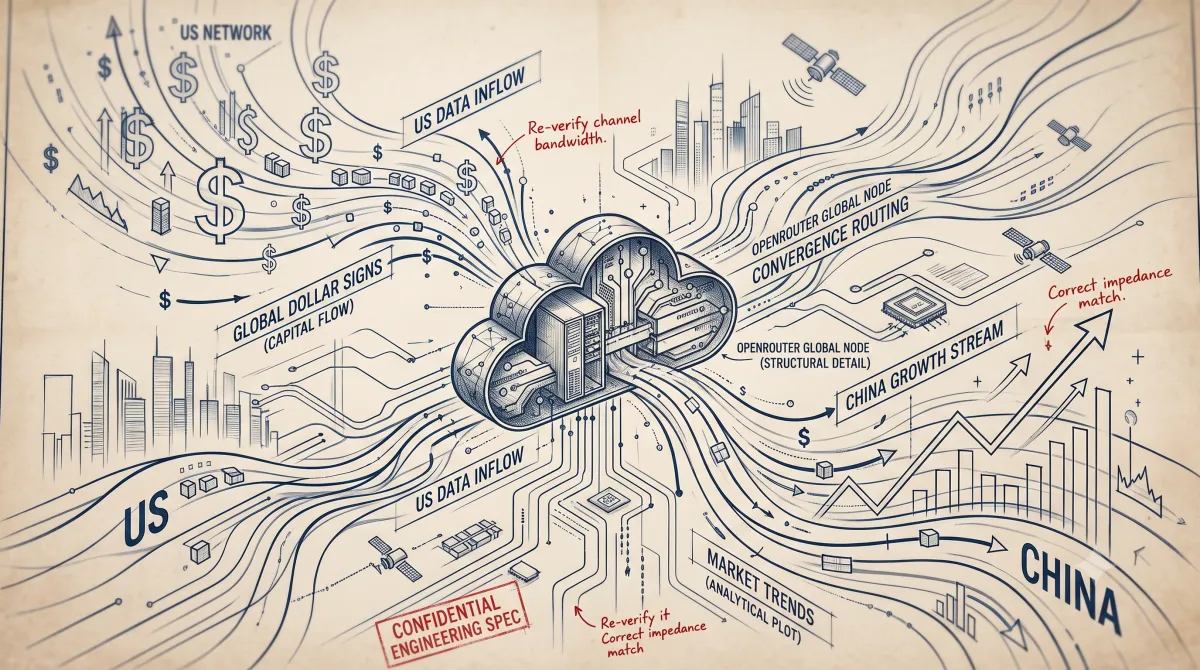
Chinese AI models now account for 23.45 trillion tokens per week on OpenRouter — half of all token volume on the platform. US models sit at 4.28 trillion. The gap has held for ten consecutive weeks.
OpenRouter routes API requests across hundreds of models for thousands of AI startups. As of the week of July 5, Chinese models processed half of all volume on the platform. In early 2025, they had about 4.5% of OpenRouter's routed token share. By mid-2026, that hit 46%. Week-over-week, Chinese token volume grew 15%.
DeepSeek is the biggest provider on the platform at 17.6% — 5.13 trillion tokens per week. Alibaba's Qwen is second at 13.9%.
Price explains most of it. OpenRouter's Justin Summerville says Chinese open-source models are 60% to 90% cheaper than Anthropic and OpenAI's top-tier products.
DeepSeek V4 Flash costs $0.14 per million input tokens. OpenAI's GPT-5.5 costs $5.00. That's a 35x difference.
US startups are voting with their wallets. Lindy, an AI automation company, switched from Anthropic to DeepSeek. CEO Flo Crivello said performance is "indistinguishable" and the switch will save "millions of dollars in just a few months."
US export controls on frontier models like GPT-5.6 Sol created an access problem. As the US tightens access to its most advanced models, enterprises are routing around the restrictions toward Chinese alternatives that are available and significantly cheaper.
US policy aimed to limit China's AI access. Instead, it's accelerating US enterprise adoption of Chinese models.
Anthropic remains the largest US provider on OpenRouter at 14.8%. But Chinese-origin models now account for 46.4% of all tokens on the platform. US-origin models are at 35.7%. More tokens are flowing through Chinese infrastructure than American.
The more the US restricts access to its best models, the more the market routes around them. And every time a US startup picks DeepSeek over GPT, the Chinese model gets better with real-world feedback.
China's daily token usage surged from 100 billion tokens in early 2024 to more than 140 trillion by March 2025 — a 1,000-fold increase in about two years. That's not a trend. That's a transformation.
For US AI startups, the math is simple. Five dollars per million tokens vs fourteen cents. The hard part is admitting the math doesn't care about politics.
P.S. At $0.14 per million tokens, you could process every word ever written on the internet for about the cost of two LaCroix twelve-packs. At OpenAI's rate, that same computation costs more than a Tesla Model 3. I checked the math. Twice