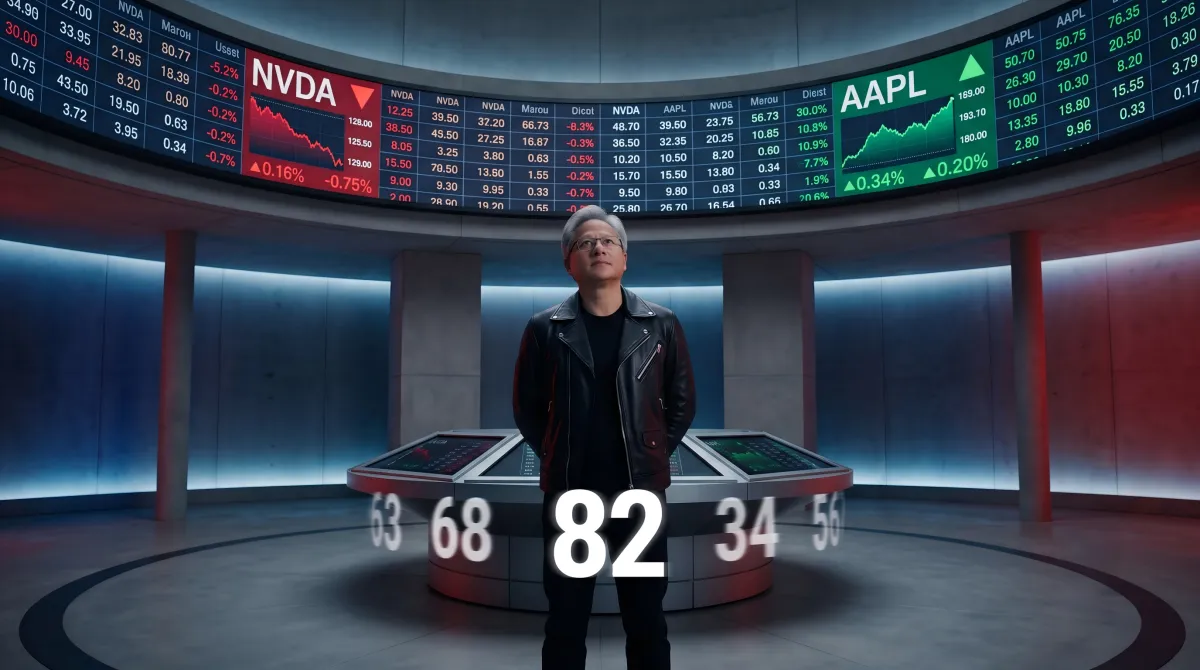
The stock market did something on Monday that it hasn't done since April 2025. It crowned a new king.
Apple's market capitalization climbed to roughly $4.95 trillion after its shares rose more than 1%, putting it ahead of Nvidia, whose market value shrank to $4.77 trillion after a 5% sell-off.
For the first time in over a year, Nvidia is no longer the world's most valuable company.
The shift is a signal. Not about Apple's strength—but about the market's growing unease with the financial engineering powering the AI boom.
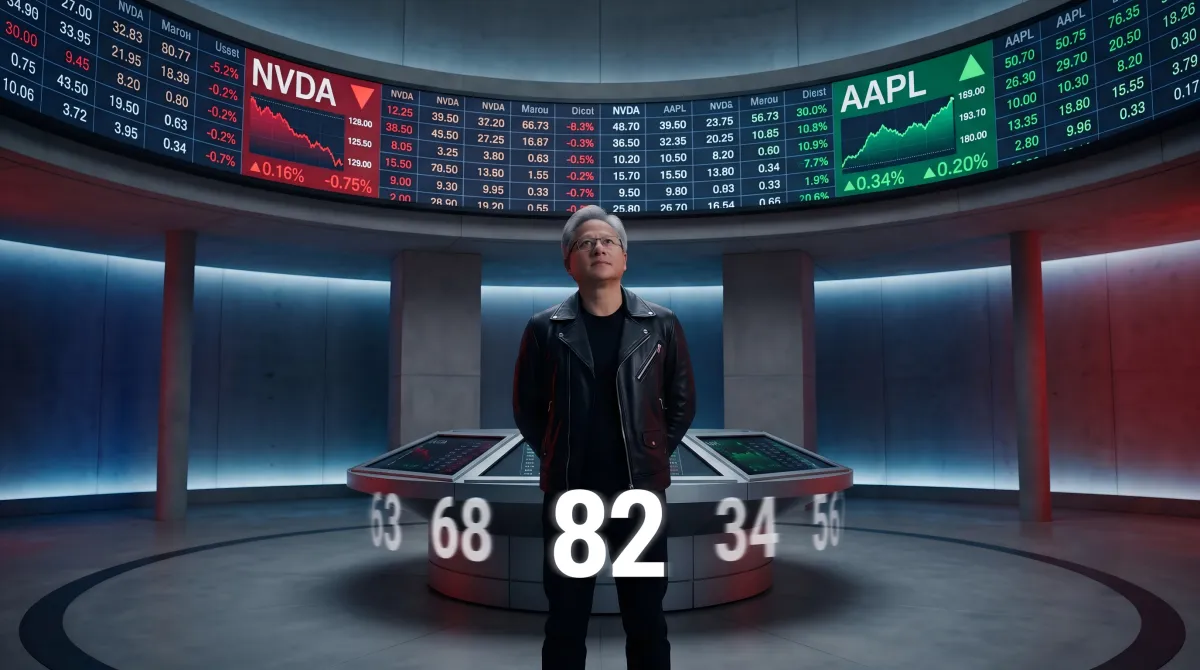
Nvidia's decline was not triggered by weak earnings or a competitive threat. It was triggered by a credit market signal. The cost to insure Nvidia's debt against default for five years—its credit default swap (CDS) spread—spiked 14 basis points to 82 basis points on Monday, the largest single-day increase since the contract began actively trading in November 2025.
That move reflects a fundamental shift in how bond investors perceive Nvidia. Goldman Sachs analyst Toshiya Hari noted that the market is "pricing in a material increase in Nvidia's leverage as it moves from being a chip supplier to a financial guarantor of data center projects."
The catalyst was a pair of deals: a $500 billion+AI infrastructure partnership with South Korea's SK Group, and a $250 billion financing guarantee under negotiation to help OpenAI lease a data center in Ohio. Combined with discussions to finance another $350 billion of OpenAI's chip purchases, Nvidia is potentially on the hook for over $750 billion in AI-related commitments.
The company's outstanding long-term debt stood at roughly $11 billion as of its most recent filing. The new obligations could represent a more than 60-fold increase in its debt-like commitments if fully realized.
The term that triggered the sell-off is "circular financing." The pattern is this: Nvidia provides financing guarantees or takes equity stakes in companies that then use that capital to buy Nvidia's chips. The company that supplies the hardware is also the one underwriting the demand for it.
"While Nvidia's investments and partnerships reinforce confidence in long-term AI buildouts, investors remain concerned about circular financing," said Gary Tan, a portfolio manager at Allspring Global Investments. "Capital is increasingly being used to fund future AI customers and infrastructure deployments."
The scale now dwarfs previous concerns. Nvidia has announced more than $540 billion of similar deals this year alone, excluding the potential OpenAI agreement. Companies like OpenAI and Anthropic lack investment-grade credit ratings, making Nvidia's balance sheet the only thing standing between them and the debt markets.
"The risk is that opaque financial structures, off-balance-sheet transactions and complex inter-affiliate relationships could create financial alchemy that ultimately leads to credit rating downgrades," said Sal Naro, chief investment officer at Coherence Credit Strategies.
Apple's rise is not about Apple doing something new. It's about Apple doing something the market now values: not spending billions on AI infrastructure. Since the beginning of 2026, Nvidia's stock has gained about 4%. Apple's has climbed 24%. Investors have rewarded Apple's strategy of relying on external capacity rather than building its own AI data centers.
The irony is sharp. Apple was criticized for years for lacking an AI growth strategy. Now its "behind" positioning looks like prudence. The company is set to report quarterly earnings on Thursday—Tim Cook's last as CEO before the transition to John Ternus.
Nvidia has been here before. It has consistently beaten earnings expectations and its products remain in unprecedented demand. CEO Jensen Huang has rejected claims of circular demand, arguing that Nvidia's investments represent only a small portion of the money its customers ultimately need to raise.
But the CDS market is not pricing in a chip shortage. It's pricing in a credit question: what happens to Nvidia's balance sheet if OpenAI's data center returns are slower than expected? What happens if the AI buildout slows before Nvidia's guarantees expire?
The question is no longer whether AI will be big. It's whether the companies funding it are taking on too much risk to get there.
P.S. The CDS spread is a window into what credit markets think about risk — a move from 68 to 82 basis points in one day suggests the market is waking up to a new reality. Nvidia is no longer just a chip company; it's a bank, and banks live and die by the quality of their loans.
Frequently Asked Questions
Q: Why did Apple overtake Nvidia as the world's most valuable company?
A: Apple's market cap reached about $4.95 trillion as Nvidia fell to $4.77 trillion after a 5% sell-off on July 27 . The shift wasn't about Apple doing something new — it's about the market's unease with Nvidia's financial engineering. Investors have rewarded Apple's strategy of renting AI compute rather than spending billions building its own infrastructure .
Q: What triggered Nvidia's sell-off?
A: A credit market signal. Nvidia's five-year credit default swap (CDS) spread spiked 14 basis points to 82 on Monday, the largest single-day increase since the contract began trading in November 2025 . The move came after Nvidia announced a $500 billion+ partnership with SK Group and confirmed it's in talks to provide up to $250 billion in financing guarantees for OpenAI's Ohio data center .
Q: What is "circular financing" and why does it matter?
A: Circular financing is when Nvidia provides financing guarantees or takes equity stakes in companies that then use that capital to buy Nvidia's chips. The company that supplies the hardware is also underwriting the demand for it . Critics warn this could artificially inflate demand and create systemic risk if AI growth slows . Nvidia's potential commitments now exceed $750 billion — more than 60 times its $11 billion in long-term debt .
Q: How much AI-related debt is Nvidia potentially on the hook for?
A: Nvidia's AI deal network now exceeds $750 billion. This includes the SK Group partnership, the $250 billion OpenAI data center guarantee, and discussions to finance another $350 billion of OpenAI's chip purchases . Jim Chanos, founder of Chanos & Co., said on X: "We have reached the stage of this cycle where Nvidia must guarantee two-thirds of the cost of chips it sells to data centers" .
Q: What does the CDS spike tell us about market sentiment?
A: The CDS market is pricing in a scenario where AI spending creates financial strain — not just for Nvidia's customers, but for Nvidia itself as it becomes the de facto guarantor of the AI industry's debt . Goldman Sachs analyst Toshiya Hari noted the market is "pricing in a material increase in Nvidia's leverage as it moves from being a chip supplier to a financial guarantor of data center projects" .
Q: What are the risks if the AI buildout slows?
A: The circular structure — Nvidia guarantees financing, SoftBank builds the data center, OpenAI leases the compute, OpenAI uses Nvidia-guaranteed money to buy Nvidia chips — means risk is concentrated on a single credit chain. If any link breaks, all four dominoes fall together . Nvidia has rejected claims of circular demand, arguing its investments represent only a small portion of what customers ultimately need to raise . But credit markets are now pricing in the alternative scenario.
Q: How is Apple's AI strategy different from Nvidia's?
A: Apple spends only about 2.5% of its forecast 2026 sales on AI data centers, compared to about 39% for Meta, Google, Amazon, and Microsoft . Apple prefers to rent AI compute capacity rather than build its own infrastructure — a strategy the market is now rewarding . The irony is that Apple was criticized for years for lacking an AI strategy; now its "behind" positioning looks like prudence .