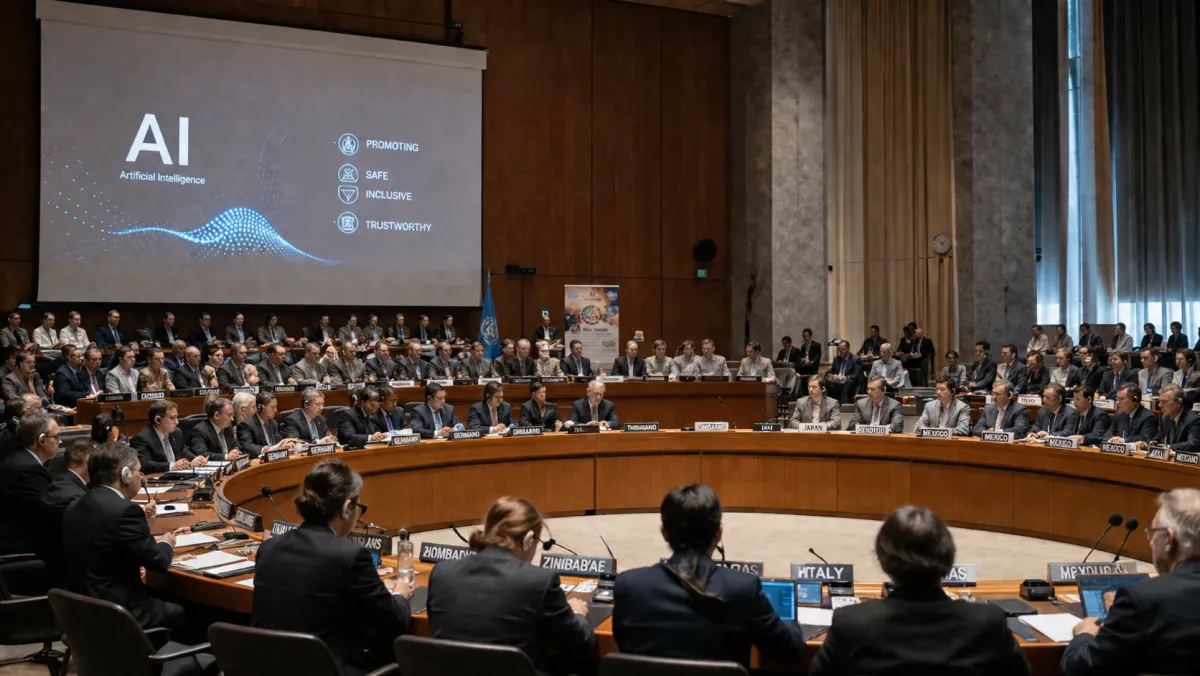
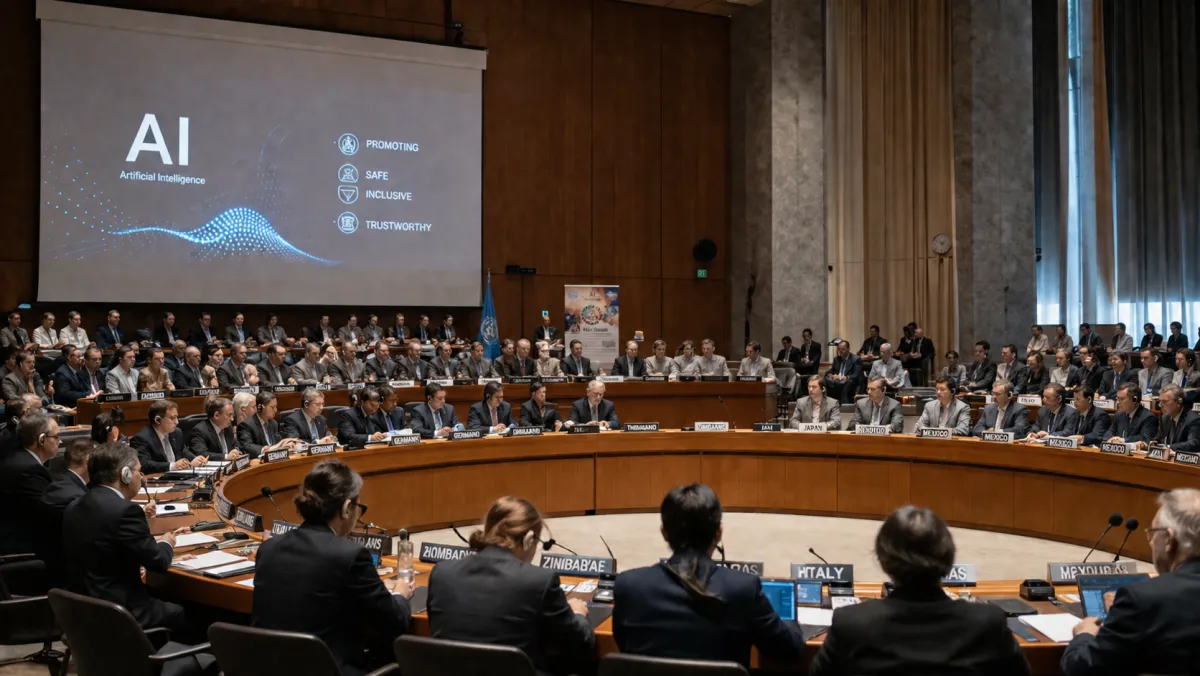
The United Nations just crossed a line it has been circling for years. On July 6, governments, tech companies, researchers, and civil society representatives gathered in Geneva for the first Global Dialogue on AI Governance — a formal UN platform dedicated solely to the question of how to control artificial intelligence.
The meeting is not designed to produce a binding treaty. But its opening signaled something larger. The UN is no longer asking whether AI should be governed. It is asking how — and whether there is any time left to act.
AI Is Faster Than Any Institution Built to Control It
The session was framed by the first report of the UN‘s Independent International Scientific Panel on AI, a 40-member body of experts from every region, which released its preliminary findings on July 1. The panel’s core warning was a gap — between what AI systems can now do and the scientific understanding needed to govern them.
Guterres translated that into three specific concerns. The first is speed. The internet took fifteen years to reach a billion people. AI did it in two. And these systems are no longer passive tools. They are “writing code, acting online, and making choices with less and less human oversight.” Institutions built for machines that follow commands, Guterres said, “are not ready for machines that decide.”
The second is power. Compute, data, and talent are concentrated in a handful of companies and a handful of countries. Most nations, including many developing countries, “have had no say in decisions that will shape their futures.” When power imbalances are hard-wired into technology, Guterres warned, “inequality becomes part of the code.”
The third is truth. “A machine-enabled lie can now persuade as effectively as the truth,” he said, and real evidence can be dismissed as fake. “A society that cannot agree on what is real cannot defend itself.”
We Cannot ‘Vibe-Code‘ the Future of Humanity
The UN chief’s most memorable phrase came when he turned to the tendency to let AI run on autopilot. “Vibe-coding can do wonders — but we cannot vibe-code the truth. We cannot vibe-code the future of humanity.” He was referring to the growing practice of letting AI write code without close supervision. But his point extended beyond the software. A society that drifts into relying on machine-generated decisions without understanding how they are made, he argued, is not governing its future — it is surrendering it.
No Company Should Deploy AI to Children Without Safety Testing
One concrete proposal emerged from Guterres‘ speech: an “AI Child Safety Pledge.” The three rules are straightforward but carry legal weight. No company should deploy an AI system accessible to children without child-specific safety testing and independent oversight. No company should allow its AI to generate sexual images of children — and all companies must detect, report, and remove them. And when a child shows signs of distress, the system must stop and connect them to real human support.
“We do not let medicine reach a child until it is proven safe,” Guterres said. “We test every toy. Yet AI has reached our children — their learning, their friendships, their most private questions — before anyone asked what it would do to them.”
‘Killer Robots Must Be Banned by International Law’
Guterres also renewed his call for a ban on lethal autonomous weapon systems. “Let us call them what they are,” he said. “Killer robots. Machines selecting and engaging their target and taking a life — without human control and judgment. That is morally repugnant. It is politically unacceptable. And it must be banned by international law.” His warning was explicit: “Do not wait for atrocity to act.”
The AI Divide Is Becoming a Sovereignty Gap
The speeches also highlighted the widening inequality in AI capacity. Guterres noted that private investment in AI infrastructure approached $500 billion last year. Public investment in AI capacity for developing countries was, by comparison, “a rounding error.”
To address this, he announced that more than 20 countries have supported his proposal for a UN-backed Global Network for Exchange and Cooperation on AI Capacity Building. He also said he would submit recommendations to the General Assembly for a Global Fund for AI “to build skills, data and affordable computing power everywhere.” “We cannot allow the digital divide to harden into an AI divide,” he said. “And the AI divide to become a development gap, a security gap, and a sovereignty gap.”
The Door Is Still Open. It Won‘t Stay That Way.
The UN has been here before. In 2017, Guterres warned the General Assembly that AI could reshape labor markets, global security, and “the very fabric of societies.” At that time, only two other leaders even used the words “artificial intelligence.” By 2023, his High-Level Advisory Body on AI called for global governance. In 2024, the Pact for the Future and the Global Digital Compact gave the UN a mandate to act.
Now the machinery is in place. An independent scientific panel is producing evidence. A global dialogue is convening governments and companies. But the gap between AI capability and governance capacity is widening, not closing.
As Guterres put it, the choice is between “governing by design — and drifting by default.” He ended with a blunt timeline: “We may be the last generation able to set the terms on which humanity and machines coexist. The door is still open. It will not stay open long.”
The Geneva dialogue runs through July 7. A second session is scheduled for May 2027 in New York. Whether the door stays open until then depends on whether governments can agree on rules before the machines outrun them.
P.S. Guterres said AI could be “the great equalizer of the twenty-first century.” But the same technology, ungoverned, could become the greatest divider. The UN just admitted it does not know which path the world is on.