
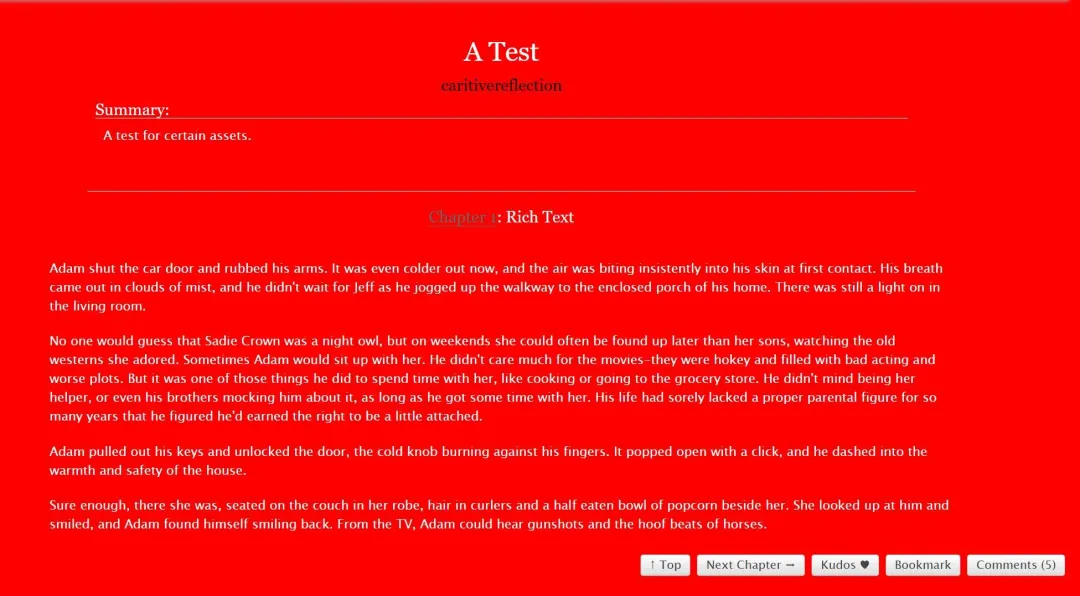
Earlier this week, an anonymous X user released a skin for the fanfiction platform AO3 that turns a work’s background red if it was copied directly from Anthropic‘s Claude. The tool detects a specific piece of HTML code that Claude leaves behind when text is pasted directly — the font-claude-response-body class name. The fanfiction community, already deeply divided over AI-generated content, quickly mobilized to publicly shame writers whose works were flagged.
The Verge reported on the fallout. But here’s the part of the story they didn‘t tell you: this isn’t a fanfiction problem. It‘s a global one. And it’s exposing a fundamental flaw in how we‘re trying to distinguish humans from machines.
The Logic That Doesn’t Work
The AO3 skin is clever, but its limitations are obvious. It only catches Claude, only catches direct pastes, and only flags the presence of text without revealing how much AI was used. One writer was caught in the crossfire because a trusted editor used Claude for spell-checking. Her work turned red, and she had to defend herself against accusations of something she didn‘t do.
It’s the same logic behind academic AI detection tools. Students are spending more money and time trying to get their AI scores down. One education company sold more than 4,000 “AI reduction” services — basically, using AI to make papers sound worse so they pass as human. Students submit a perfectly coherent paper, get flagged with a 90% AI score. They pay a service to “fix” it, which intentionally adds typos and breaks up sentence structures. The AI score drops, but the paper is now a mess. And universities are using these numbers as the basis to reject dissertations.
One student in California was accused of cheating because his history paper was flagged as “likely AI-generated” by a detection tool. His only way to prove he wrote it was to share his Google Docs edit history — every keystroke, every correction, every moment of hesitation. An honor society member was told his research article, which he wrote and published without any AI, had a 70% AI probability. He now has to “downgrade” his writing to sound less polished.
Why the ‘Write Worse to Prove You‘re Human’ Paradox Exists
The root of the problem is technical. Most AI detectors don’t “read” meaning. They scan statistical patterns: word choice, sentence length, phrase sequences. The more precise, logical, and grammatically clean a text is, the more likely the system flags it as AI. Conversely, a choppy, error-filled passage is more likely to be classified as human.
A paper by an honor society member on an academic portal was flagged as 70% AI. Thomas Jefferson‘s Declaration of Independence has been flagged as 99.99% AI-generated. A professor’s paper from 45 years ago was flagged as 77% AI. Shakespeare has been flagged. The system doesn‘t read historical context or understand that “perfect” prose existed before silicon.
The writer isn’t failing because they cheated. The writer is failing because they’re too good at writing.
The Real Loss Isn‘t Time — It’s Trust
Academics and writers alike have described the new reality as a “cat-and-mouse” game. OpenAI itself has admitted its detection tools are unreliable, can misclassify human-written text, and disproportionately flag the writing of people who learned English as a second language. The tools also suffer from an “AI vs. AI” paradox: a detection tool trained on data generated by a large language model is trying to detect output from a different large language model, making the entire process a self-referential loop.
But the damage extends beyond misfires. When trust is broken, the writer has to “prove” they are real. People have begun to sacrifice the clarity and quality of their own expression in order to satisfy an algorithm that was never meant to be a judge. A teacher isn’t evaluating an idea; they’re evaluating a number from a black box that doesn‘t explain its reasoning.

Fanfiction Is Just the Canary in the Coal Mine
The AO3 skin is a feature, but the fanfiction community’s quick turn toward self-policing and public shaming is a signal of a deeper cultural fracture. Writers are divided between those who see any use of AI as an unforgivable betrayal and those who see it as an inevitable tool of the modern era.
This fracture mirrors what is happening in education, journalism, and publishing. We are collectively trying to solve a problem that is fundamentally unsolvable with current technology. The fixation on “catching” AI has already caused significant damage to the trust between creators, students, and audiences. In fanfiction, the writer and the reader are in a gift economy. In education, the student and professor are in a trust economy. In both, the AI detection tool has become an outside force that has broken that trust without offering a clear path back.
P.S. The fanfiction community is at war with AI. The academic community is at war with AI. Both are actually at war with flawed detection tools. And both are losing. A group of writers are being labeled for having a clean writing style. A generation of students is being taught that the best way to prove you’re human is to write badly. We can‘t stop these tools from existing. But the least we can do is stop pretending they work. The writers and students who are now having to justify their own humanity deserve better than a “99.99% AI-generated” stamp on their work.