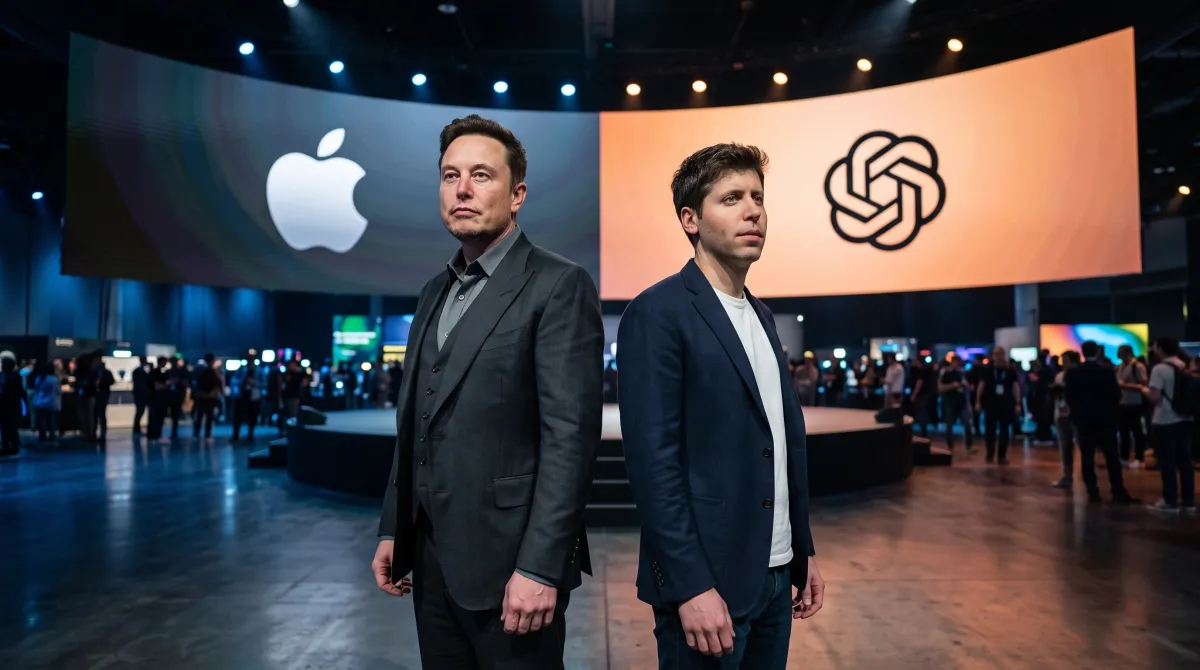
Apple sued OpenAI on Friday. The 41-page complaint accuses the ChatGPT maker of systematically stealing hardware secrets.
A legal dispute between two tech giants is serious enough.
Then Elon Musk weighed in.
"The concept of him taking a charity and turning it into this is crazy enough," Musk wrote on X. "But then to steal all of Apple's phone technology, too? Wow."
He called Altman "Scam Altman" and posted a photo of the OpenAI CEO testifying before Congress. The caption read: "I do this because I love it." Musk added: "He probably enjoys scamming more than anyone on Earth."
Altman hit back. "Homeboy, you're the one selling public market investors on short-term space datacenters."
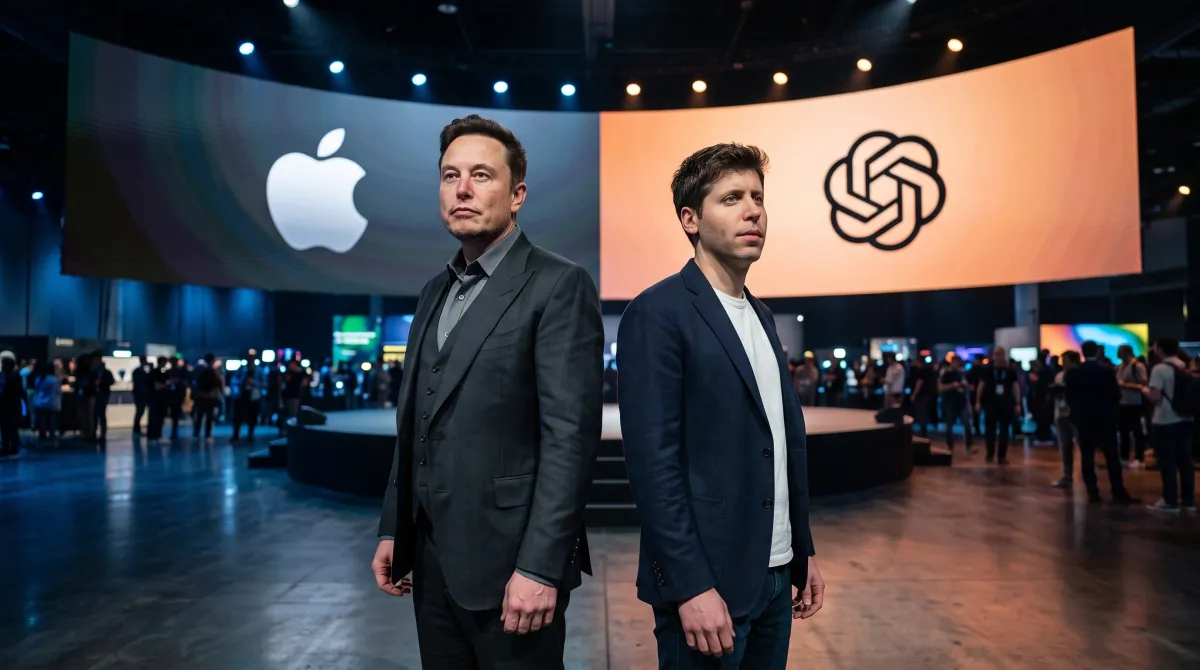
In two exchanges, they summed up a feud that's been brewing since 2015. And Apple's lawsuit became the backdrop for the latest chapter in Silicon Valley's most personal rivalry.
The roots run deep. Musk co-founded OpenAI as a nonprofit in 2015. He donated roughly $44 million. He left the board in 2018, citing conflicts with Tesla's AI work.
In 2024, Musk sued. He alleged OpenAI abandoned its founding mission by turning into a for-profit entity. The case went to trial in May 2026. He testified that he felt "duped." He admitted xAI's Grok model trains partly on OpenAI's work.
The jury ruled against him. His claims fell outside the statute of limitations. He vowed to appeal. Now he's turned the courtroom defeat into a public relations war.
Apple's lawsuit gave him new material.
The complaint names two former Apple employees now at OpenAI: Tang Tan, former iPhone design lead and now OpenAI's chief hardware officer, and Chang Liu, a former electrical engineer who allegedly downloaded "dozens" of confidential files after leaving. Apple also claims OpenAI hired more than 400 former Apple employees.
For Musk, it was evidence of a pattern. "First he stole an open source AI charity," Musk wrote. "Now he's stealing Apple's technology."
Altman's rebuttal was sharper. He didn't defend against the lawsuit. He went straight for Musk's vulnerability: a $2 trillion public company that needs to justify its valuation.
SpaceX went public on June 12. It was the largest IPO in history, pricing at $135 a share and closing its first trading day worth roughly $2 trillion. The company allocated about 20% of shares to retail investors.
Musk's pitch to those investors includes orbital data centers. AI1 satellites. Computing in space. The idea is to solve AI's energy problem by putting data centers above Earth.
Altman called it a "short-term" story. Investment researcher CFRA opened coverage with a "sell" rating, citing what it called an extremely ambitious growth strategy and elevated valuation. Morningstar's math was harsher: it valued the shares at a fraction of their debut price.
So when Altman jabbed at "public market investors," he wasn't just insulting Musk. He was questioning the financial narrative SpaceX is selling.
The feud is personal, but the stakes are business.
OpenAI is preparing for its own IPO. The company confidentially filed draft paperwork in June. Reports point to a listing above $1 trillion. But Apple's lawsuit could complicate that timeline. The complaint asks the court to block OpenAI from using any misappropriated trade secrets and to redesign products that rely on them.
If the case proceeds, discovery could expose more. Musk's taunts about "scamming" are just noise. The real threat is a federal judge restricting OpenAI's hardware plans.
Altman's response — mocking SpaceX's orbital data centers — is a reminder that Musk's companies are also vulnerable to skepticism. Investors didn't buy the AI1 story at the valuation CFRA and Morningstar would have liked. Altman is betting the public market will start asking harder questions.
Neither man is acting out of principle. Musk isn't defending Apple's intellectual property. Altman isn't genuinely concerned about space-based computing.
They're using each other to shape their own narratives. Musk wants OpenAI's IPO to be clouded by legal uncertainty. Altman wants SpaceX's growth story to look overhyped.
The lawsuit is real. The feud is real. The mutual destruction is the point.
P.S. If you're an investor in either company, ignore the insults. The court will decide one question; the market will decide the other — and both will probably take longer than Musk's orbital datacenter timeline.