
On July 29, two tech giants reported earnings on the same day. The market treated them very differently.
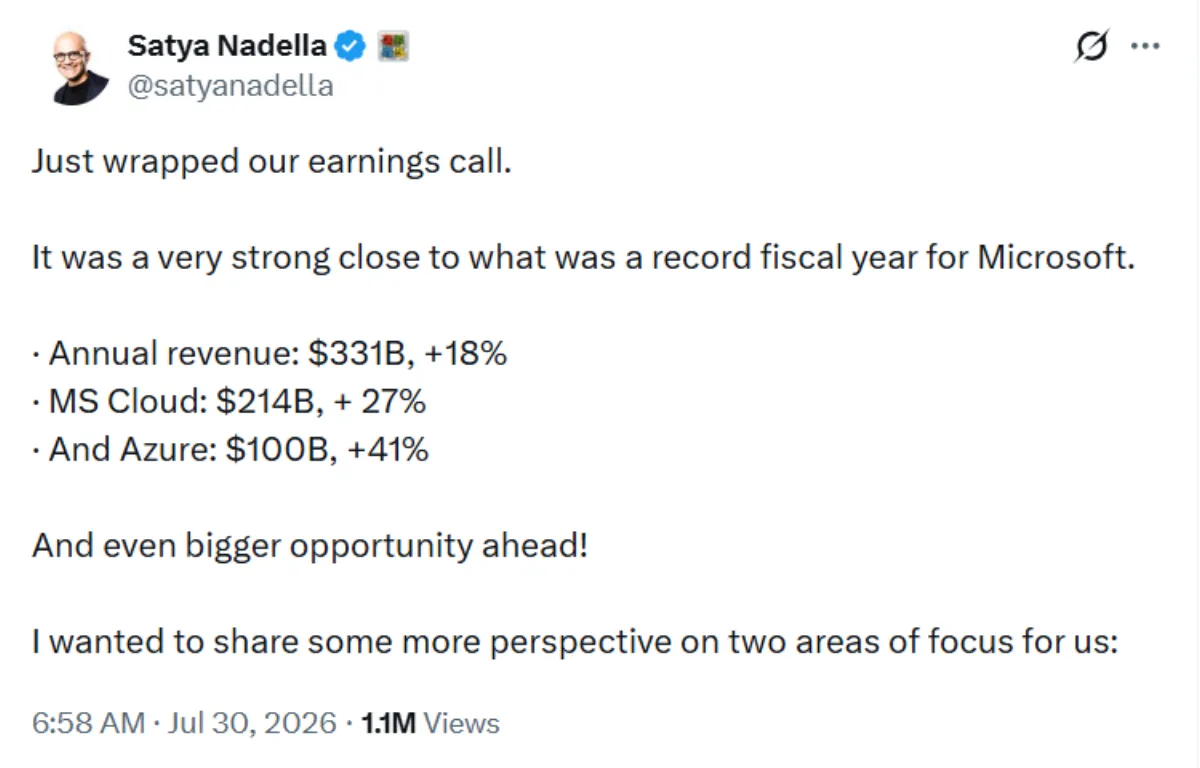
Microsoft's revenue hit $90 billion, up 18%. Azure grew 43% — the fastest since early 2022, and above analyst expectations. Microsoft 365 Copilot paid users reached 30 million, up 10 million in a single quarter. The company's commercial backlog hit $678 billion. The stock jumped 8-10% after hours .
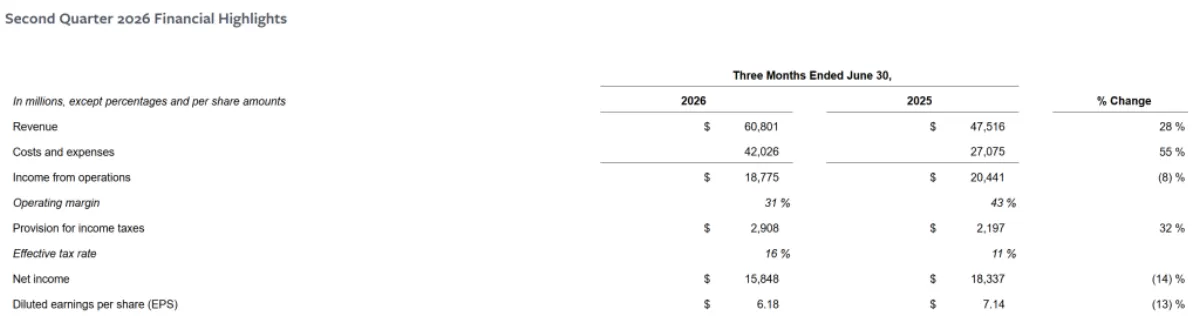
Meta's revenue hit $60.8 billion, up 28% — slightly above expectations. But profit fell 14% to $158.5 billion. Free cash flow crashed from $8.5 billion a year ago to just $784 million — a 91% drop. The stock fell 10% after hours .
Both companies are spending billions on AI. One is getting rewarded. The other is getting punished. The difference is not the spending. It is the path to return.
The Microsoft Story: AI Is Already Generating Revenue
Microsoft's numbers tell a clear story: AI spending is translating into revenue.
Azure's 43% growth was the standout. The cloud business crossed $100 billion in annual revenue for the first time — the second cloud after AWS to reach that milestone . The company added 88 data centers this fiscal year, and capital spending hit a record $410 billion for the quarter, up 69% .
But the market was not just buying growth. It was buying confidence. Microsoft's 2027 capex guidance came in $150 billion lower than earlier estimates, signaling that the company sees a path to reduced spending . The stock reacted to the signal that the biggest spending may be behind it.
Copilot's growth reinforces the narrative. 30 million paid seats — up from 20 million last quarter — means enterprises are willing to pay for AI productivity tools . GitHub Copilot now has 50 million users. More than 90% of Fortune 500 companies use some form of Copilot .
The Meta Story: Bigger Spending, Less Revenue
Meta's numbers tell a different story. The company is spending heavily on AI infrastructure without the revenue bridge to justify it.
The second-quarter capex hit $310.8 billion. The full-year capex guidance was raised to $130-$145 billion, nearly double 2025's spending and up from the previous forecast . Research and development spending jumped 67% year-over-year .
The cash flow impact was severe. Operating cash flow of $318.6 billion was almost entirely consumed by capex, leaving just $7.8 billion in free cash flow — the lowest in four years . At this rate, analysts project Meta's free cash flow could turn negative in the current quarter .
The revenue side is more complicated. While advertising revenue grew 28%, AI has not yet become a primary revenue driver for Meta . Unlike Microsoft, Meta lacks a large-scale cloud business to sell compute. Its AI revenue streams — consumer chatbots, enterprise agents, and business services — are still nascent.
CEO Mark Zuckerberg addressed the gap directly: "We have quite a number of offers at a meaningful premium over what we paid for the compute" . But he added: "Simply selling computing power for short-term profit is stupid" . Instead, Meta is betting that it will earn more by building intelligence on top of its compute and selling the resulting products.
The market is not convinced.
The Diverging Logic
Both companies face the same market question: will AI spending produce returns? But the market is applying different standards to each answer. Microsoft has demonstrated a clear path to returns through Azure and Copilot. Meta's AI strategy remains tied to advertising, a business that is already saturated and does not require the level of infrastructure investment Meta is making .
Zuckerberg's response is to argue that AI is accelerating Meta's core business by improving ad targeting and content recommendations . But investors are asking why those improvements require the same level of spending as building an entirely new cloud business.
The gap between the two companies is not the size of the bet. It is the clarity of the payoff.

P.S. If you are an investor in AI infrastructure, the Microsoft-Meta split is a useful reminder: the market is no longer rewarding spending. It is rewarding revenue. The companies that can show a clear line from capex to cash flow will get the premium. The ones that cannot will keep paying the price of patience.
Frequently Asked Questions
Q: Why did Microsoft's stock rise after earnings while Meta's fell?
A: Microsoft's Azure cloud revenue grew 43% and its 2027 capex guidance came in $150 billion lower than expected, signaling a clear path from AI spending to revenue . Meta's free cash flow crashed 91% to just $784 million, with no equivalent revenue engine to show for its spending . Microsoft proved AI can make money; Meta proved the market won't reward spending without returns.
Q: How much did Microsoft spend on AI infrastructure this quarter?
A: Microsoft's capital expenditures hit $410 billion in Q4 2026, up 70% year-over-year. The company added 88 data centers this fiscal year . However, Microsoft also lowered its 2027 capex guidance to $1750 billion — $150 billion less than earlier estimates — signaling that it sees a path to reduced spending as AI investments start paying off.
Q: What happened to Meta's free cash flow?
A: Meta's free cash flow plummeted from $8.55 billion a year ago to just $784 million in Q2 2026 — a 91% drop . The company's capex hit $311 billion in the quarter, almost entirely consuming operating cash flow. Analysts project Meta's free cash flow could turn negative in the current quarter .
Q: Why can Microsoft show AI returns while Meta cannot?
A: Microsoft has a cloud business as an "intermediate reservoir" — Azure revenue directly converts AI infrastructure spending into customer revenue . Meta has no cloud business; its AI spending must filter through advertising efficiency gains, a much longer chain with more leakage . Microsoft's commercial backlog hit $678 billion, while Meta has no comparable locked-in revenue.
Q: How many Copilot users does Microsoft have?
A: Microsoft 365 Copilot paid users reached 30 million in Q4 2026 — up from 20 million in the previous quarter, adding 10 million paid seats in three months . GitHub Copilot has 50 million users. More than 90% of Fortune 500 companies use some form of Copilot.
Q: What did Meta's CEO say about selling compute capacity?
A: Mark Zuckerberg said Meta has received "quite a number of offers at a meaningful premium" for its compute capacity, but he will not sell it for short-term profit . Instead, Meta is betting that building "intelligence" on top of its compute will produce higher long-term returns than renting out the hardware.