
SpaceXAI released Grok 4.5 on July 8. It is the first model built with Cursor since SpaceX's $60 billion acquisition of the AI coding startup . The pricing is aggressive. $2 per million input tokens. $6 per million output tokens . That's 75% below Anthropic's Opus 4.8 ($5 input, $25 output) and well below OpenAI's GPT-5.6 Sol . Even against GPT-5.6 Luna, which matches Grok 4.5 on output pricing at $6, Grok 4.5 offers significantly stronger capabilities for the same output cost .
But the real story isn't the sticker price. It's the token efficiency. Artificial Analysis found Grok 4.5 uses roughly half the output tokens per coding task compared to comparable models . On the Coding Agent Index, Grok 4.5 scored 76, on par with GPT-5.5, but cost $2.49 per task versus $5.07 for GPT-5.5 and $11.80 for Fable 5 in Claude Code .

For enterprises, the calculus shifts. Forrester analyst Biswajeet Mahapatra framed it precisely: "Enterprise buyers should focus on cost per successful outcome rather than cost per token" . Grok 4.5's pitch is simple: it doesn't need to be the smartest. It needs to be cheap enough that you don't think twice about using it.
Musk's framing reflects this. He didn't claim the best model. He claimed the best deal. "Opus-class, but faster, more token-efficient and lower cost" . That is a deliberate pivot. The AI race has moved from "who is smartest" to "who is cheapest to actually use" .
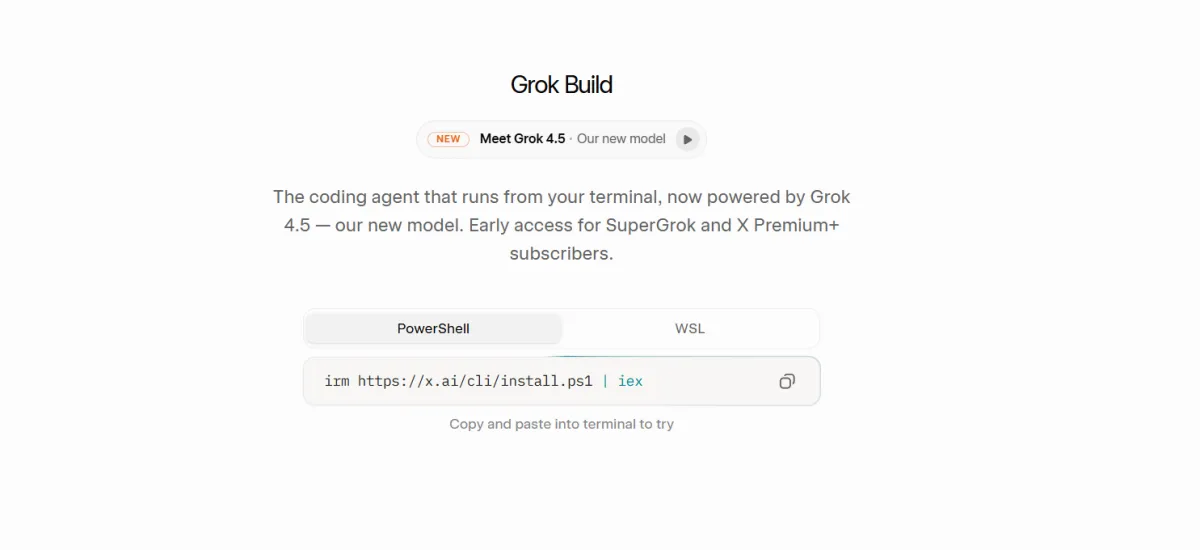
A week later, SpaceXAI open-sourced Grok Build, the terminal-based coding agent that powers Grok 4.5 . The move came after a privacy backlash. Users discovered that running the CLI tool in a directory could upload files to SpaceXAI's cloud. One user reported running it in their home directory and seeing it upload "my SSH keys, my password manager database, my documents, photos, videos, everything" .
The response was decisive. Default data retention was disabled on July 12. All previously retained coding data was deleted. Now the entire Grok Build codebase is open-source under Apache 2.0. You can run it locally, point it to your own inference, and keep everything private . The GitHub repo contains 844,530 lines of Rust .
The open-sourcing repairs trust, but it also signals something else. It positions SpaceXAI as an enterprise-friendly alternative at a moment when organizations are growing wary of single-provider lock-in .
The two moves work together. Grok 4.5 is the competitive model. Grok Build is the distribution. Open-sourcing the tool gives developers control and transparency, addressing the privacy concern head-on, while the pricing strategy makes the model itself a no-brainer for cost-conscious teams . Musk is building a model that competes on price and a tool that competes on openness. That's not a pivot. It's a playbook.
P.S. If you are an enterprise architect evaluating AI coding tools, the question is not "is Grok 4.5 better than Claude?" It's "does 75% cheaper with 80% of the capability change your math?" For most teams, the answer is yes. That is what Musk is counting on.