

DeepSeek is designing its own AI chip. Reuters reported on July 6 that the Chinese AI lab is developing a custom processor focused on inference — the phase where trained models generate responses, not the training phase itself. The project started about a year ago and remains in early stages, with the company in discussions with chip designers, foundries, and memory suppliers. DeepSeek has also been quietly hiring chip design engineers without posting public job listings.
The move puts DeepSeek on a list that already includes OpenAI, which released its Jalapeño inference chip last month, and Anthropic, which is reportedly exploring its own silicon. But DeepSeek‘s situation is fundamentally different. The company isn’t just trying to lower costs. It‘s trying to survive a supply chain that Washington is actively trying to sever.

DeepSeek’s Rise Was Built on Nvidia. Then the Ban Hit.
DeepSeek‘s rise to global prominence was built on Nvidia hardware. The company’s R1 reasoning model was trained on Nvidia‘s H800 chips, which were designed specifically for the Chinese market. Washington banned exports of the H800 in late 2023, cutting off the very supply chain that powered DeepSeek’s breakthrough. In response, DeepSeek shifted its workloads to Huawei‘s Ascend processors. In April, the company released its V4 model optimized for Ascend, and orders for Huawei’s Ascend 950 chips surged after the release.
But Huawei‘s chips, while available, lag behind Nvidia’s most advanced offerings. The performance gap is real, and DeepSeek is now trying to close it. The company‘s founder, Liang Wenfeng, has said for years that chip export controls are his biggest concern, not funding. In 2023 and 2024 interviews, he said: “The real challenge is never funding — it’s the export ban on high-end chips.”
Inference Is the Real AI Market — and DeepSeek Knows It
DeepSeek is targeting inference, not training. That‘s a strategic choice that aligns with the industry’s broader shift. As AI applications scale, the bulk of compute demand is moving from model training to model deployment — running models to serve users, not building them from scratch. Inference chips are cheaper and more power-efficient than general-purpose GPUs. They‘re also harder to restrict with export controls, because they’re less critical for cutting-edge research.
Nvidia‘s $10B China Business Is Under Threat
The financial implications are clear. Nvidia generates roughly $10 billion to $12 billion in annual data center revenue from China. If DeepSeek and its Chinese peers replace Nvidia and Huawei chips with their own designs, that revenue stream could face structural erosion. The company trades at roughly 35x forward earnings, a multiple that assumes continued dominance in the Chinese market. That assumption is becoming harder to defend.
At the same time, Huawei’s 50 percent share of China‘s $50 billion AI chip market is under pressure from both sides: customers building their own chips and competitors like Alibaba and Baidu developing alternatives.
This Isn’t About Cost. It‘s About Survival.
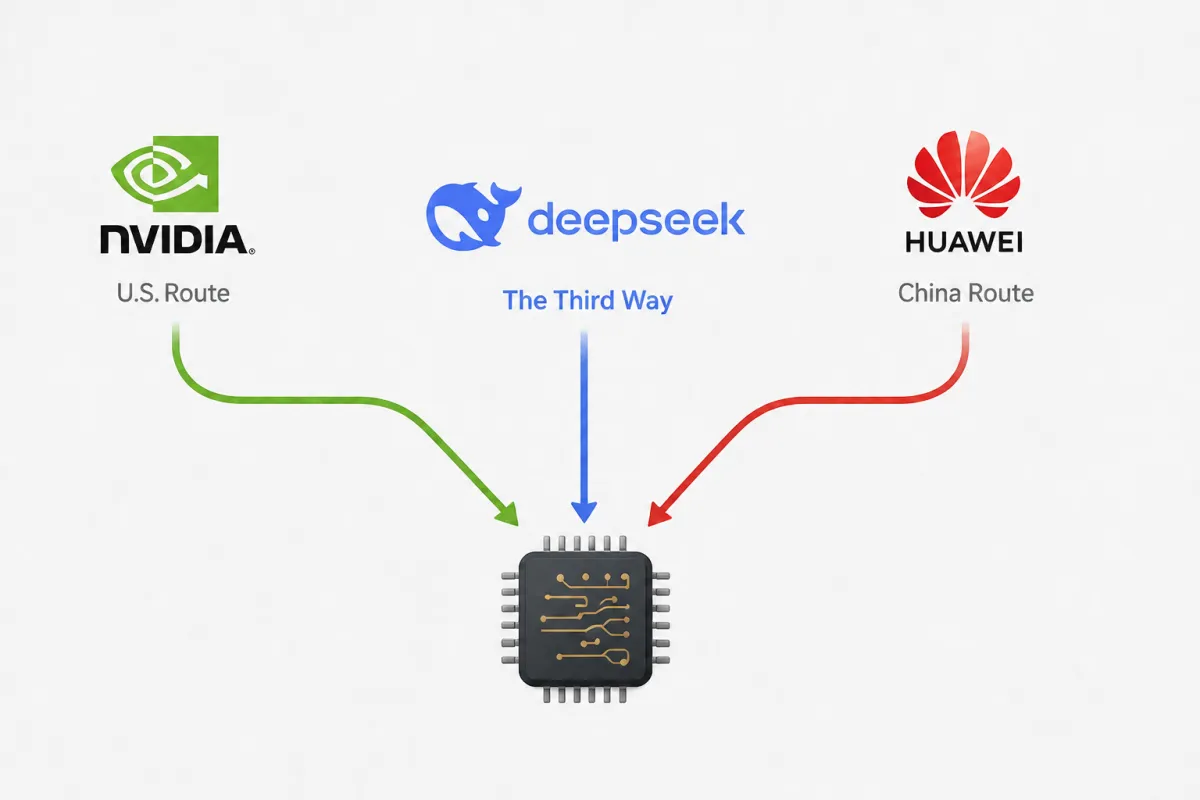
OpenAI’s Jalapeño chip is about cost control. Anthropic‘s reported chip plans are about leverage. DeepSeek’s chip is about something else entirely. It‘s about creating a third supply chain that doesn’t depend on either Nvidia or Huawei. The project started a year ago, just as the H800 ban was implemented. The timeline is not a coincidence. And the success of DeepSeek‘s chip effort will be measured not by benchmark scores, but by whether the company can keep its models running when the next export control lands.
P.S. Liang Wenfeng said in 2024 that “the real challenge is never funding — it’s the export ban on high-end chips.” That same year, he described himself as “never thinking about chip issues before” and said his attitude toward compute is “never too much.” Now DeepSeek is designing its own silicon. That‘s not just a strategy change. It’s the realization that a dependence you can‘t control is not a dependence at all.