A few weeks ago, we asked whether Kimi K3 would be the cheapest frontier model on the planet — or just another premium API product. Now we have an answer.
Moonshot AI officially launched Kimi K3 on July 17. The numbers are real. 2.8 trillion parameters. A million-token context window. Native multimodal understanding. API pricing: $3 per million input tokens, $15 per million output. Open weights drop on July 27.
It is the largest open-weight model ever released. It is also the first open-weight model to crack the Artificial Analysis top three, scoring 57 points — ahead of Claude Opus 4.8 and behind only Fable 5 and GPT-5.6 Sol.
Moonshot's founder Yang Zhilin revealed on Reddit that K3 uses KDA, a hybrid linear attention architecture the team says delivers up to 6.3x faster decoding in million-token contexts while maintaining the efficiency of linear attention. The model runs on H800 GPUs. The team is "outnumbered" by US competitors on hardware. Every card is "put to good use." KDA is the lever.
The benchmark claims are verifiable. Kimi K3 ranks first on Arena.ai's WebDev leaderboard, ahead of Fable 5. It leads DECK-Bench for knowledge work at 73.5 percent. It scored 1,548 Elo on AA-Briefcase, second only to Fable 5.
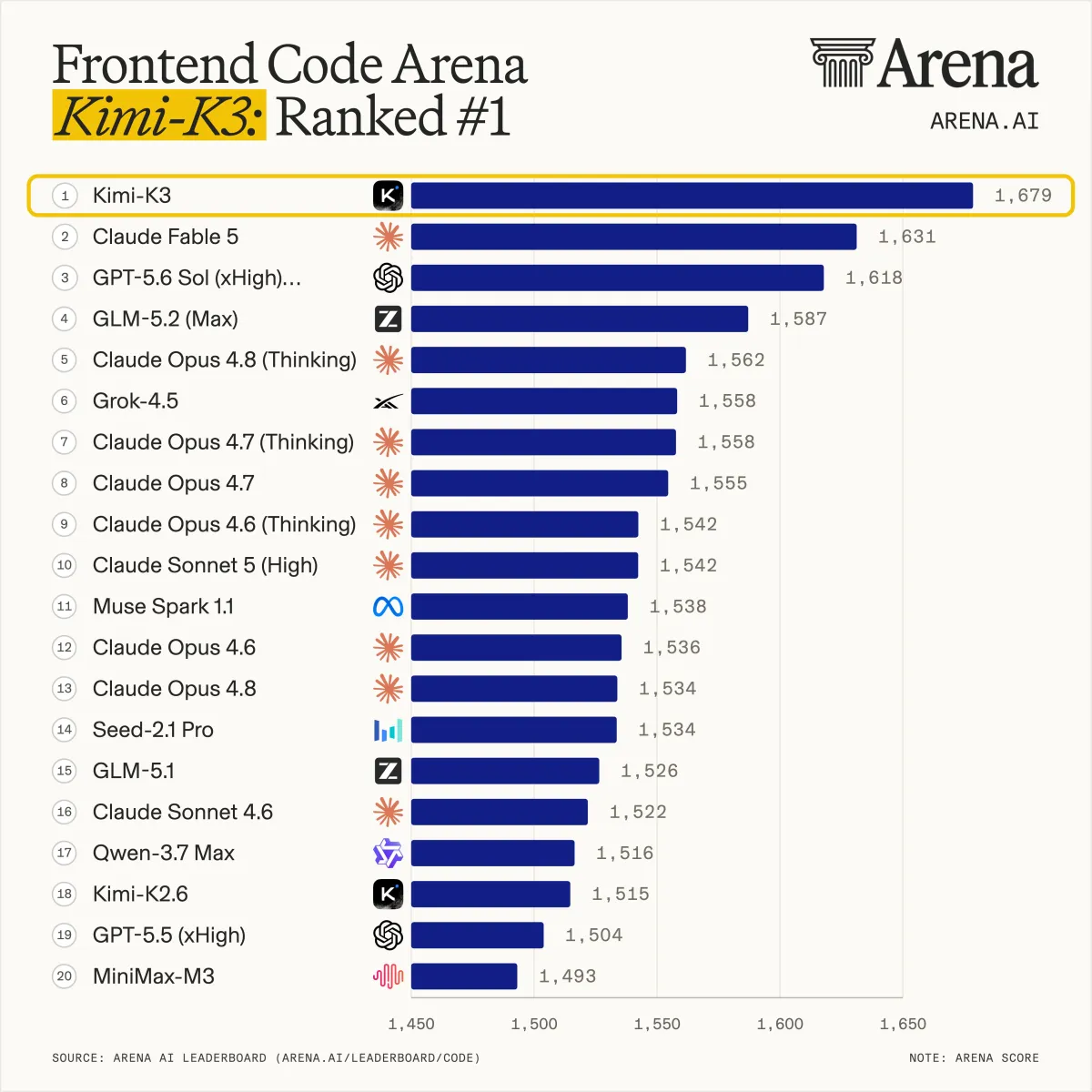
Performance is one thing. Price is another. At $15 per million output tokens, K3 costs less than Fable 5 ($50) and GPT-5.6 Sol ($30). It is also about 21 percent more token-efficient than its predecessor — meaning less token spend per completed task. This is a different kind of competition. Not a benchmark race. A cost race.
The market noticed. Taiwan Semiconductor fell 7 percent on Friday despite strong earnings. SoftBank fell 9 percent. Z.ai, a Chinese competitor, plunged almost 30 percent in Hong Kong.
The open weights are the final piece. On July 27, anyone will be able to download K3 and run it locally. For enterprises with infrastructure, the cost equation shifts further. For compliance-heavy sectors in Europe and elsewhere, self-hosting offers a path through GDPR and AI Act requirements that closed APIs cannot.
There are limits. Moonshot itself admits K3 still trails Fable 5 and GPT-5.6 Sol overall. Self-hosting a 2.8T MoE model requires 64-accelerator supernodes. The full technical report isn't out yet.
But K3 is proof that Chinese AI labs are not slowing down. The "paper vs reality" gap that defined earlier releases is closing. The model works. The API is live. The weights are coming. The question is no longer "can Chinese models compete?" It is "how long can US models justify their price tags when an open alternative sits at 60 percent of the cost?"
P.S. If you are an enterprise AI buyer, the math just changed: you can pay $50 per million output tokens for Fable 5, or wait nine days for a model that costs $15, runs on your own infrastructure, and beats Fable 5 on front-end coding. The choice is becoming uncomfortably obvious.